Pakistan's economy has left the ICU, says Khawaja Asif
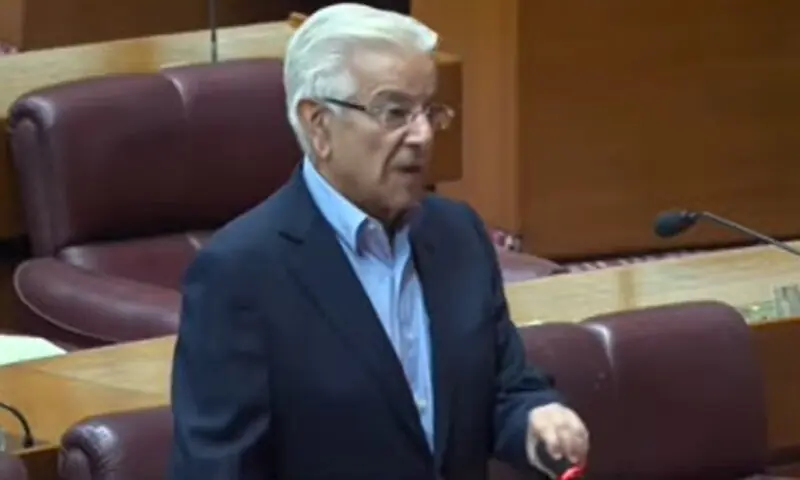


Defence Minister Khawaja Asif said on Tuesday that Pakistan’s economy had left the “intensive care unit”.
He made the remarks while speaking in the National Assembly, during which he also talked about insecurity in Balochistan and Pakistan’s role in brokering the agreement with the United States and Iran.
“When we [presented] the first budget, we were insolvent. There was always the danger that we would default today or tomorrow. The International Monetary Fund (IMF) bailed us out with strict conditions, which we are now bearing but we have become solvent. Our economy is breathing; it has left the ICU,” he said.
“I will not say that we are reaching the stars but our trajectory bears witness that in one or two years … we will reach a place where Pakistan achieves a growth rate of 6-7 per cent,” he said.
He said that there were multiple “inbuilt taxes” in the country, adding that “we have to get rid of all these things to become solvent”. He said that the tax rate should be brought to a level where the entire country was ready to pay it instead of becoming prohibitive.
“Why should we force people to search for ways to evade taxes? We should bring taxes to a level where a conducive environment is created, where people pay taxes and do so with pride,” he said.
In his remarks, the defence minister also addressed the issue of terrorism in Balochistan, saying the situation had not been created “yesterday or the day before” but that many people had contributed to it.
“I will not take names … but it is everyone’s responsibility,” he said, stressing that if Balochistan’s roads were not safe, the “collective responsibility” also lay with the House.
“I can accuse my brothers on that side of the aisle about what happened in their time, and they can accuse me, but it goes back to the 50s,” he noted, adding, “If we want to search for a solution, we have to search for it collectively.”
“This problem is not of any one party or any one province,” Asif stated. “If there are problems in Balochistan … then I think the responsibility is our collective responsibility, and its solution should be such a solution that it is acceptable to Balochistan’s public, whether they are Baloch or Pashtun.”
On Afghanistan, Asif noted that people had complained that Pakistan should negotiate with the Afghans and that the leadership’s approach was “impersonal” and indirect.
“Terrorism is happening directly in Pakistan; whether in Balochistan or KP, both problems originate from Afghanistan,” he said, pointing out that he had travelled to Kabul twice alongside senior delegation members, where negotiations were held with the entire leadership, including the then DG ISI.
“They agreed with everything,” he said of the Afghan side, “but insisted that they could not give anything in writing.”
The defence minister added that besides Kabul, he had also met Afghan delegations in Turkiye and Qatar, alongside “high-powered” delegations from both those countries.
He added that when Pakistan was asked for Rs10 billion, it was “ready to give it” but wanted assurances that if those people were settled in remote areas of Afghanistan, they would not spend the Rs10 billion and return again.
Asif said that 4,317 people had been martyred in the war on terror from 2022 to date, including army personnel, law enforcement agency (LEA) personnel and civilians.
He termed it a “very big sacrifice” and said, “These sacrifices are being made at whose hands? Those people who were our guests for 45 years.”
He also regretted Pakistan’s previous policy of being “America’s proxy” with the expectation of big returns, saying, “Pakistan became a battleground. And who won that war? The people who came here, used us, and after that went back to their homes, leaving debris and weapons here.”
He demanded a “guarantee” from even those who had spoken on the matter in the House, saying, “If they make a jirga and go there, we are ready. But then don’t come back without results.”
“Don’t use this issue for point-scoring,” Asif stressed. “Two generations are already bearing the consequences of this, and for God’s sake … future generations will also bear it. The decisions we made in the 1970s and 1980s, and during Musharraf’s time, this is the dividend of that.”
“Find the people on whose hands this blood is,” he demanded, referring to the 4,317 martyrs. “I attended 21 funerals the day before yesterday … small children are being martyred.”
The defence minister compared the sacrifices of personnel posted at the border in Balochistan and KP with those of MNAs, saying they regularly complain about transfers to Balochistan and even within Punjab. He questioned the “insensitivity” of MNAs, asking, “Are we fulfilling our responsibilities? No. We complain when the power centres shift elsewhere. Why did they shift? It was because of us; no one captured them.”
Talking about Islamabad’s role in facilitating an agreement between the US and Iran, Asif said the “greatness” of Pakistan had been recognised by the world within a year, crediting the efforts of the military leadership as well as the prime minister and the “whole team” working with them in this regard.
“I think the whole nation should be thankful to them, because they steered us [through] an issue that seemed impossible,” he said. “They made the impossible possible.”
He also noted that India’s Prime Minister Modi, in his statement on the US-Iran agreement, had congratulated US President Donald Trump but neglected to include Pakistan’s name in the statement despite its heavy involvement in the process.
He stressed that Pakistan stood to benefit greatly from the “extremely pleasant developments” in relations with Iran in recent times, including from the relaxing of sanctions and removal of restrictions on Iran’s oil and gas exports. He noted that the biggest beneficiary of this change would be Balochistan.
“Let’s see how we can proceed in this direction so that we can maximise our dividends,” he said.
Mustafa Kamal lambasts ‘flawed’ NFC award distribution formula
Earlier in the session, Health Minister Mustafa Kamal on had criticised the formula of fund distribution under the National Finance Commission (NFC) award — which is based on the size of every provinces’ population — as “flawed”.
In his remarks during the National Assembly, where a debate on the federal budget fiscal year 2026-27 was ongoing, Kamal noted that the NFC formula was 82 per cent population-based.
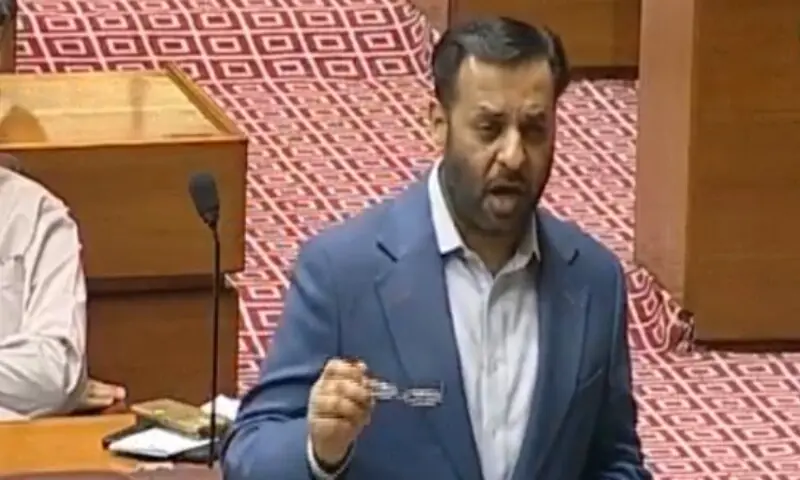
“What province will reduce its income by controlling the population?” the minister, who belongs to the Muttahida Qaumi Movement-Pakistan (MQM-P), said.
“Balochistan is the smallest province [population-wise] and gets the lowest share [in the NFC]. If it wants to get [a larger] share like Punjab, it will have to increase its population,” he pointed out, adding the distribution of funds based on population was the “biggest flaw” in the system.
Without mentioning the name of any country, the health minister added that “in our neighbouring country, the weightage of population in the NFC award is 17pc,” while the rest was based on “revenue, backwardness, income and other areas”.
In his remarks, Kamal stated that “neighbouring countries are growing because they have controlled” their population growth.
He added that if the current trajectory of population growth continued, “we will need 64,000 new primary schools”.
“Do we have the capacity in the budget to allocate the resources for it?” he asked. The minister continued that at this rate, “we have to provide jobs to 65 million young people [and] will require 135,000 new beds in hospitals”.
He proposed that a “32pc incentive” had to be provided to every province that was trying to control its population.
He also lauded the government’s proposal in the budget to remove tax on contraceptives, which was earlier set at 18pc, saying it would reduce the birth rate and would have a greater impact on the population.
He also went on to highlight the issues in how funds allocated under the NFC were spent.
“Under the current system of governance … we can’t provide resources and solutions to people’s issues at their doorsteps,” he said.