For almost a decade now, successive governments have pinned their hopes on “Digital Pakistan” as the country’s growth engine and to help us escape our boom-and-bust cycles. The phrase is casually thrown around at every conference and op-ed, including the latest budget speech by the finance minister.
Before we get into what’s all in store for the upcoming year, let’s pause for a second and define the digital economy. Frankly, it’s not an easy task, let alone in Pakistan, where the statistical and data infrastructure was largely designed decades ago and has barely evolved since, barring a few exceptions. The best, albeit complicated, way to think about it is as a cross-cutting theme spanning sectors and functions, from infrastructure to service delivery.
At the bottom are the enablers: the telecom networks and fibre as enterprise infrastructure, plus mobile and computer accessories as hardware. Sitting on top of that are the earners: the tech or tech-enabled firms, such as software houses or e-commerce platforms, plus freelancers and content creators. Cutting across all of it is the consumption layer: the citizen buys something on Daraz, using InDrive, etc.
Given this premise, let’s review what the budget offered for Digital Pakistan. First, the telecommunication, computer and information services sector, arguably the most important, if not the biggest, due to its export-oriented mix and critical from a balance of payments perspective, has contributed $4.5 billion in forex inflows in the last 12 months. It enjoys a low tax rate of 0.25 per cent on remittance income, which has been extended for another three years to the tax year 2029-30. Basically, the government has maintained the status quo for now.
Steep tariffs on fibre and network equipment undermine the foundations of a truly digital economy
On the other hand, income received from social media platforms such as YouTube or TikTok will be taxed 5pc at source, up from the 1pc currently in place. This is a minimum rate for tax residents, meaning the actual liability depends on the relevant bracket. For non-residents, it will be the final tax.
However, it appears to be only for platform-based monetisation, ie direct payouts. Other revenues, largely from direct partnerships with brands, were already at least partly netted, as big advertisers typically withheld taxes. What remains to be seen is how they plan to apply this to non-tax residents, since they are unlikely to bring their platform payouts to Pakistan.
With respect to digital payments, there has been some meaningful change, as the government has proposed reducing the withholding tax on card transactions at foreign merchants to 0.5pc, down from the existing 5pc. This is targeted, though not limited to, individuals and businesses paying for subscriptions, such as streaming or artificial intelligence tools.
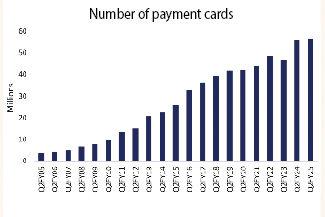
Now let’s put this in context. In 2025, Pakistani cardholders spent Rs528.7 billion across 119 million transactions. Of this, only Rs196.7bn and 50m were routed through locally registered merchants. Put another way, the majority of the spending, ie volumes of 69m worth Rs332bn, was on international platforms.
Currently, this chunk of spending faces high taxation in the form of federal excise duties, withholding, and forex fees, which add an extra cost of over 10pc. As a result, whoever can, at least among small businesses, is figuring out ways to pay with foreign-domiciled cards, whether through Payoneer, a foreign neobank, or the many stablecoin-backed wallets that have mushroomed lately. The latest move would reduce the price distortion a bit, though the penalty for a locally issued card still remains.
Which brings us, finally, to the enablers at the bottom. The budget does throw a few bones here and there: zero customs duty on SIM/smart-card raw materials, the omission of advance tax on SIM sales, and concessionary rates for internet service provider machinery. These are sensible, supply-side nudges that could lower the cost of building out the pipes that everything else depends on.
However, they remain incremental. For last-mile fiberisation, tariffs and duties remain extremely steep, around 70pc, for key equipment.
For Digital Pakistan to be a genuine growth engine rather than a slogan, the infrastructure, ie critical hardware, needs to be incentivised.
Published in Dawn, The Business and Finance Weekly, June 15th, 2026