

• Budget keeps lender’s targets intact on revenue, deficit, primary surplus
• Divisible pool frozen for three years at Rs13.35tr; govt eyes Rs1.9tr fiscal space
• Revenue target up 17.6pc after record Rs1.15tr shortfall; defence up 17.7pc to Rs3tr
• Salaries, pensions to rise 7pc; minimum wage proposed at Rs40,700
• Super tax scrapped for Rs150m-Rs500m incomes
• Social media earnings, traders face new tax measures
• Incentives for small EVs; curbs on luxury ones
• Petroleum now top non-tax earner at Rs2.034tr
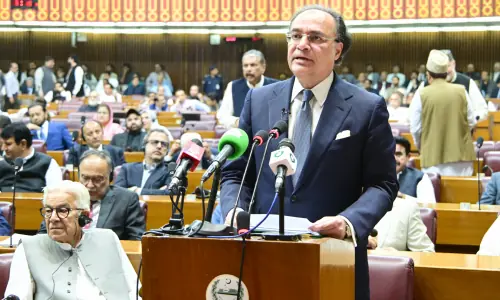
ISLAMABAD: Religiously following critical conditions of the International Monetary Fund (IMF) — revenue target, fiscal deficit and primary surplus — to continue fiscal consolidation, Finance Minister Muhammad Aurangzeb on Friday announced a three-year freeze on provincial transfers as the government reallocated resources for security needs and relief measures for the salaried, corporate, real estate and export sectors to revive struggling economic activity.
In his third budget — and the fifth of the major coalition partners — the minister also proposed taxes on social media earnings, a fixed tax scheme for small traders and shopkeepers, a higher minimum tax rate for wholesalers and retailers, incentives for small electric vehicles and bikes, and barriers for luxury e-vehicles.
Mr Aurangzeb said next year’s budget had been prepared with a clear strategy aimed at increasing productivity and promoting exports. To achieve this, incentives had been provided for export industries, increased agricultural productivity and facilitation of information technology.
He said an important objective of the budget was to increase revenue through better tax compliance and enforcement, rather than increasing the burden on existing taxpayers. This would be done through new compliance and enforcement systems alongside the FBR’s restructuring.
The minister announced a 7pc increase in salaries and pensions for all government employees and a 10pc increase in the minimum wage to Rs40,700 — a measure seldom implemented by the private sector.
On the other side, income tax relief has been provided for salaried individuals in various slabs.
The tax rate has been reduced by 3 percentage points for annual incomes between Rs2.2m and Rs3.2m, by 5 percentage points for those earning over Rs3.2m and up to Rs4.1m, and by 6 percentage points to 29pc for those earning between Rs4.1m and Rs5.6m.
Likewise, the super tax has been abolished for business incomes ranging from Rs150m to Rs500m and reduced by 2 percentage points to 8pc for those above Rs500m. This relief is not applicable to banks, oil and gas exploration companies and fertiliser companies, which will remain subject to the current rate.
Tax cuts have also been offered for the sale and purchase of real estate and the construction sector, as the minister said these would activate construction and associated industries such as cement, iron, glass, paints, tiles and hardware.
With a historic Rs1.15tr tax shortfall in the current fiscal year, the finance minister announced an ambitious tax target of Rs15.264tr for next year, up Rs2.28tr, or 17.6pc, from the revised assumption of Rs12.983tr after missing the Rs14.131tr target set in last year’s budget.
This would involve revenue adjustments of around Rs650bn to Rs700bn to be filled through additional measures and stronger enforcement. The remaining Rs1.6tr or so is expected to flow organically from the combined 12pc impact of inflation and economic growth.
The minister said the federal and provincial governments had agreed on a mechanism of “cooperative federalism” to collectively meet national needs without affecting the constitutional rights of the provinces. Under the mechanism, to be renewed every year until 2028-29, provincial shares from the federal divisible pool under the 7th National Finance Commission will remain intact.
However, despite Rs15.264tr tax collection next year, the divisible pool for the purpose of provincial and federal shares has been frozen at Rs13.35tr to meet “strategic national requirements”.
The Rs1.9tr higher amount — the difference between the Rs15.264tr tax collection and the Rs13.35tr frozen amount — would remain available to the federal government in the shape of grants under Article 164 of the Constitution, the finance minister said.
A part of the additional funding would go to defence expenditure, up 17.7pc, or Rs450bn, to Rs3tr. Another additional amount of Rs707bn has been earmarked for “other grants”, up 39pc to Rs2.528tr for next year, while Rs430bn would be set aside for emergency needs instead of Rs275bn this year, including Rs20bn for natural disasters.
“Defence budget has been increased sufficiently to make the country’s defence invincible in view of the uncertain regional situation,” the minister said.
This additional fiscal space is on top of the Rs1.8tr provincial surplus, or 1.3pc of GDP, to be provided to the federal government under the IMF-dictated National Fiscal Pact. The provinces provided Rs1.38tr cash surplus to the Centre under the pact this year.
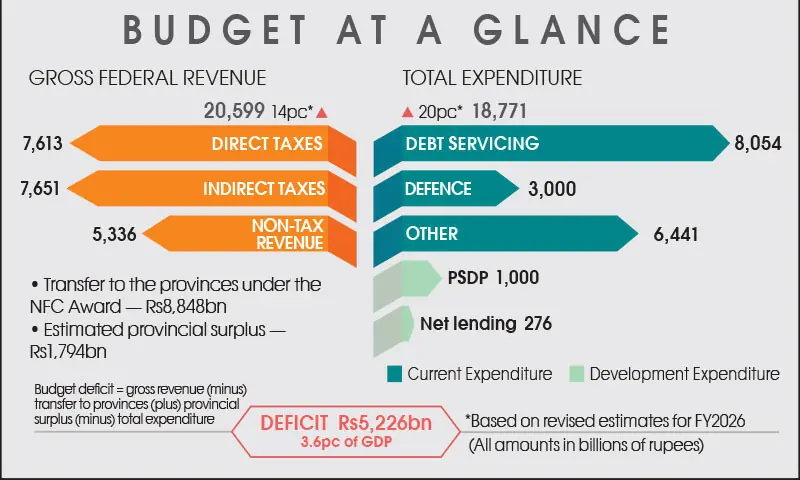
Despite this rebalancing, the finance minister did not change three key targets set by the IMF in April this year — FBR revenue target at Rs15.264tr, primary surplus at 2pc, or Rs2.828tr, of GDP and fiscal deficit at 3.6pc, or Rs5.226tr.
The target for non-tax revenue has been set at Rs5.336tr, up from Rs5.1tr this year, even though the largest source — State Bank profit — will be down 40pc to Rs1.435tr next year from Rs2.43tr, owing to lower interest rates.
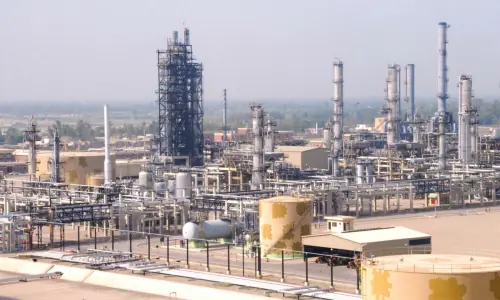
The petroleum sector would thus take over as the largest non-tax revenue spinner, with Rs2.034tr contribution next year, up from Rs1.8tr this year. This means petroleum revenue would be a critical driver, with almost Rs1.68tr contribution next year, up from Rs1.498tr this year.
Total federal expenditure has been estimated at Rs18.77tr for next year compared to Rs16.286tr budgeted this year. The Rs7.03tr federal deficit would be met through Rs1.79tr provincial surplus, Rs813bn of external financing, Rs6.046tr of domestic borrowing and Rs161bn in privatisation proceeds.
The government has allocated over Rs8tr for mark-up payments, up 16pc from Rs6.94tr this year. Total expenditure has been projected at Rs17.495tr — almost Rs2.5tr, or 16.6pc, higher than Rs15tr during the current year.
Pension expenditure would also rise to Rs1.17tr next year from Rs1.055tr this year. The major chunk of Rs822bn would go to military pensions and Rs272bn to civil pensioners. On top of this, Rs64.5bn would be the additional impact of the 7pc increase in civil and military pensions next year.
The amount of subsidies has been scaled down to Rs1.09tr for next year against Rs1.157tr this year, while running the civil government would cost Rs1.07tr next year compared to Rs1.02tr this year.
Power sector subsidies have been curtailed to Rs830bn for next year against Rs893bn this year. Of this, subsidy allocation for K-Electric has been increased by 30pc to Rs163bn next year against Rs125bn this year, while subsidy for AJK has been increased by Rs7bn to Rs81bn.
On the other hand, subsidy for all other distribution companies has been scaled back to Rs333bn for next year from Rs341bn this year. A block allocation of Rs252bn has been made for overall circular debt containment.
Published in Dawn, June 13th, 2026