US helicopter crew who went down in Strait of Hormuz rescued by drone
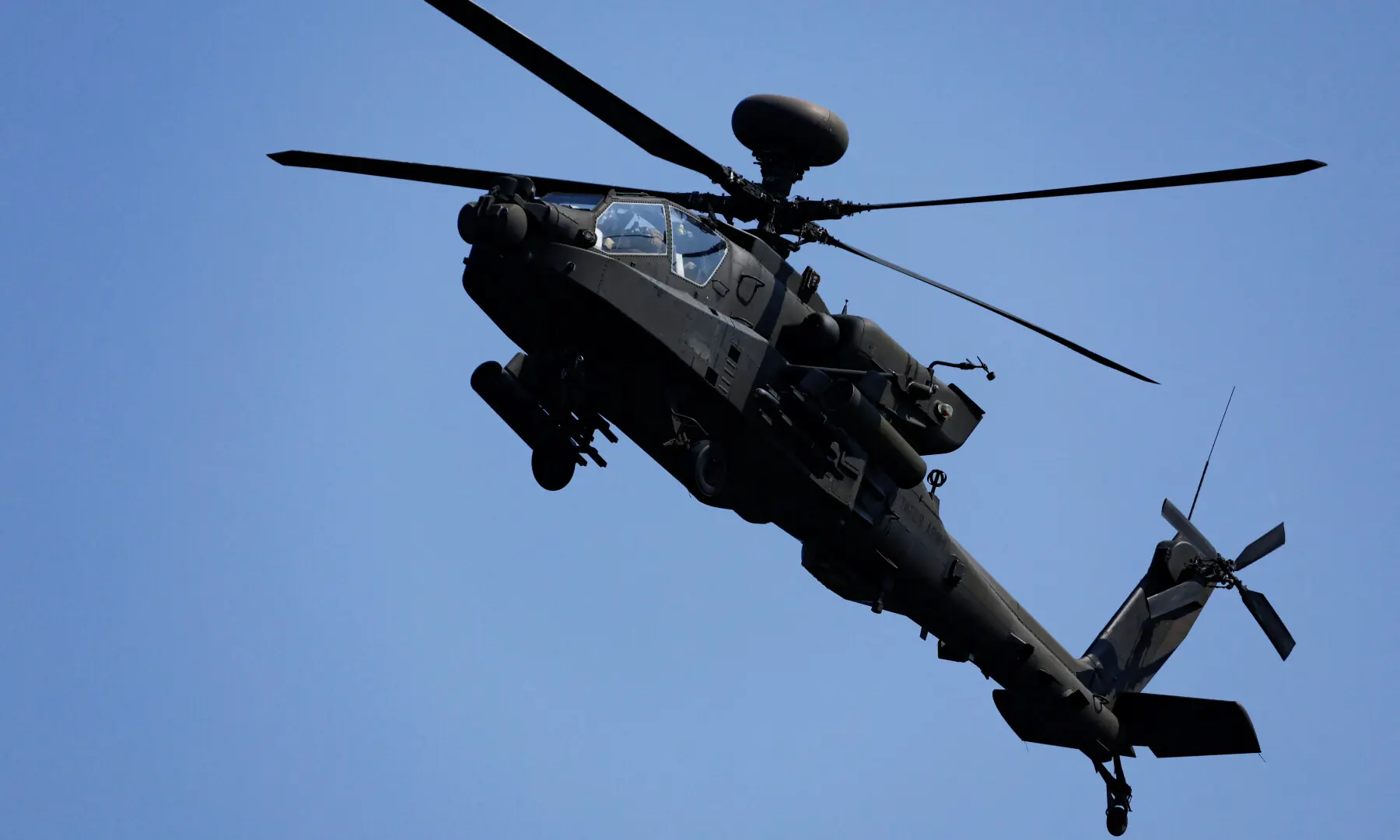


United States President Donald Trump said on Tuesday that two US helicopter crew members were “fine” following their rescue by a US Navy drone after their Apache gunship went down in the Iran-controlled Strait of Hormuz.
The US military’s Central Command (Centcom) said the AH-64 Apache went down at around 3am local time on Tuesday (4am PKT) near the coast of Oman while patrolling regional waters. It gave no reason for the crash.
The pair were rescued within about two hours and were in stable condition, Centcom said.
Centcom told Reuters the rescue was carried out by a drone but did not specify the model.
It was not immediately clear whether the Apache had been shot down by Iranian fire, experienced mechanical failure, or encountered another problem.
Asked if he knew what had brought the helicopter down, Trump said a report would be issued later on Tuesday.
“The pilots are fine,” Trump said, speaking on the runway at John F. Kennedy International Airport before returning to Washington, DC.
“Nobody injured.”
The incident happened a day after Iran and Israel said they had halted attacks on each other following an appeal from Trump, though Tehran warned it would resume hostilities if Israel continued to hit Hezbollah in Lebanon.
The resumption of the tenuous ceasefire comes as Washington tries to reach an agreement with Tehran to end their more than three-month-old war.
Trump also told reporters he could have “an idea” for an Iran deal within a few days, without elaborating. The Republican president, struggling with record-low approval ratings ahead of November midterm elections, has often hinted at an imminent deal with Tehran, but none has yet eventuated.
The weekend saw the most direct confrontation between Iran and Israel since a ceasefire in April. Tehran had fired missiles towards Israeli territory late on Sunday, calling the strikes retaliation for attacks on the outskirts of Beirut.
Israel then hit Iranian air defence systems and a petrochemical plant that it claimed was used to produce ballistic missiles. Iran’s Islamic Revolutionary Guard Corps (IRGC) said it retaliated with a strike aimed at a similar Israeli plant in the city of Haifa.
No deaths were reported by authorities on either side.
Trump tells Netanyahu to ‘be careful’
US and Israeli officials said Trump and Israeli Prime Minister Benjamin Netanyahu spoke on Monday.
In an interview with Axios, Trump said he warned Netanyahu that if the Israeli leader went back to war with Iran, he might find himself fighting alone.
“I said, ‘Bibi, you better be careful, or you will be on your own very soon,’” Trump said.
An Israeli military official said Israel was prepared to continue operations for “as long as it takes”, while Iranian officials struck a similarly defiant tone.
A military source quoted by the semi-official Tasnim news agency said Tehran was ready for a prolonged conflict and could renew strikes against US interests in the region.
Iranian Foreign Ministry spokesperson Esmaeil Baqaei said Tehran was exchanging messages with Washington in an atmosphere of “extreme suspicion”.
Tehran has long said any peace deal with the US depends in part on an end to fighting in Lebanon, which Israel invaded in March.
Israel has never halted its Lebanon campaign, which has killed thousands of people, saying the conflict should be treated separately from any US-Iranian ceasefire. Hezbollah has also continued its attacks.
Tehran has continued to block most shipping through the Strait of Hormuz, which before the war carried a fifth of the world’s crude oil and liquefied natural gas. Washington has imposed its own blockade of Iranian ports.
Trump has said any peace deal must ensure Iran cannot develop a nuclear weapon. Tehran denies the US stance, saying its nuclear programme is only for civilian purposes.
Iran’s demands include the lifting of international sanctions, the release of billions of dollars in frozen assets and recognition of its control of the strait.