IN November 1970, the Bhola cyclone killed up to half a million people in East Pakistan. Yahya Khan’s government introduced a 10 per cent surcharge to fund emergency relief. Bangladesh became independent 13 months later. The affected territory was gone. The levy remained. Zulfikar Ali Bhutto’s government absorbed the revenue into general federal accounts in 1972. No accounting was published. In 1985, Gen Zia introduced the Iqra surcharge, framed as an education fund. The revenue balanced federal operating accounts. No alternative education instrument replaced it when it was abolished under the IMF’s insistence. The template was set.
Fifty years later, Pakistan has not deviated from this template. What began as a cyclone surcharge is now a Rs1.55 trillion instrument misclassified as non-tax revenue. The architecture is identical but the scale has changed.
Pakistan has pursued this through two parallel tracks. The first collected resources in the name of disaster relief, later rebranded as climate resilience as floods became more frequent. The second imposed non-tax revenue through petroleum pricing. The petroleum development levy (PDL), a general development surcharge dating to 1961, was structurally insulated in 2010 to bypass provincial NFC sharing. It grew steadily, crossing Rs100 billion annually by the mid-2010s and exceeding Rs200bn by FY2018-19. Although never formally framed as a climate instrument, it has acquired a distinct environmental gloss, culminating in the climate support levy of 2026.
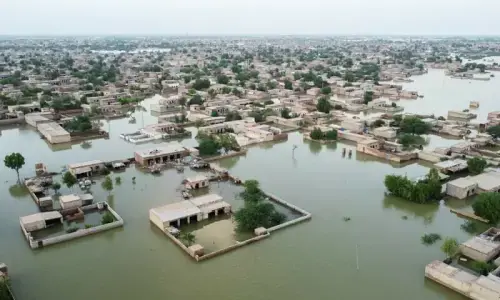
The flooding track: The 1973 floods wiped out three million houses and erased a year of economic growth. Bhutto created the Federal Flood Commission. Three consecutive 10-year national flood protection plans followed, running from 1978 to 2008 across four governments, each funded through the PSDP with no ring-fencing. Pakistan suffered catastrophic floods throughout. Three decades of federal plans, without a rupee ring-fenced.
No relief fund has ever been legally ring-fenced.
Since 1992, when Nawaz Sharif’s government first activated the prime minister’s relief fund model, Pakistan has deployed the same instrument at least five times across floods and earthquakes. The design is deliberate: by classifying flood revenue as voluntary donations rather than taxation, governments simultaneously escape parliamentary scrutiny, judicial challenge and NFC distribution requirements. Benazir Bhutto deployed the identical model after the 1994 floods. So did every government after 2010.
The 2010 floods affected 20m people and caused $43bn in damages. The government announced a flood relief surcharge projecting Rs40bn, collected it, and absorbed it into the federal consolidated fund while simultaneously negotiating IMF targets. After the 2022 floods, the government quietly renamed its existing super tax: Section 4B, whose stated purpose was rehabilitation of temporarily displaced persons, became Section 4C, a super tax on high-earning persons. The humanitarian justification was dropped without explanation. The revenue mechanism stayed the same.
Three findings hold across every instrument. No relief fund has ever been legally ring-fenced: every prime minister, president and chief minister relief fund is credited to the account of the federation, making it general government money. International pledges substitute for domestic accountability rather than supplementing it. And every fund since 2005 has carried a public commitment to publish an independent audit. None has been published.
Justice Saqib Nisar’s 2018 dam fund collected Rs11.5bn from the public in the name of water security, earned Rs2.2bn in mark-up over six years, and was quietly transferred to the public account of the federation in 2024 without a single rupee spent on the stated objective. If money raised under the highest judicial authority in the country can still end up in the general budget, no argument remains that any executive fund can be trusted to do otherwise.
The petroleum track: Climate change has been weaponised as a justification to tax citizens. Gen Musharraf used clean-fuel rhetoric to justify development surcharges during the CNG transition without a single rupee being traced to a cleaner fuel outcome. In 2009, the Supreme Court under chief justice Iftikhar Chaudhry ruled that revenue collected without a verifiable service to the payer is a tax, not a surcharge, and that imposing it by executive notification violates Article 77. The response was the Petroleum Products (Development Levy) Amendment Act, 2009, that satisfied the court’s procedural requirement while eliminating any ring-fencing obligation.
The consequences are calculable. At Rs1.55tr, the PDL represents 10-11 per cent of total federal revenue. Under the seventh NFC Award, provinces are entitled to 57.5pc of all taxes. If correctly classified, Punjab would receive Rs461bn annually, Sindh Rs219bn, KP Rs13bn and Balochistan Rs81bn. They receive zero. It is a tax called a levy because of the NFC Award. The classification is deliberate.
PML-N elevated PDL margins in 2016 on the justification that the premium would fund cleaner fuel production. The revenue went instead to IPP capacity charge payments and circular debt service, which reached Rs1.14tr by FY2017-18. The revenue collected in the name of cleaner fuel financed the liabilities of a fossil-fuel-dependent power grid. The PTI then scaled the PDL to Rs424bn, the highest in Pakistan’s history, while branding it a carbon instrument aligned with its Ten Billion Tree Tsunami project. In March 2022, it froze the levy at zero for political reasons. The IMF suspended a $1bn tranche within weeks. A climate-labelled levy had become a macroeconomic emergency.
Across 23 programmes since 1958, the IMF has required Pakistan to enhance the PDL without requiring it to distribute the revenue constitutionally.
The way forward: Can the PDL be ring-fenced or audited? Ring-fencing 15pc of PDL collections into a sovereign climate fund (SCF) would deploy Rs232bn annually, shared with provinces under the NFC Award and structured as a statutory trust.
Following global benchmarks, it can leverage private investment at a ratio of one to four, unlocking approximately Rs900bn in total climate finance conditioned on climate resilience outcomes aligned with Pakistan’s commitments.
The IMF objection is predictable but answerable. The SCF does not reduce total PDL collections. Tabled in the next programme negotiation as a structural benchmark rather than a provincial concession, the IMF’s incentives align with the reform rather than against it. The question is not whether Pakistan can create such a fund. It is whether any government is willing to surrender a revenue stream that it has prized too much to ring-fence.
The writer is a climate expert.
Published in Dawn, June 4th, 2026