0
0

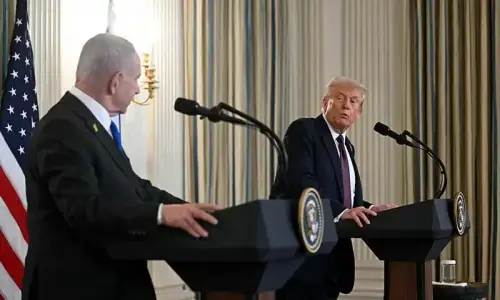
THE statement by Israeli Prime Minister Benjamin Netanyahu regarding a pros-pective ‘hexagon of alliances’ signals a significant shift in the geopolitics related to the Middle East. The proposed align-ment, reportedly involving India, Greece, Cyprus, alongside unnamed Arab, African and Asian partners, is framed as a strategic mechanism to contain what is described as a ‘radical axis’ led by Iran. However, such formulations reveal less a commitment to cooperative security and more an entrenched logic of threat perception.
Alliances constructed primarily on the anticipation of adversaries rather than the pursuit of mutual gains tend to reproduce insecurity rather than resolve it. The history of the region demonstrates that exclusionary blocs often deepen sectarian polarisation and intensify proxy contes-tations. Reactions from Pakistan and Turkiye underscore the broader unease within the Muslim world regarding initiatives perceived as targeting particular identities.
From a practical standpoint, framing regional politics through binaries of ‘axes’ risks simplifying complex socio-political realities and undermining possibilities for inclusive dialogue. Moreover, the institutionalisation of fear-driven alliances may inadvertently accelerate military competition and strategic mistrust that may divert critical resources away from pressing challenges.
The Middle East does not lack alliances; it lacks sustainable frameworks of co-operation grounded in shared development and human security. If regional actors continue to prioritise deterrence over diplomacy and alignment over engage-ment, the resulting order will remain fragile and perpetually contested.
Genuine stability cannot emerge from architectures designed to counter imagined threats alone; it requires confidence-building, institutional transparency, and inclusive regional governance. The en-visioned ‘hexagon’ represents not merely a strategic initiative, but a broader paradigm of politics rooted in apprehension. The Middle East region deserves a future defined by cooperation rather than containment, and by trust rather than fear.
Furthermore, historical precedents, such as Cold War politics, illustrate that rigid alliance systems often entrench divisions and prolong conflicts instead of resolving them. In the contemporary Middle Eastern context, where non-state actors and transnational challenges already complicate governance, additional layers of militarised alignment may exacerbate volatility rather than mitigate it.
A forward-looking approach would instead emphasise multilateral engage-ment, economic interdependence, and conflict-resolution mechanisms that address root causes rather than symptoms. Such a recalibration is essential for transforming entrenched rivalries into opportunities for durable regional peace.
Naimat Ullah Khan
Lahore
Published in Dawn, June 2nd, 2026