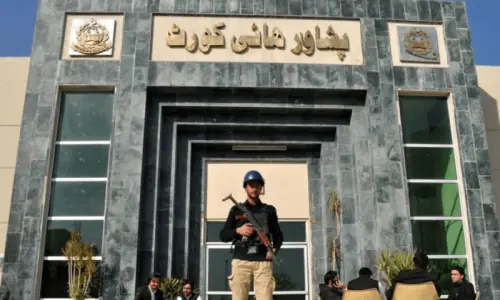
PHC orders govt to identify officials delaying criminal justice reforms
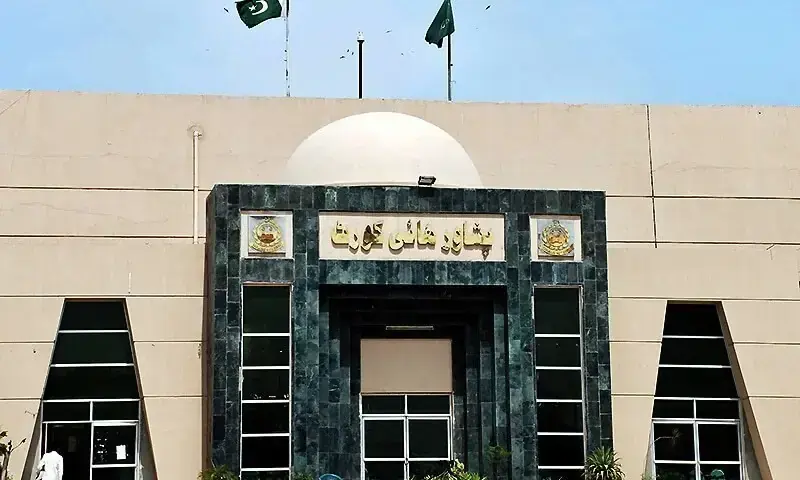

PESHAWAR: The Peshawar High Court has expressed displeasure at the failure of authorities to implement its full-bench orders to reform the criminal justice system in the province and directed the provincial chief secretary to identify the culpable officials.
“Such persons, whether serving within the police department, prosecution service or any other public institutions, cannot be permitted to continue undermining the rule of law and weakening State institutions with impunity, particularly at the cost of approximately forty-five million citizens of this volatile province,” declared a bench consisting of Chief Justice S.M. Attique Shah and Justice Mohammad Ijaz Khan in the 13-page detailed order on a contempt petition.
Expressing dissatisfaction with an interim report submitted on behalf of the provincial government and administrative secretaries, the court observed that the act “appeared to be nothing more than a cosmetic, superficial and perfunctory exercise, wholly lacking any meaningful indication of sincere, effective and result-oriented compliance with the judgement.”
As requested by chief secretary Shahab Ali Shah, the bench granted him a month’s time to submit a compliance report.
Rejects interim report, seeks compliance with orders within a month
“However, it is made abundantly clear that the respondents shall ensure that tangible, visible, effective, and result-oriented steps are taken for the swift and complete implementation of the judgement under implementation,” the bench declared.
It warned that in case of continued inaction, negligence, deliberate delay or noncompliance, it would proceed strictly in accordance with law against all officials responsible for obstructing due compliance of the judgement, and the consequences thereof would rest solely upon those officials.
The court appointed additional advocate general Naumanul Haq Kakakhel as the focal person in the case and fixed July 1 for next hearing into a contempt petition of Asifullah, who insisted that the respondents including the provincial government had failed in complying with the direction and guidelines laid down by a larger bench of the court in its judgement delivered on Jan 15, 2026.
The bench, which heard the case on May 21, also voiced concern in the orders over “governance issues” in the province.
“It is frequently proclaimed that the affairs of the Province are being managed under the principles of good governance, transparency, merit, and accountability. However, the ground realities presently emerging before this Court depict an entirely disturbing and contrary picture,” it observed.
The court added that such practices severely eroded institutional credibility, compromised merit, encouraged favouritism and ultimately weakened public confidence in governance structures and state institutions.
“Public offices are sacred trusts and cannot be converted into instruments of personal convenience or vested interests.”
The court declared that the people of the province were continuously suffering not only the loss of their precious lives, but also deprivation of their honour, respect, dignity, liberty and both movable and immovable properties.
“Owing to the fragile criminal justice administration and ineffective dispensation of justice, they are further being denied timely and effective justice in accordance with law, which is their constitutional right guaranteed under Article 37(d) of the Constitution, 1973, whereby the State is obligated to ensure inexpensive and expeditious justice to the citizens under all circumstances.”
Referring to corruption and misconduct by government officers, the court pointed out that prior to the judgement in question, the judiciary itself undertook concrete, painful and meaningful corrective measures.
It added that as a consequence, nearly 21 judicial officers, holding positions in BPS 18-21, were proceeded against on allegations of misconduct and were ultimately removed from service after due process of law.
“In these circumstances, there appears to be absolutely no justification whatsoever as to why the executive authorities have failed to identify, proceed against, and remove corrupt, inefficient and delinquent officials functioning within their own departments and institutions,” it declared.
The court maintained that such inaction not only frustrated implementation of the judgement, but also seriously eroded public confidence in state institutions and strengthened the perception that accountability does not exist in the government departments.
“It is an undeniable reality that corruption, maladministration, and abuse of authority by public functionaries have severely damaged institutional integrity, weakened governance structures, which resulted into low conviction rate i.e. 7% to 8 %, and thus has shaken the confidence of the people in the justice delivery system,” the bench pointed out.
INTERIM REPORT: The interim report submitted by advocate general Shah Faisal Uthmankhel highlighted multiple steps taken by the provincial government for implementation of the court’s orders.
“That for implementation of the guidelines, directives and recommendations rendered in the above public interest litigation, requires the combined inputs/ actions/involvement of the Executive and Legislature of the Province. Accordingly, the Home and Tribal Affairs Department has circulated the guidelines to all the stakeholders and departments with the approval of the chief secretary for implementation,” the report said.
It added that for criminal justice system reforms, the draft bills had been received from the high court and were under consideration of the Criminal Justice Reforms Committee, constituted under the chairmanship of the law secretary.
“Once the committee finalises and approves the bills, the same will be processed in terms of Khyber Pakhtunkhwa Government Rules of Business, 1985. The bills, thereafter, will be submitted to the Provincial Assembly for enactment,” it said.
The report said the provincial cabinet, in its 49h meeting held on March 9, 2026, under the subject “Financing of ADP Scheme establishment of Forensic Science Laboratory at Peshawar”, approved the financing of the scheme from the provincial exchequer, so Nespak submitted PC-I with an estimated cost of Rs20 billion.
It claimed that for effective implementation of Alternate Dispute Resolution mechanism, necessary amendments had been processed and approved by the Cabinet Committee on Legislation constituted under the chairmanship of the law minister and that the draft bill would be presented to the cabinet for consideration in terms of Khyber Pakhtunkhwa Government Rules of Business, 1985.
“The constitution of the Witness Protection Board and Witness Protection Units, as required under the Khyber Pakhtunkhwa Witness Protection Act, 2021, are under consideration and will be processed for the approval of the Provincial Government,” it said.
Published in Dawn, May 31st, 2026