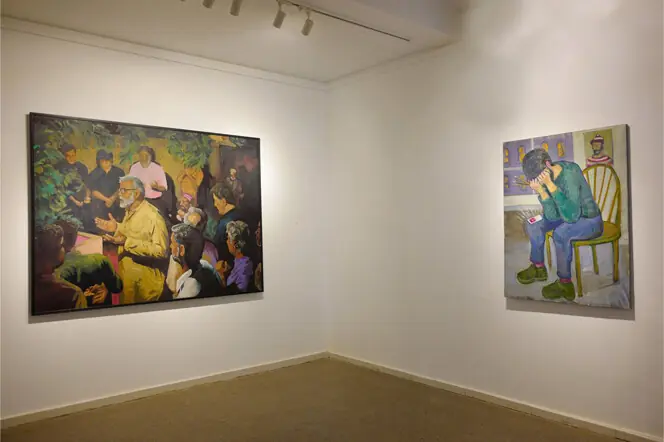
The Geography of Memory’ at Canvas Gallery brings together four Pakistani artists who live abroad: Noormah Jamal, Mustafa Mohsin, Usaydh Agha and Ruby Chishti.
Their practices engage memory as something porous, shifting and deeply embodied. The exhibition unfolds as a layered meditation on identity, displacement and the emotional residues of lived experience. Each artist approaches memory through a distinct visual language yet, together, they construct a nuanced cartography of the personal and the collective.
At first glance, Jamal’s oil pastel drawings appear almost childlike, with simplified forms, vivid colours and a playful, dreamlike sensibility. Yet, this apparent innocence gives way to something more complex. Her compositions operate as symbolic constellations where mountains, flames, celestial forms and domestic objects coexist in ambiguous relationships.
Figures drift between states, caught between vulnerability and quiet authority. Drawing on oral traditions and cultural motifs, Jamal creates images that feel both intimate and mythic, where memory appears fragmented, layered and unresolved.
A deeply introspective four-person exhibition in Karachi presented memory as something that can be reimagined and reconstructed
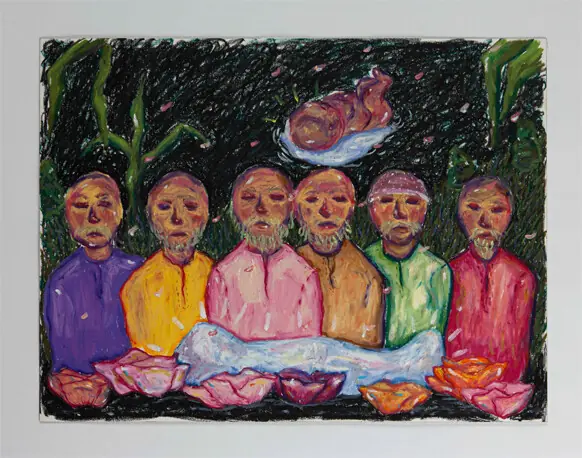
In Masharaan (Elders), Jamal constructs a scene that is both intimate and ceremonial. A row of elderly men sits shoulder to shoulder, eyes closed, their expressions poised between repose and solemnity. Each figure wears a differently coloured kurta — purple, yellow, pink, ochre, green, red — creating a rhythmic chromatic sequence across the composition.
While the colours lend a visual vibrancy, the mood remains restrained, even mournful. In the foreground, a pale, elongated form lies almost spectrally. It may suggest the shrouded body of a child, a symbolic offering, or a tangible fragment of memory. The act of gathering feels significant, though its meaning remains deliberately open.
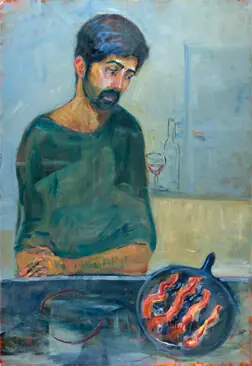
In contrast, Mohsin’s paintings are marked by restraint and psychological stillness. Rooted in a sense of cultural dissonance shaped by movement across geographies, his figures inhabit spaces of introspection, suspended between presence and absence. There is a subtle theatricality to these works: the subjects appear aware of being observed, yet remain internally withdrawn.
Mohsin’s unconventional journey, from cake artistry to economics to fine art, manifests in a refined sensitivity to surface, colour and composition. His paintings engage with the performance of identity, reflecting how individuals navigate layered expectations imposed by society and self.
In Haraam, Mohsin distils a moment of quiet tension. A solitary male figure sits at a table, absorbed in a private reckoning. The composition is sparse, yet charged. The title, with its connotations of prohibition and moral transgression, frames the scene as one of internal conflict rather than simple contemplation. What unfolds is an encounter with the self — fraught, unresolved and deeply human.
Agha’s paintings extend the exhibition’s concerns into a more philosophical register. Agha was an advocate before becoming a figurative painter. He studied at the Royal College of Art in the field of history painting, and later received training through courses at the Florence Academy of Art in Florence, Italy.
His images are deeply private yet resonate with a broader universality. His imagery emerges from internal landscapes, occupying spaces between dream and document. Themes of power, violence and cultural inheritance surface obliquely, inviting reflection rather than assertion. Memory, here, is not a fixed record but an evolving negotiation.
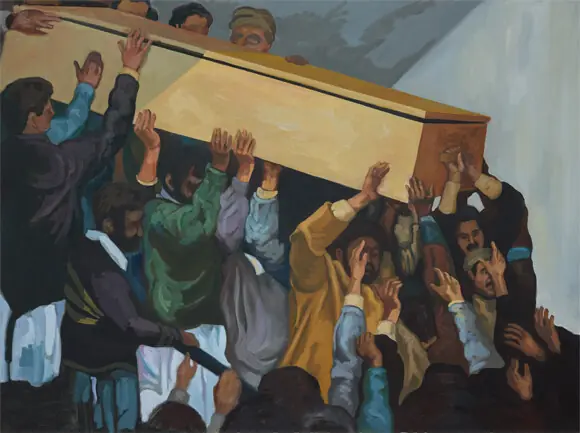
The Deposition reinterprets the historical motif of Christ’s removal from the cross through a contemporary lens. A coffin is lowered or supported by surrounding figures whose gestures convey grief and collective burden. Time and place are deliberately blurred, allowing the scene to move beyond its biblical origins into a more universal meditation on loss and interdependence. The scale of the work intensifies its emotional impact, foregrounding both the fragility of the body and the persistence of care.
If Jamal, Mohsin and Agha explore memory through image and atmosphere, Chishti grounds it in materiality. Her sculptural works, constructed from discarded textiles, carry the weight of touch, use, and time. These fabrics, often drawn from personal or ceremonial contexts, are not neutral but act as repositories of memory. Chishti’s practice, shaped by experiences of displacement and familial rupture, transforms these remnants into forms that speak of endurance and survival.
Her engagement with the idea of the caryatid (a sculpted female figure as architectural support) is telling. In her work, this classical ideal is reimagined through bodies marked by lived experience. These figures are not monumental in scale, yet they possess a quiet strength, embodying what might be understood as the architecture of memory: the invisible ways in which histories are carried within the body. An ecological dimension also underlies her practice, as the reuse of textiles gestures towards cycles of consumption, care and preservation.
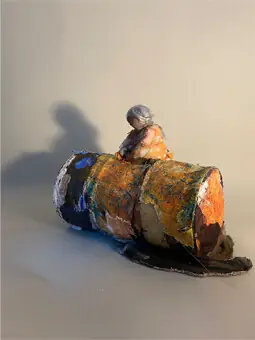
In Until the Sparrows Return, a small sculpture fashioned from discarded cloth takes the form of an industrial oil barrel, upon which a female figure perches. Suspended between refuge and abandonment, she inhabits the silence that follows devastation — when even the sparrows have disappeared. Her worn, repeatedly stitched clothing becomes a testament to endurance, each seam resisting erasure. The figure exists at a threshold between ruin and return, where survival itself becomes a form of waiting.
Chishti connects this work to her earlier series In the Absence of Sparrows, where women are depicted holding one another in the aftermath of conflict. These works foreground the often unseen labour of women who sustain life amid destruction.
What binds ‘The Geography of Memory’ is its refusal to treat memory as stable or singular. Instead, memory emerges as fluid, contested and deeply subjective, something that can be reimagined and reconstructed. The exhibition resists definitive narratives, opening space for reflection and personal association.
It offers a compelling reminder that memory, in all its fragility and persistence, remains one of the most vital terrains through which art can engage the world.
‘The Geography of Memory’ was on display at Canvas Gallery, Karachi from May 5-14, 2026
Rumana Husain is a writer, artist and educator. She is the author of two coffee-table books on Karachi, and has authored and illustrated 90 children’s books
Published in Dawn, EOS, 31st, 2026