


At 5’10” with a sculpted build, 26-year-old Muhammad Affan looks the part of a fitness model. He works as a trainer instead, navigating the floor between clients at SMF Studio, a multi-storey gym in Karachi’s upscale DHA locality.
As Affan walks his grunting and sweating clients through their regimen, he compliments and censures them — while maintaining his signature smile. One of the clients is Zain, who tells Eos that Affan helped him stick to the exercise and dietary regimen for his physical transformation. Sabien, who has been training with him for two years, finds him strict but funny. A third, Fouzia, adds that Affan “is always pushing you to do more and doesn’t waste time on mindless conversations.”
Affan might be sparing with his words but quick to praise. His economy of speech partially stems from a congenital impairment; he had jaundice at birth, which caused excessively high bilirubin levels and resulted in a hearing impairment.
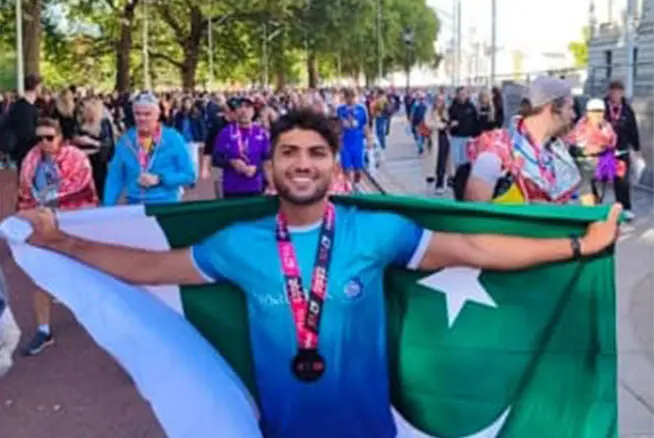
Speech therapy, learning lip-reading and a supportive family helped him find his voice — lisp and all. But it was his own conviction — and relentless hard work — that carried him into the life he has now. Today, he is a competitive athlete with a disability: powerlifting medals for Pakistan on the global stage, the full London Marathon completed and five years as a fitness trainer.
Born with a hearing impairment into a family of limited means, Muhammad Affan was written off early. Today, he holds in his name powerlifting medals, marathon finishes and a fitness career…
But before he became an inspiration, he was a lonely child, struggling to make sense of the world — mocked and ridiculed.
THE BOY THEY MOCKED
Born to a middle-income household — his father is a medical practitioner and his mother a government school teacher — Affan’s family had limited resources to deal with their son’s impairment. Muhammad Imran, his father, tells Eos that they visited multiple specialists but failed to find an affordable solution.
While growing up, Affan was admitted to multiple schools, only to be sent back home in a few months every time, for being unresponsive and inattentive. The parents acknowledge that, initially, the worry about their child not having a ‘normal’ childhood might have led them to not be completely forthcoming about their child’s impairment.
One incident stands out for them, when Affan refused to go back to school because he had been hit. “I don’t know how many times before he had been hit, but this episode made him fear learning,” his mother Shabana tells Eos.
Affan also had a tough time adjusting with others, particularly in his neighbourhood of Landhi: the children on the street ran their own lord-of-the-flies experiment, and Affan was their chosen prey. His speech and hearing issues were fodder for bullies, with other children often joining in.
Shabana wells up as she recounts those days. “Even when our relatives would wonder about Affan’s future as a ‘deaf and mute’, all I wanted was to throw them out of the house,” she says.
When Affan was 12, the family sold a few things to afford a basic hearing device. It changed Affan’s world. His mother says he would marvel at sounds he had never heard before — water from the tap, sizzling from the kitchen and her motherese.
But the device brought new problems: some sounds were startling or painful, and a constant whistling feedback plagued him. Affan still struggled at school, unable to retain lessons. Any setback — a failed lesson, a missed word — brought back memories of rejection.
In 2015, his mother heard about the Aghosh Special Children School, but he was denied admission for being too old. “I sat there crying, begging,” she says. Miss Nighat, an instructor there and a person with dwarfism, agreed to help Affan with speech therapy. A year later, he was finally inducted — surrounded by peers whose first instinct was not to mock him.
Initially, his mother travelled with him daily — an hour-long journey one-way from their home in Landhi to Gulshan-i-Hadeed during rush hour, involving two public buses — to take him to the school and bring him back. A few weeks down the line, Affan memorised the routes and signs, and started doing the journey on his own — armed with specific instructions from his mother.
GOLD IN HIS HANDS
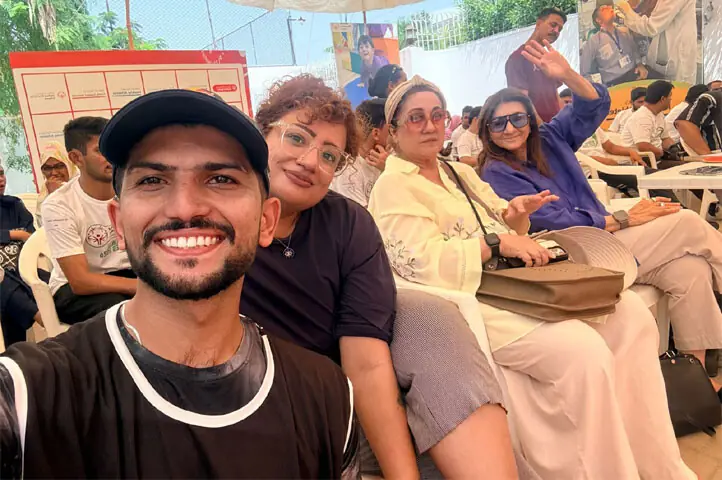
Affan always stood out because of his physique, but he excelled at cricket. Mishi Zehra, a representative for Special Olympics Pakistan, spotted Affan at a match and recognised his potential at once. He was inducted into the national cricket team for special athletes, toured multiple cities and was selected to play in India in 2017 — though visa issues scrapped the trip.
At the Special Olympics National Games the same year, he dominated powerlifting, winning gold medals in bench press, squat and deadlift, along with the overall powerlifting gold. He also won four silver medals in powerlifting at the World Games in the UAE in 2019, and later represented Pakistan in Berlin.
In the midst of it, he also joined the SOP team on a stipend. Then came the pandemic, during which time Affan started long-distance running. Impressed by his endurance and commitment, SOP hired Pakistan’s leading marathoner, Adnan Gandhi, to train him for the London Marathon. The target was for Affan to do the half-marathon. But by the time of the marathon in 2022, he was prepared for the full 42 kms, and finished it in 4:42:21.
“The same people who ridiculed him now want to take photographs with him as he is a star,” says his mother.
FINDING HIS NICHE
In 2021, with the help of his best friend Muneeb, Affan contacted Hydris Wajiuddin, a gym owner he had met at an SOP-organised event, to ask him for work. He spent a few months on trial at the gym, after which he was hired. It provided a clear career path to Affan, who quickly immersed himself in learning about exercise regimens and dietary requirements.
While he can’t read or write, he remains an effective communicator — using text-to-audio and translation apps, or even sending screenshots to his mother to help him understand the requirements. When asked if it is challenging, he rattles off the calorie count of various foods by portion, without missing a beat.
During this time, another unexpected offer arrived: a client at the gym, who would sometimes train with Affan, offered to sponsor a cochlear implant, eventually contributing more than three million rupees. The surgically implanted device can be managed with an application on his phone, so that sudden loud sounds no longer overwhelm him.
By then, Affan had also found a partner. “I saw how she stood by him during the surgery,” adds the donor, who wishes to stay anonymous. The two married in 2025.
Around the same time, though, came a professional setback. Wajihuddin closed shop and moved to the UAE.
“Affan spiralled a bit, worrying what he would do, but found an equally good employer again,” says his mother. “But throughout that period, Affan was confident that the people at SOP — people like Ronak Lakhani, Sadia Baig and Mishi Zehra — will help him get through it,” adds his father.
He found work quickly — and his clients from the previous gym have followed him. He also owns a motorcycle and contributes to household expenses.
For his parents, though, their son has achieved more than they could have ever wished for. “We can’t thank the people at SOP enough for what they did for our child,” says his father.
Affan still has one item outstanding: a gym of his own. He knows what it will cost, and he is already working on it. For a man who memorised bus routes alone, ran a full marathon when a half was expected and built a career without ever reading a contract — it seems, in his own quiet way, inevitable.
The writer is a member of staff.
X: @hydada83
Published in Dawn, EOS, May 24th, 2026




























