Russia flexes nuclear muscles as tensions rise with Nato
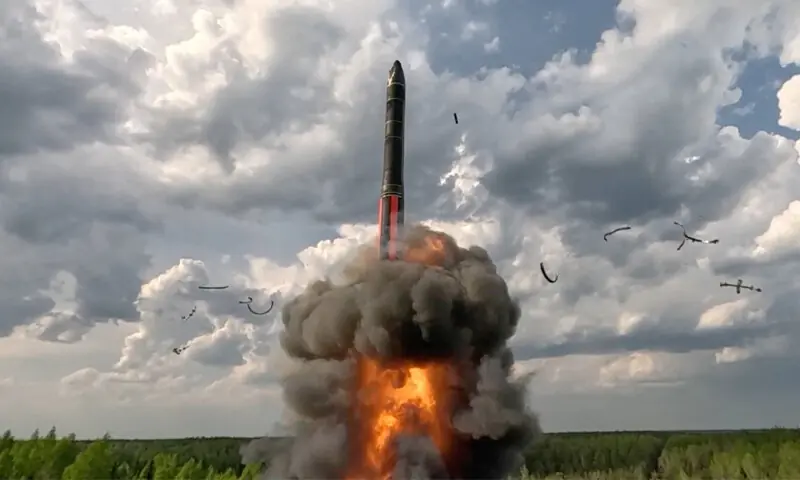
MOSCOW: Russia launched nuclear-capable missiles and issued nuclear munitions to some units on Thursday as part of major nuclear exercises amid heightened tensions with Nato over the Ukraine war and drone activity in the Baltic.
Russia is conducting some of the biggest nuclear exercises in years, involving 64,000 people to drill its forces in “the preparation and use of nuclear forces in the event of aggression”.
Russian President Vladimir Putin told Belarusian President Alexander Lukashenko, Russian Defence Minister Andrei Belousov and top generals that the use of such weapons would always be an exceptional and extreme measure of last resort.
“Given the growing tensions in the world and the emergence of new threats and risks, our nuclear triad must continue to serve as a reliable guarantor of the sovereignty of the Union State of Russia and Belarus,” Putin said in the Kremlin.
While Russia does not want to get involved in an arms race, he added, it will develop its nuclear forces and keep them on a sufficient level, including with new missiles and submarines.
Russia has the world’s biggest nuclear arsenal with about 4,400 deployed and stockpiled nuclear warheads, while the US has about 3,700, according to the Federation of American Scientists.
China is the world’s third-largest nuclear power with about 620, followed by France with 290 and Britain with about 225, the federation says. Russia and China said on Wednesday that US President Donald Trump’s Golden Dome missile-defence shield plans threatened strategic stability.
Nuclear war games
As part of the drills, Russia test-fired a Yars intercontinental ballistic missile from the Plesetsk Cosmodrome in northern Russia and a Zircon hypersonic missile from a frigate in the Barents Sea, while a submarine launched a liquid-fuelled Sineva ballistic missile, the defence ministry said. Russia displayed a Borei-class nuclear-powered ballistic missile submarine, Il-38 anti-submarine aircraft and a MiG-31 armed with a Kinzhal hypersonic missile.
Units in Belarus and Russia were issued with nuclear munitions as part of the exercises, Valery Gerasimov, chief of the Russian General Staff, told Putin.
Russian nuclear exercises typically use dummy warheads. One video released by the defence ministry showed a tarp-backed military truck travelling with minimal security. The drills come as Moscow says it is locked in an existential struggle with the West over Ukraine. Throughout the war, Putin has issued reminders of Russia’s nuclear might as a warning to the West not to go too far in its support of Kyiv. Ukraine and some Western leaders have dismissed such moves as irresponsible sabre-rattling.
Baltic tensions escalate
Moscow has accused the Baltic countries of allowing Ukraine to fly over their territory to attack northern Russia, an accusation Nato denies. The Baltic states, all strong backers of Ukraine, say Russia is redirecting Ukrainian drones into their airspace from their intended targets in Russia.
The Kremlin criticised remarks by Lithuania’s top diplomat as “verging on insanity” on Wednesday after Foreign Minister Kestutis Budrys said Nato had to show Moscow it was capable of penetrating the Russian exclave of Kaliningrad.
Kaliningrad is sandwiched between Nato members Lithuania and Poland on the Baltic coast. It has a population of around one million and is heavily militarised, serving as the headquarters of Russia’s Baltic Fleet.
Published in Dawn, May 22nd, 2026