PM Shehbaz credits 'political-military partnership' for Pakistan's recognition as US-Iran mediator, changed image
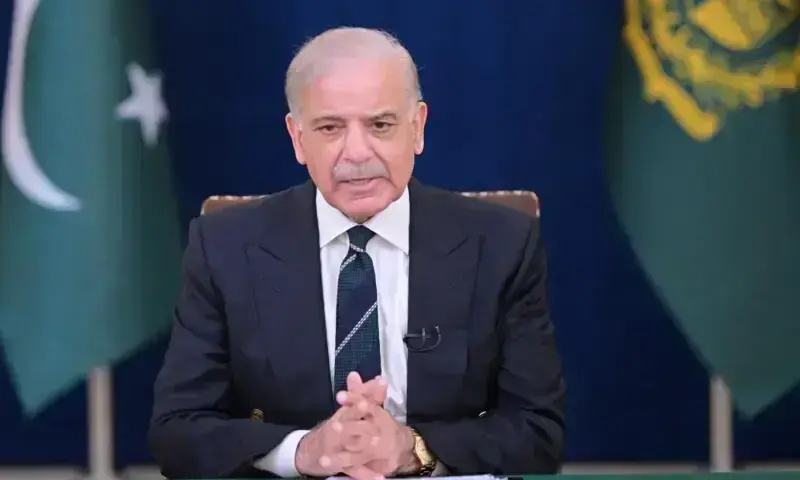
Prime Minister Shehbaz Sharif has termed Pakistan’s emergence as a key mediator between the US and Iran as a “shining moment in our history”, crediting the “political-military partnership” for the change in the country’s image internationally.
The premier made these remarks during an interview with The Sunday Times, as Islamabad remained engaged in efforts for de-escalation between the US and Iran.
“It’s one of the shining moments in our history. Pakistan is acknowledged worldwide as an honest mediator and as a country in which international leadership has full trust and faith. It’s our shining hour, and I feel a very proud Pakistani — as do 240 million Pakistanis,” he was quoted as saying in the interview published on Saturday night.
The PM’s expressed optimism even as military pressure and fears of renewed confrontation continue to shape the conflict that began with US-Israeli strikes on Iran in late February.
While a deal for a complete end to the war is yet to happen, hostilities have largely ceased since the two sides agreed on a Pakistan-brokered ceasefire on April 8. Following the ceasefire, a first round of historic direct US-Iran talks was held in Islamabad on April 11 and 12, with Pakistan playing the role of a mediator. The talks had ended without an agreement, but also without a breakdown.
With challenges in convening a second round, Islamabad continues its peace efforts. The latest development on this front is Interior Minister Mohsin Naqvi’s visit to Iran, where he has held meetings with Iranian President Masoud Pezeshkian and Parliament Speaker Bagher Ghalibaf.
Diplomatic sources said the visit was linked to Pakistan’s continuing efforts to revive the stalled Iran-US peace process after President Donald Trump rejected Tehran’s latest response to American proposals.
In his interview with The Sunday Times, PM Shehbaz said he was “hopeful” of a second round of direct talks between the US and Iran, leading to lasting peace.
“By a stroke of good luck, we have been placed in this prestigious position,” he said.
“Fortunately, Iran trusts Pakistan as does the US administration — and also the Gulf states — and I’m grateful to Presidents Trump and Pezeshkian for accepting our invitation,” he added.
The PM said Pakistan’s efforts for peace were ongoing, adding that “peace is never won easily”.
“You have to have patience, sagacity and ability to move things despite the most difficult challenges.
“As we speak, we’re still doing our best to ensure that this peace effort achieves a long-lasting peace through another session here in Islamabad, and we are hopeful that will happen,” he said.
He further noted, “Our international image has completely changed through this partnership of our political and military hierarchy.”
The premier went on to praise Chief of Defence Forces and Chief of Army Staff Field Marshal Asim Munir, saying: “What we are seeing is team efforts of the political and military leadership. I must acknowledge that the Field Marshal has played a critical role, which will be recorded in history.”
He also commended the efforts of Deputy Prime Minister and Foreign Minister Ishaq Dar, who he said had been “engaging his counterparts and making untiring efforts”.
He was also asked about recent border tensions between Pakistan and Afghanistan, and reports of civilians’ killing in Afghanistan in attacks by Pakistan — an allegation that Islamabad has denied.
In his reply, PM Shehbaz said, “Our country is facing an onslaught of terrorism again despite our best efforts — whether it’s from Kabul, the TTP, the BLA and other externally sponsored proxies.”
He added, “With Afghanistan, we had no other choice but kinetic action against terrorist hideouts and support infrastructure. We have lost hundreds of police and soldiers. What do you do? We sent peaceful messages to Kabul, telling them we have to stay neighbours forever, we share a boundary spanning over 2,000km and that if there is peace, there will be prosperity for both of us.
“Those messages have been conveyed to Kabul not once but dozens of times. Our only demand was that they commit not to let those terrorist outfits operate from Kabul.”
The PM further stated, “What should we do? Have lunch or dinner with them while our innocent people are being killed? It’s our unwavering commitment to wash the stigma of terrorism from the face of this country. It’s a war we are fighting not just for Pakistan but the world over.”