LAW: MEDIATION BEFORE LITIGATION
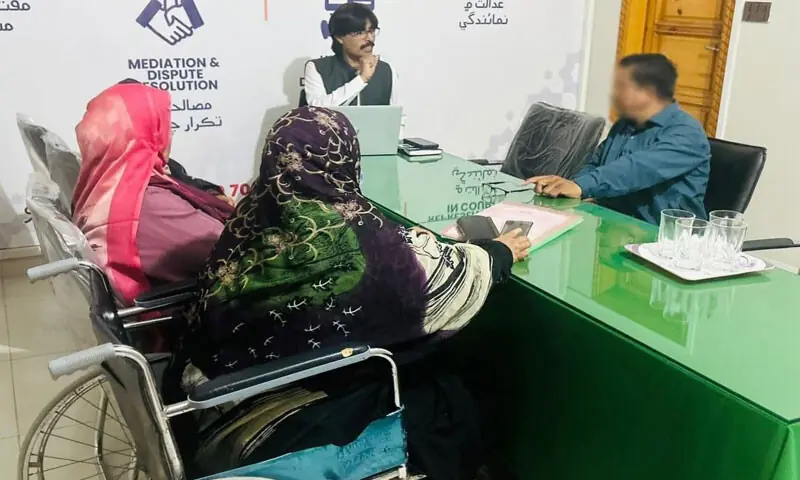
Farida had paid Rs1.9 million towards a flat worth Rs2.35 million when illness intervened. She could not clear the remaining dues and the builder cancelled the booking. But the refund that she was offered came to a fraction of what she had already paid.
Farida went to court. Four years passed. She won at trial, an appeal followed. Only later did the dispute reach mediation, where it was settled in four sittings. The relief was real. So was the thought that four years of litigation had not delivered what four sittings eventually did.
Farida’s case is not unusual. What is unusual is that it was eventually resolved.
By the end of June 2025, 2.27 million cases were pending across Pakistan’s courts — and the judiciary was operating with nearly 1,200 fewer judges than its own sanctioned strength. According to the Law and Justice Commission of Pakistan (LJCP), a statutory authority, 361,677 of the pending cases were in the superior courts and 1,908,907 in the district judiciary.
Pakistan does not need to invent mediation. It needs to stop treating it as a peripheral remedy and start using it early, before ordinary civil disputes are pushed into years of litigation
The Ministry of Law and Justice has itself acknowledged that civil disputes can take up to 15 years to conclude. A judiciary — particularly one dealing with such a backlog — cannot go on assuming that every civil dispute must begin, and often end, in full adversarial litigation.
A DIFFERENT ROUTE
Mediation offers a different route: a confidential process in which a neutral third party helps the parties reach a negotiated settlement — without imposing one. The parties remain free to settle or to walk away. Litigation decides rights through adjudication. Mediation tests whether a practical, lawful settlement can be reached sooner, and at lower human and financial cost.
The costs of delay are not confined to questions of humane justice. Prolonged civil disputes create uncertainty, complicate contracts and push small businesses away from legitimate claims. In such a setting, delay itself becomes an economic signal. It tells citizens and markets alike that resolution may come too late to matter.
Justice Mansoor Ali Shah, among Pakistan’s most senior jurists, makes the case directly: in commercial disputes, it makes the most commercial sense for companies to first exhaust mediation as a dispute resolution forum before jumping to arbitration and litigation. “With a global success rate of 70 percent on average, contracts must include a mediation clause,” he tells Eos.
But this requires behavioural change on behalf of companies and their legal counsels.
FRAMEWORK WITHOUT HABIT
Pakistan is not starting from nothing. The Alternative Dispute Resolution (ADR) Act is on the books. The ADR (Accreditation) Rules and the ADR Mediation Accreditation (Eligibility) Rules were both notified in 2023.
The Musaliha International Centre for Arbitration and Dispute Resolution (MICADR) currently has two stations — in Islamabad Capital Territory (ICT) and Karachi. Mediation already exists in Pakistani law. What it lacks is the habit of being tried early, in ordinary disputes, before litigation has hardened the parties and raised the cost of agreement.
Across much of Pakistan, mediation is still treated as something to be attempted after litigation has begun, positions have calcified and costs have escalated. Existing procedural space for settlement is not the same thing as a general rule favouring an early mediation attempt before the full machinery of trial is engaged.
The judiciary itself is beginning to take mediation more seriously. In April 2025, the Sindh High Court referred a company dispute to MICADR. The Islamabad High Court’s Mediation Practice Direction (Civil) Rules, 2023, gave fresh procedural shape to court-referred mediation, including referral without a suit.
MOVING OFF THE MARGINS
Slowly, this shift is visible beyond the larger cities. In April 2026, a family court in Sanghar sent a maintenance and restitution matter to the Justice Hub, an initiative of the Legal Aid Society to provide free legal support, mediation, referrals and institutional facilitation to vulnerable communities.
It might be a small example, but it carries weight: in places such as rural Sindh, the question is not only whether courts are willing to refer cases, but whether a local forum exists to receive them. In Sindh and ICT, the Justice Hubs now serve that role. None of this yet amounts to settled national practice. It does suggest that mediation is moving from the margins of the system into its working life.
Pakistan would not be moving into unfamiliar territory. Türkiye has required mediation as a precondition for filing certain employment and commercial disputes since 2018. In England and Wales, the courts have recently moved further in the same direction, and now hold the power to compel parties into mediation in lower-value civil claims. Neither model is a template to import wholesale. But both reflect the same underlying judgement: that an early settlement attempt is sound institutional design, not a soft alternative to adjudication.
Muhammad Shahzar Ilahi, a civil and commercial international mediator, argues for the compulsory integration of mediation into the legal system, drawing in part on Türkiye’s model, where civil and commercial disputes must first attempt out-of-court settlements. Properly designed, he says, such a system does not strip citizens of their legal rights; it simply requires parties to pass through a preliminary forum for settlement before entering the courtroom.
But procedure alone will not be enough. If mediation is to move from the margins into the mainstream, ADR will also have to be taken more seriously in legal education and professional training.
THE OBJECTIONS, ANSWERED
The strongest objection to mandatory mediation is voluntariness: if mediation is supposed to be a choice, can the law require it?
The answer lies in the distinction between process and outcome. The state cannot compel agreement, but it can require a genuine attempt. Parties may be required to attend an initial session and engage in good faith, without being forced to settle. The obligation is to participate in the process, not to surrender legal rights.
Not every case belongs in mediation, and any serious reform must say so plainly. Anything urgent — interim relief, restraining orders, applications that need immediate judicial attention — should go straight to court. So should cases shadowed by coercion or domestic abuse, where the imbalance between parties cannot be repaired in a settlement room. So should disputes that need a precedent, or whose consequences run beyond the parties themselves. A mediation-first regime has to be targeted and screened. It cannot be automatic.
There is an international commercial dimension as well. Pakistan signed the Singapore Convention on Mediation in May 2025 — a signal that it sees mediated commercial outcomes as worth defending abroad. The Convention covers international disputes, not domestic ones, and signature is not ratification. But the contrast with how casually mediation is still treated at home is difficult to miss.
The harder questions are operational, not conceptual. Does Pakistan have enough trained mediators? How will the quality be kept high? How to build public trust, case by case, in places that have seen too many false starts? These are valid concerns, but they are problems of design and oversight — not reasons to defer reform.
What follows from all this is not the replacement of courts, but a change in sequence. In defined categories of civil and commercial disputes, Pakistan should move towards an early mediation-first model — supported by trained neutrals, screened against the cases that don’t belong there, and backed by settlements the courts will enforce. The aim is plain enough. Make structured dialogue the ordinary first step, where settlement is realistically possible. Not a late-stage afterthought once years have already been lost.
Farida eventually got her relief. But justice delivered after years of exhaustion is not a model to celebrate. It is a warning.
A serious justice system should know which cases must be fought and which should first be tested through structured dialogue. Pakistan too often learns that distinction at the end of a case. It needs to learn it at the beginning.
**Name changed to protect privacy*
The writer is an advocate of the High Court and an accredited mediator of The Hague-based International Mediation Institute.
He can be reached at dasoomro@gmail.com
Published in Dawn, EOS, May 17th, 2026