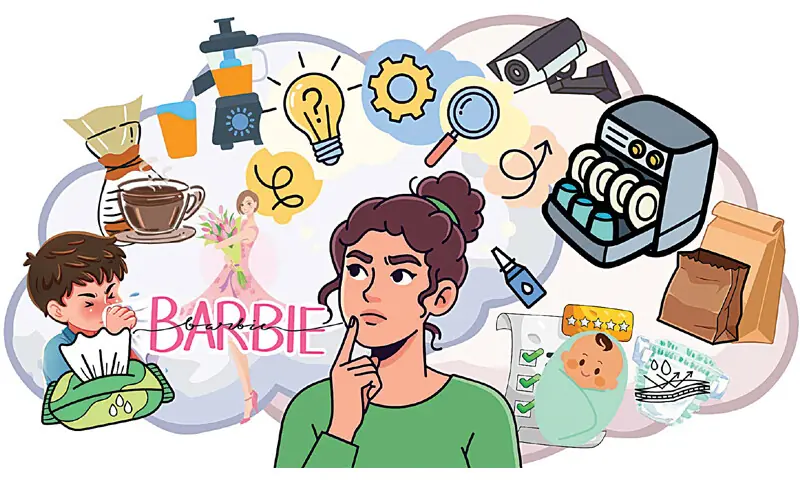

Mothers have always been holding things together at home. From cooking, cleaning and washing dishes to doing the laundry and the floors, her work never stops. It is simply expected as part of their everyday life.
But some mothers, while doing all of that, stopped and thought, ‘Why is this so hard?’ They figured out better way of doing things and built them not just for themselves, but for the whole world.
So today, we’re looking at a few such women who turned their daily frustrations into inventions that helped people all over the globe. The list is very long, so we are focusing on just a few due to limited space.
Between chores and chaos, some mothers paused, questioned and created solutions the world still uses today
Margaret Knight
Paper bag machine, 1870–71
Born in York, Maine, Margaret was just a child when her father died, and to keep the family going, she started working in a cotton mill. So Margaret grew up working around machines.
Years later, she got a job at a paper bag company. There, she observed workers fold bags by hand all day. She thought the tedious work could easily be done if there were a machine for this task. And thus, she built one herself!
However, her design was copied by a man who tried to patent it before she could. But Margaret proved it was hers in court.
Josephine Cochrane
The dishwasher, 1886
Washing dishes is a tedious task that is not only done repeatedly, but needs to be done carefully so that no glass or crockery breaks. But despite all care, breakage happens.
But for Josephine Cochrane, it was happening a little too often by her servants. She started thinking innovatively — what if the dishes didn’t have to be touched at all and water could still reach them and clean them? She started working on her plan and got her patent in 1886.
By 1893, she was at the World’s Fair in Chicago, and people loved her machine. After her death, her company was bought by KitchenAid and they still name her as one of their founders.
Melitta Bentz
The coffee filter, 1908
Melitta Bentz was frustrated by the remains of the coffee grounds at the bottom of the cup, leaving a bad taste. She decided to punch holes in a brass cup and lined it with a sheet of her son’s blotting paper, which resulted in the invention of the modern coffee filter.
Marie Van Brittan Brown
Home security, 1966–69
Mariewas a nurse and mother in Queens, NYC, a neighbourhood infamous for crime at the time. So instead of living in fear, she figured out a way to put cameras at different heights in her door so she could see whoever was standing outside.
She added a two-way microphone so she could talk to them without opening the door, and also installed a panic button that would alert the police directly.
Bessie Blount Griffin
Electric self-feeding apparatus (1948/1951)
Bessie, a nurse and physical therapist, worked with soldiers who had lost their limbs in World War II. She watched them struggle to do the simplest things, like eating.
Wanting to relieve their suffering, Bessie built a tube that a patient could bite down on and food would come through right to their mouth. No hands were needed.
She patented it and took it to the American government. They passed the patent, but didn’t allow the production of the device. She then gave it to France, and it was manufactured there.
Bette Nesmith Graham
Correction fluid/liquid paper, 1951
A secretary at a bank, Bette and the other secretaries often made mistakes while using the newly-introduced electric typewriter. The mistakes couldn’t be erased so Bette came up with a simple formula inspired by painters.
She mixed a white liquid in her kitchen blender and created liquid paper corrector. She put it in a nail polish bottle, brought it to work and used it whenever she made a mistake.
Mindee Hardin
Boogie Wipes, 2007
Mindee and her partner Julie Pickens formed a company and created Boogie Wipes — saline-moistened tissues that mums use so their sick kids can avoid a raw nose during the cold season.
The business grew, got acquired and then things fell apart, resulting in bankruptcy, postpartum depression and an eating disorder during those years. Then Mindee picked herself back up and started helping other mothers do what she had done.
Madeline M. Turner
Fruit press, 1916
With the desire to improve the time-consuming process of manually squeezing citrus fruits for juice, Madeline M. Turner designed a machine with a feed opening, cutting blades that split the fruit and opposing plungers that pressed the juice out cleanly.
Dr Virginia Apgar
Apgar score, 1952
Dr Virginia was an anaesthesiologist who worked in delivery rooms. She was concerned that there was no proper system, or consistent way to check if a newborn was actually healthy right after birth. Babies were just assumed to be fine unless something was visibly wrong.
So, she wrote five ‘must-check’ signs: breathing, heart rate, colour, reflexes and muscle tone. This became a 10-point Apgar score to assist physicians and nurses in assessing the status of newborns.
Marion Donovan
Waterproof diaper cover, 1946
Babies have been born forever, but diapers as we know them weren’t always around. Every culture had its own way of handling it, and none of those ways were perfect or pleasant.
Like all mothers, Marion Donovan went through cleaning her baby’s soiled clothes, sheets and diapers. So out of frustration, she pulled down a shower curtain, cut and sewed it accordingly. That first rough version eventually became a proper cover made from parachute cloth, with a breathable design that didn’t give babies rashes.
She was not taken seriously by any manufacturer. She sold it herself and later came up with a fully disposable diaper, only to be rejected again. It took the industry another ten years to catch up to what she had already figured out.
Ruth Handler
The Barbie doll, 1959
Ruth Handler notice her daughter, Barbara, ignored her baby dolls to play make-believe with paper dolls of adult women. Handler realised the need for a toy that allowed little girls to imagine the future.
In 1959, Barbie was introduced to the world at the American Toy Fair in New York. Ruth named her after her daughter Barbara, and Ken, the male doll, after her son.
Published in Dawn, Young World, May 9th, 2026