KARACHI: Journalists, politicians and rights activists on Sunday marked World Press Freedom Day with a strong call for an end to censorship, repeal of restrictive laws including the Prevention of Electronic Crime Act (Peca) and urgent measures to protect media workers.
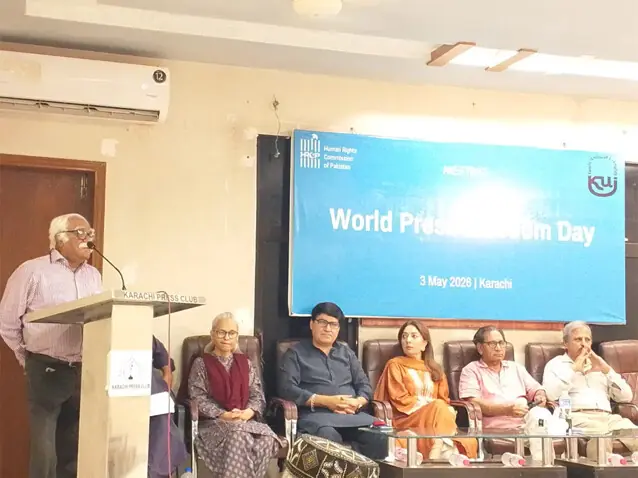
A seminar jointly organised by the Karachi Union of Journalists (KUJ) and the Human Rights Commission of Pakistan (HRCP) here at the Karachi Press Club adopted a comprehensive resolution highlighting the worsening state of press freedom in Pakistan.
The speakers included PPP leader Sharmila Farooqui, academic Dr Tauseef Ahmed, KUJ President Tahir Hassan Khan, senior journalist Mazhar Abbas, labour leaders Habibuddin Junaidi, Nasir Mansoor and Zehra Khan.
The speakers noted that this year’s World Press Freedom Day is being observed in Pakistan under “extremely inimical conditions,” not only for journalists but also for citizens seeking to exercise their constitutional rights to freedom of expression and access to information.
At World Press Freedom Day seminar, speakers propose five-year tax exemption for media houses, provision of soft loans; demand new wage award
The resolution adopted at the seminar demanded that the government and its institutions immediately halt censorship and harassment of journalists.
It stated that fears long expressed by media professionals following the introduction of Peca have materialised, with the law allegedly being misused to intimidate journalists and suppress independent reporting.
Calling for the repeal of Peca, the participants stressed that such legislation undermines democratic norms and discourages accountability.
The speakers criticised what they described as the growing use of state power —both security-related and economic— to weaken the media sector. It pointed to layoffs, delayed or unpaid salaries, and job insecurity as factors that have significantly eroded the strength of the country’s “fourth estate.”
To address the financial crisis faced by media organisations, the seminar proposed a comprehensive bailout package. Suggested measures included a five-year tax exemption for media houses, provision of soft loans, concessional electricity tariffs and duty-free import of equipment.
The speakers said such steps are essential given the lack of a strong business environment to sustain media through advertising revenue.
The resolution also urged political parties and lawmakers to take up the issue during upcoming budget sessions, calling for immediate policy interventions to safeguard journalists’ livelihoods.
Among key demands was the announcement of a new Wage Award for newspaper employees, taking into account the sharp rise in inflation since the last revision.
Participants further called for the development of a similar regulatory framework to ensure minimum wages and a structured service system for employees in electronic and digital media sectors, which currently lack uniform protections.
Concerns were also raised about internal practices within media organisations. The reso for the development of a similar regulatory framework to ensure minimum wages and a structured service system for employees in electronic and digital media sectors, which currently lack uniform protections.
Concerns were also raised about internal practices within media organisations. The resolution highlighted the need to prevent diversion of government advertisement revenues away from workers’ welfare and criticised disparities in salary structures, where a few officials receive disproportionately high compensation while many employees face financial hardship.
Another issue flagged during the seminar was the absence of legal safeguards for employees during mergers, acquisitions or closures of media organisations. Participants stressed the importance of legislation to protect workers’ rights in such situations, ensuring job security and fair compensation.
The speakers reaffirmed their commitment to defending press freedom and democratic values. They urged all stakeholders, including government institutions, political parties and civil society, to recognise the central role of a free press in ensuring accountability and protecting citizens’ rights.
The seminar ended with a renewed pledge by participants to continue advocating for an independent and secure media environment in Pakistan, despite the challenges.
Published in Dawn, May 4th, 2026