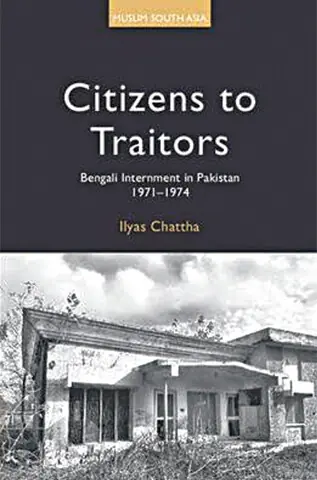
From Citizens to Traitors: Bengali Internment in Pakistan, 1971–1974
By Ilyas Chattha
Cambridge University Press
ISBN: 978-1009568241
330pp.
At its core, From Citizens to Traitors advances a stark and unsettling argument: in the aftermath of Pakistan’s defeat and dismemberment in 1971, the Pakistani state systematically transformed tens of thousands of its own former citizens into rightless internal enemies through the bureaucratic machinery of mass internment.
Ilyas Chattha demonstrates that the incarceration of over 80,000 Bengalis in West Pakistan between 1971 and 1974 was not an administrative aberration or wartime excess, but a calculated exercise of sovereign power — one that suspended citizenship, criminalised ethnicity and instrumentalised human lives as diplomatic leverage. By foregrounding the internment of Bengalis as a constitutive, rather than marginal, episode of the 1971 crisis, Chattha compels a rethinking of state violence, belonging and postcolonial citizenship in South Asia.
The book intervenes in a historiographical landscape long structured by silences. While the Bangladesh Liberation War has been extensively examined through the lenses of genocide, nationalism and international diplomacy, the reciprocal captivity that followed — Pakistani prisoners of war in India and Bengali civilians in Pakistan — has remained largely absent from scholarly and public memory. Chattha identifies this absence not as accidental but as politically produced.
The internment of Bengalis became a “non-event” precisely because it destabilised foundational narratives in both successor states: Pakistan’s self-image as a Muslim homeland premised on unity, and Bangladesh’s liberation narrative centred on heroic resistance. By excavating this buried history, the book performs a dual task: it reconstructs a forgotten crisis of captivity and explains the conditions that rendered it historiographically invisible.
A book of rare moral clarity and scholarly courage excavates the internment of over 80,000 Bengalis in Pakistan after the secession of East Pakistan and forces a rethinking of belonging and citizenship in postcolonial South Asia
Methodologically, From Citizens to Traitors is distinguished by its breadth and originality of sources. Drawing on hitherto unused state archives, Red Cross records, vernacular newspapers, literary writings, and extensive interviews with former internees and their families, Chattha assembles a granular account of life inside the camps scattered across Kohat, Mianwali, Harappa, Qadirabad, Zhob, Fort Sandeman and Chak Daulat.
This archival depth allows the author to move seamlessly between the macro-level logic of the state and the micro-level experiences of suffering bodies. The camps emerge not merely as sites of confinement, but as spaces where racialisation, humiliation and denaturalisation were routinised through bureaucratic procedures.
One of the book’s most powerful contributions lies in its conceptual framing of internment as a form of non-judicial punishment imposed on “internal others.” Bengalis were not detained for acts committed but for what they represented: a reminder of defeat, betrayal and the fragility of Pakistan’s national project.
Through directives that categorised Bengali civil servants as “white”, “grey” or “black”, and through questionnaires that forced impossible choices between East and West Pakistan, the state reduced citizenship to a revocable status, contingent on loyalty as defined by the regime. In this sense, Chattha’s work resonates with broader theoretical debates on sovereignty, exception and statelessness, echoing but also extending the insights of scholars such as Hannah Arendt and Giorgio Agamben into a postcolonial context.
The book intervenes in a historiographical landscape long structured by silences. While the Bangladesh Liberation War has been extensively examined through the lenses of genocide, nationalism and international diplomacy, the reciprocal captivity that followed — Pakistani prisoners of war in India and Bengali civilians in Pakistan — has remained largely absent from scholarly and public memory. Chattha identifies this absence not as accidental but as politically produced.
The empirical chapters documenting camp life are among the most harrowing in recent South Asian historiography. Overcrowding, disease, starvation, sexual violence and racial abuse were not incidental but systemic. Women’s testimonies, in particular, reveal how gendered violence functioned as a tool of domination and erasure. The camps institutionalised what Chattha aptly describes as racial violence under bureaucratic logic, stripping internees of legal protections while cloaking abuse in administrative normalcy.
The effect is devastating: former citizens reduced to hostages, bargaining chips in negotiations over Pakistani POWs held in India. The moral inversion, exchanging soldiers for civilians, stands as one of the most disturbing legacies of the period.
Crucially, the book does not end with repatriation. Chattha traces the afterlives of internment, showing how return to Bangladesh often brought not recognition but suspicion, neglect and stigma. Repatriated officers and professionals found themselves labelled as “repatriates” rather than freedom fighters, excluded from pensions, promotions and symbolic belonging. In revealing this double abandonment, the book exposes the fragility of nationalist solidarities and the ease with which states disown inconvenient populations. Identity, Chattha suggests, is not a stable inheritance but a revocable grant of power.
The novelty of the book lies precisely in this reframing of 1971 through the lens of internment and denaturalisation. By situating Bengali internment within global histories of confinement and encampment, Chattha elevates the South Asian experience into comparative perspective, making the book relevant well beyond regional studies.
If there is a tension in the book, it lies not in its argument but in its emotional weight. The relentless accumulation of suffering risks overwhelming the reader, yet this is also the source of its ethical force. Chattha refuses the comfort of abstraction. Instead, he insists that theory remain tethered to lived experience, to malnourished children clutching pens, to women giving birth under torchlight, to citizens rendered disposable by the very state they once served.
Ultimately, From Citizens to Traitors is more than a recovery of a forgotten episode; it is an indictment of modern statecraft. It forces readers to confront unsettling questions. Who decides loyalty? How easily can citizenship be withdrawn? And what remains of the individual when both homeland and nation refuse recognition?
In recovering South Asia’s “ghost citizens”, Ilyas Chattha has produced a work of rare moral clarity and scholarly courage. The wound he opens — of exclusion, betrayal and silence — refuses to heal, and nor should it.
The reviewer is professor of liberal arts at Beaconhouse National University, Lahore
Published in Dawn, Books & Authors, May 3rd, 2026