iPhones, Androids set to get costlier after new valuation
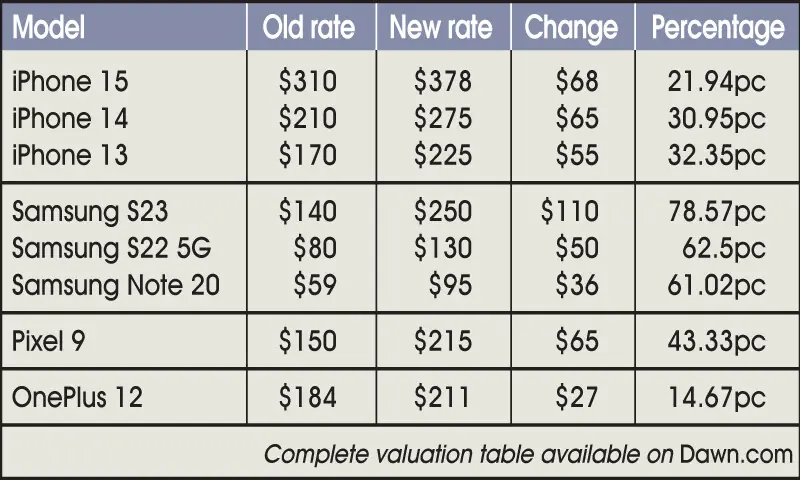

• FBR increases customs values for 62 older, used handset models
• Says move aims to align values with market prices
ISLAMABAD: The Federal Board of Revenue’s (FBR) Directorate General of Customs Valuation has increased the customs value for 62 models of older and used mobile phones, saying the move was aimed at aligning assessed values for duty and tax purposes with prevailing market rates, it emerged on Thursday.
The development comes after senior FBR officials had assured a National Assembly parliamentary committee last week that mobile phone rates would be reduced in the upcoming budget.
The directorate issued the revised benchmarks through the Valuation Ruling No. 2070 of 2026 on Thursday, replacing the earlier Ruling No. 2035 issued in January. Ahead of finalising the revised values, the directorate also held a meeting with relevant stakeholders on April 13.
The new valuation will apply to imports of old and used mobile phones in commercial quantities without packing or accessories.
According to the data, the sharpest upward increase was recorded in Google Pixel and Samsung models, indicating that the new ruling significantly revised values that were relatively lower in the previous schedule. Apple devices also saw increases across most models, though the revisions remained comparatively moderate, particularly for newer flagship variants.
In regulatory terms, it preserved the earlier framework on six-month activation, higher declared value and freight adjustment.
The revision comes against the backdrop of a sharp rise in handset imports, which grew by 28 per cent to $1.44 billion during the first nine months (July to March) of the current fiscal year compared to $1.129bn a year ago.
This higher customs values means higher duty and tax incidence per handset. The burden is likely to be most pronounced in models with a very large percentage jump, such as older Samsung and Google Pixel devices.
Importers dealing in second-hand, mid-range and older flagship phones will see sharper cost escalation than traders in new Apple flagship phones. The FBR is also likely to raise its revenue owing to an across-the-board increase in the value of all mobile sets.
The comparison of the data in the two rulings showed that Apple devices experienced steady increases, particularly in mid-range and older models. However, the increase is uneven.
Recent premium models, such as the iPhone 15 Pro Max, rose only 9.8pc, while some older and cheaper models rose sharply, including the iPhone SE 2 and the original SE. The two models with no change are iPhone XS Max and iPhone SE 3, which stand out as the most stable Apple valuations across both rulings.
Samsung has recorded one of the steepest upward increases in values. The most striking jumps were recorded in older but still marketable premium and upper mid-range devices, such as the Galaxy S22+ 5G, S21+ 5G, S21 5G, and S10 series.
The Galaxy S23 Ultra increased only 19.6pc, which is modest relative to the overall Samsung basket.
That pattern suggests that the earlier ruling may have undervalued non-flagship and slightly older Samsung models more, while the very top flagship was already closer to customs’ new valuation rates.
Google Pixel showed the highest average increase of all major brands. The steepest revaluation increases were concentrated in the Pixel 5, 5A, 6, and 6A lines, with increases ranging from 161pc to nearly 194pc.
That scale of upward revision was too large to be seen as a minor update. It pointed to a substantial reassessment of customs value in the resale market for used Pixel devices.
By contrast, the Pixel 8 Pro and 8A changed only modestly, suggesting that the January ruling was closer to the later benchmark for newer Pixel models than for older ones.
The values of all brands rose, but the changes were smaller than those for Samsung and Google Pixel on average. The OnePlus 12 increased only 14.7pc while the OnePlus 12R and 10Pro rose much more.
This suggests that the revision particularly tightened values for performance-oriented older or secondary flagship variants. Valuation rulings issued under Section 25A of the Customs Act, 1969, serve as administrative instruments for fixing customs values where routine declared values are not considered reliable enough for uniform assessment.
The rulings provide benchmark C and F values for assessment of duty and taxes, reduce valuation disputes at the clearance stage, and guide collectorates on how to treat specified goods in commercial quantities.
Published in Dawn, April 24th, 2026