Lebanon restores lifelines as Israel extends demolition
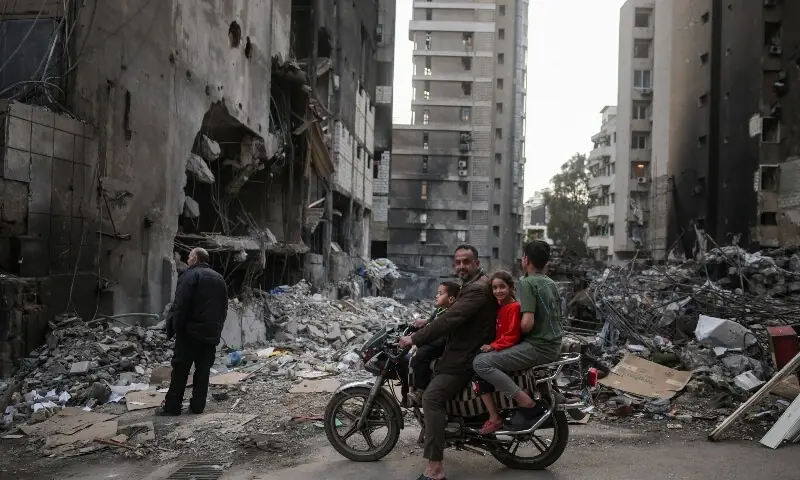
• Beirut reopens vital Qasmiyeh bridge, road linking the south after strikes
• Israel pushes deeper, mapping buffer zone inside Lebanese territory
BEIRUT: Lebanon’s military announced on Sunday it had reopened a key road and bridge destroyed by Israeli strikes in the country’s south, a crucial step for civilians even as a fragile 10-day truce is undermined by continued Israeli occupation and demolitions.
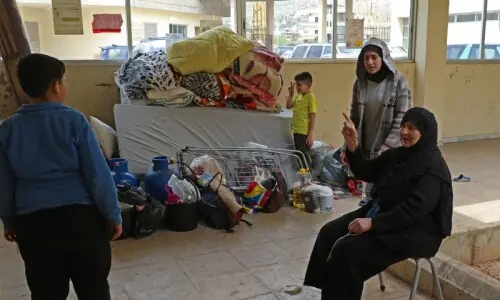
The conflict, which escalated on March 2, prompted an Israeli offensive that killed more than 2,100 people, including 177 children, and forced over 1.2 million to flee, Lebanese authorities say. Including all casualties, nearly 2,300 people have been killed.
Lebanon’s military said it “fully reopened” a road linking Nabatieh with the Khardali area and “partially reopened the Burj Rahal-Tyre bridge.”
“Work is also underway to rehabilitate the Tayr Falsay-Tyre bridge … following damage caused by the Israeli aggression,” the army added.
Israeli strikes on bridges crossing Lebanon’s Litani River, which flows about 30km north of Israel, largely cut off the area south of the waterway.
The vital Qasmiyeh bridge reopened, allowing displaced residents to check on property. However, many remained hesitant to venture back with the truce’s longevity uncertain.
An AFP correspondent in the southern city of Sidon saw heavy traffic heading to Beirut as displaced southerners returned to temporary homes and shelters in the capital after briefly visiting southern areas.
As civilians navigate the destruction, the Israeli military published a map on Sunday of its new deployment line inside Lebanon, bringing dozens of mostly abandoned Lebanese villages under its control.
The line runs 5km to 10km deep from the area where Israel plans to create a buffer zone, while Israel also established a “Yellow Line”, similar to one in Gaza.
Also, Israeli forces carried out demolitions in the southern Lebanese town of Bint Jbeil, a scene of intense fighting prior to the truce.
“The Israeli enemy is repeating its house detonating operations in the town of Bint Jbeil,” Lebanon’s state-run National News Agency said on Saturday.
Lebanese Defence Minister Michel Menassa decried the plans as evidence of an intention to “forcibly displace hundreds of thousands of citizens, and systematically destroy villages.”
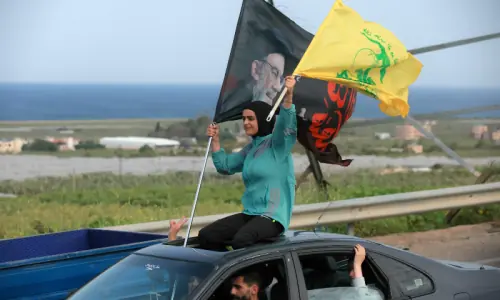
Despite the US-backed ceasefire taking effect on Friday after the first direct talks between the sides in decades, tensions remain high.
Hezbollah official Mahmud Qamati warned, “Israeli treachery is expected at any time, and this is a temporary truce.”
“Take a breath, relax a little, but do not abandon the places you have taken refuge in until we are completely reassured about your return,” Qamati said.
Underscoring the pause fragility, Israel’s military said a soldier, Lidor Porat, was killed during combat in southern Lebanon. Israeli Defence Minister Israel Katz said the military was instructed to use “full force” in Lebanon, even during the ceasefire, if troops face threats. “Prime Minister Benjamin Netanyahu and I have instructed the IDF to act with full force, both on the ground and from the air, including during the ceasefire, in order to protect our soldiers in Lebanon from any threat,” Katz said in the occupied West Bank.
He said that homes on the border “exploited by Hezbollah” would be demolished and that “any structure threatening our soldiers and any road suspected of explosives must be immediately destroyed”.
Diplomatically, French President Emmanuel Macron will meet Lebanese Prime Minister Nawaf Salam in Paris on Tuesday. The visit highlights Macron’s commitment to seeing “full and complete respect for the ceasefire in Lebanon” and France’s support for Lebanon’s “territorial integrity”, his office said Sunday.
The meeting follows an attack on UN peacekeepers that left one French soldier dead and three wounded. Macron will urge Lebanese authorities to “shed full light on the incident” and “identify and prosecute those responsible without delay”, his office added.
Published in Dawn, April 20th, 2026