0
0

• Aurangzeb says fresh funds to be disbursed within a week
• Insists govt exploring bilateral borrowing, commercial loans, Eurobonds
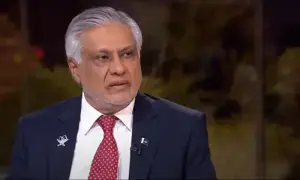
WASHINGTON: Saudi Arabia has committed an additional $3 billion in deposits for Pakistan and extended its existing $5bn facility for three years, Finance Minister Muhammad Aurangzeb announced in Washington.
Briefing journalists at the Pakistan Embassy on Tuesday evening, Mr Aurangzeb said the Saudi support provides a major boost to the country’s external financing position. The minister, who is in Washington to attend the IMF-World Bank Spring Meetings, said the fresh $3bn deposit would be disbursed in the coming week.
He described the support as “timely and critical for strengthening Pakistan’s foreign exchange reserves and reinforcing its external account”.
The announcement follows detailed discussions with Saudi Finance Minister Mohammed bin Abdullah Al-Jadaan, who is also in Washington for the annual meetings.
Mr Aurangzeb said he had also met the Saudi minister in Islamabad the previous Friday, but the government had refrained from commenting publicly until formal communication and a joint understanding were in place.
Under the new arrangement, the existing $5bn Saudi deposit — previously subject to annual rollovers — has been extended until 2028, providing longer-term certainty to Pakistan’s external financing framework.
The finance minister reiterated that Pakistan remains committed to maintaining foreign exchange reserves in line with market obligations and the programme agreed with the International Monetary Fund (IMF).
He said the government aims to build reserves to around $18bn by the end of the current fiscal year, equivalent to roughly 3.3 months of import cover. Highlighting Pakistan’s recent external payments performance, Mr Aurangzeb noted that the country repaid its $1.4bn Eurobond last week, describing the transaction as a “non-event due to smooth execution”.
He reaffirmed that Islamabad is fully “committed to meeting all upcoming maturities on time and implementing its external financing plan in a disciplined manner”.
The minister said he held meetings in Washington along with the governor of the State Bank of Pakistan and Pakistan’s ambassador to the United States. He expressed gratitude to Saudi Arabia’s leadership, particularly Crown Prince Mohammed bin Salman, as well as Finance Minister Al- Jadaan and the Saudi vice finance minister, for their continued support.
He also acknowledged the role of Pakistan’s leadership in securing and operationalising the arrangement. Referring to his engagements during the meetings, Mr Aurangzeb said Pakistan was receiving strong appreciation from international financial institutions, including the IMF and the World Bank, as well as institutional investors.
He said international counterparts were particularly recognising Pakistan’s recent diplomatic efforts in facilitating dialogue between parties that had not held face-to-face discussions for decades.
The minister said the improved sentiment, combined with Saudi financial backing, would provide positive momentum for the economy and support Pakistan’s commercial market access efforts.
He noted that Pakistan was advancing its broader external financing agenda, including the recently announced Global Medium-Term Note programme and preparations for its inaugural Panda bond issuance, aimed at diversifying funding sources.
Mr Aurangzeb also reaffirmed the government’s commitment to macroeconomic stability, reform continuity and sustained engagement with bilateral and multilateral partners, adding that a more detailed briefing would be given at the conclusion of the visit.
In statements issued earlier on Tuesday, the finance minister said Pakistan was exploring multiple financing options, including bilateral borrowing, commercial loans and Eurobonds, to stabilise its foreign exchange reserves after the UAE asked for repayment of a $3.5bn loan. The development comes at a sensitive time for the country’s external account position, which is already under strain from rising global oil prices and economic spillovers linked to tensions in the Middle East. According to official figures, Pakistan’s foreign exchange reserves stood at $16.4bn as of March 27, sufficient to cover close to three months of imports. However, the repayment requirement from the UAE has added fresh pressure on the country’s external buffers.
Earlier this month, Pakistan failed to secure an agreement with the UAE to roll over the $3.5bn facility, marking the first such failure in seven years and raising concerns about near-term financing gaps.
In remarks to Bloomberg and Reuters on the sidelines of the IMF-World Bank Spring Meetings in Washington, Mr Aurangzeb said Pakistan was keeping “all options on the table” to manage external financing needs.
These options include Eurobonds, commercial borrowing and loans from friendly countries. Mr Aurangzeb acknowledged that the $3.5bn UAE debt repayment added to the pressure the country was already facing. He said the external shock from the ongoing Middle East conflict had also forced policymakers to reconsider energy security strategies.
He suggested Pakistan may consider establishing a strategic petroleum reserve and accelerating its transition to renewable energy sources.
“The shock from the ongoing war in the Middle East means we must consider structural changes,” he said, adding that energy diversification is now part of Pakistan’s macroeconomic planning.
Published in Dawn, April 16th, 2026