Entire country can be taken out in one night: Trump
• US president renews threat, asserting no change in 8pm deadline
• Iran rejects 45-day ceasefire proposal, forwarded through intermediaries
• Says framework doesn’t address core concerns
• Demands ‘permanent cessation’ of hostilities, lifting of sanctions, funds for damages
• Insists on a protocol to regulate navigation through Hormuz; end to what it described as ‘wider regional hostilities’
ISLAMABAD: US President Donald Trump on Monday threatened to entirely decimate Iran in one night, possibly as early as Tuesday, after Tehran rejected a ‘ceasefire’ proposal and instead set out demands for returning to negotiations.
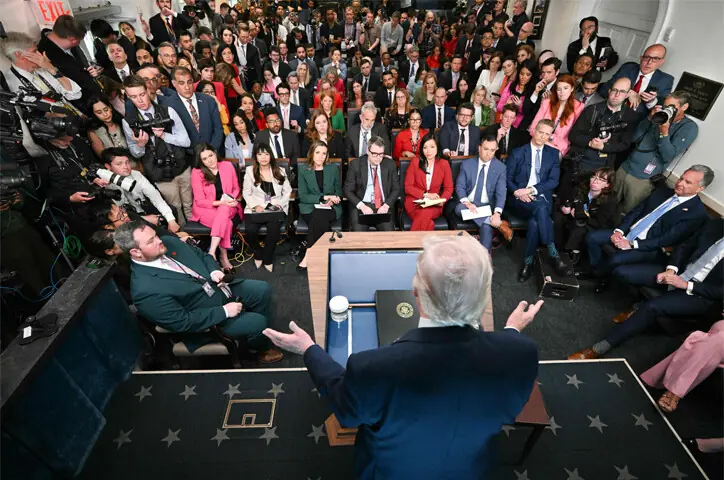
“The entire country could be taken out in one night, and that night might be tomorrow night,” Trump told a White House press conference, underscoring that the 8pm Tuesday deadline he had set for Iran to make a deal and reopen the Strait of Hormuz was final.
He said Washington had given Tehran an opportunity to respond but was prepared to escalate if no agreement was reached.
US officials, even before Trump’s press conference, had described Iran’s latest response as “maximalist” and indicated that the administration was unlikely to extend the deadline again.
War Secretary Pete Hegseth also warned that the scale of military action was set to increase. “Today will be the largest volume of strikes since day one,” he said, adding that operations would intensify further if required.
The threats came as Iran formally rejected a 45-day ceasefire proposal that had been put forward amid a renewed diplomatic push by Pakistan and Egypt to halt hostilities and open space for negotiations. The proposal envisaged a temporary truce followed by structured talks on a broader settlement.
Tehran, however, insisted on a permanent end to the war and framed its position as a response to an earlier US proposal developed after two weeks of internal deliberations.
Iranian officials said the terms conveyed by the US were difficult to accept and did not address core concerns.
According to officials familiar with the response, Iran conveyed a 10-paragraph reply through Pakistan, which has been acting as a key intermediary between Washington and Tehran.
Iranian Ambassador Reza Amiri Moghadam met Deputy Prime Minister and Foreign Minister Ishaq Dar late Monday to deliver the response.
The Iranian response called for a permanent cessation of hostilities, lifting of sanctions, and funds for reconstruction in the form of war reparations. It also sought the establishment of a protocol to regulate the movement of ships through the Strait of Hormuz and an end to what it described as wider regional hostilities.
Iran’s position reflected longstanding concerns in Tehran about the durability of temporary arrangements and deep mistrust of US intentions. Officials there have argued that a short-term ceasefire without broader guarantees could lead to a recurrence of hostilities.
The latest exchange took place against the backdrop of an intensifying conflict that has entered its sixth week, with strikes expanding to energy infrastructure, the industrial sector and maritime routes.
Despite efforts by Pakistan, supported by a number of countries, particularly China, the gap between US and Iranian positions remains wide.
‘Immediate versus lasting’
Washington is pressing for an immediate ceasefire and reopening of shipping lanes, while Tehran is linking any pause in fighting to a broader settlement that addresses sanctions, reconstruction, security guarantees and a simultaneous cessation of hostilities in all theatres.
The stalemate reflects structural differences, with both sides appearing to believe they hold the upper hand in the conflict.
Analysts say escalation by US and Israel is unlikely to produce a decisive outcome and could instead trigger more intense Iranian retaliation across the region, particularly against energy infrastructure and US partners, aggravating the energy and supply chain crisis.
The US therefore faces a dilemma between a negotiated settlement, which would require concessions that may be politically difficult, and further escalation, which risks a prolonged conflict with uncertain outcomes.
Published in Dawn, April 7th, 2026