AI is rewiring the world’s most prolific film industry


 0
0
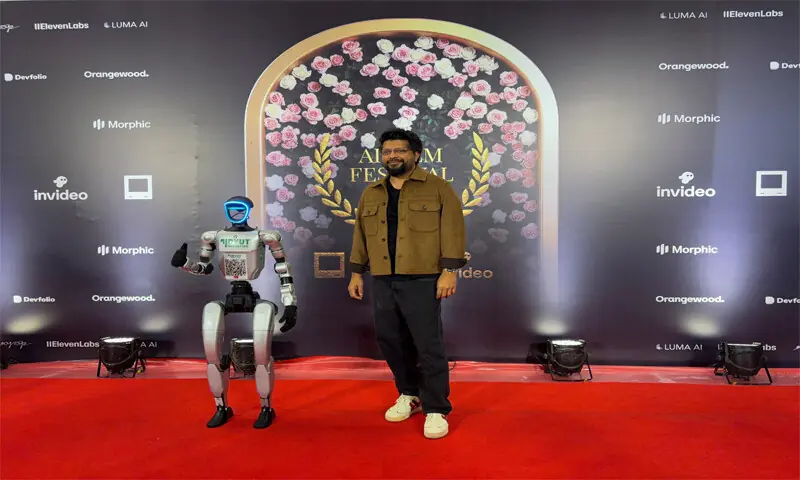

BENGALURU: Welcome to the new-look movie set, where the quiet hum of a coding floor has replaced the cacophony of cameras, clapperboards and shouted directions.
The Collective Artists Network, a top talent agency for Bollywood A-listers, has long brokered the careers of real-life superstars. Now, its engineering digital ones. In its Bengaluru premises, filmmakers use artificial intelligence tools to create content based on Hindu mythology a popular genre in India.
One movie, based on the religious text Ramayana, has a scene showing the god Hanuman flying while carrying a mountain. A show based on a separate ancient epic, Mahabharat, features a sequence depicting the princess Gandhari, who blindfolded herself upon marrying a blind king.
India produces the most movies of any country, and stars such as Shah Rukh Khan and Amitabh Bachchan command cult-like followings. But shifting audience habits, including the rise of streaming, are squeezing production budgets, many industry players say. The number of moviegoers fell to 832 million in 2025 from 1.03 billion in 2019, according to consulting firm Ormax Media. While box-office sales hit a record $1.4 billion last year, revenue has been choppy since the pandemic and reliant on a handful of hits and pricier tickets.
Studios in India are responding by deploying AI at a scale unseen elsewhere: creating full-fledged AI-generated films; using AI dubbing to release movies in numerous languages; and recutting endings of older titles to eke out additional sales. In the process, they are reshaping the economics of filmmaking, compressing production timelines, and pitting AI-driven efficiency against a recurring problem: Audiences have often reviewed AI content harshly, even when it sells.
AI is slashing production costs to one-fifth of what they used to be for traditional filmmaking in genres such as mythology and fantasy, said Rahul Regulapati, who heads Collectives AI studio, known as Galleri5. And production time? Down to a quarter, he said.
The approach differs from Hollywood, where union contracts and fears of job displacement have constrained studios use of the technology. In India, at least one major production house is reviewing its entire library for AI re-releases, and Google , Microsoft and Nvidia have made early bets by partnering with local filmmakers. Previous reporting has explored how Indian filmmakers are harnessing AI, and India’s divergence with Hollywood.
American and British studios have experimented with AI filmmaking producing the first full-length AI animated features in 2024 and an AI-powered immersive version of The Wizard of Oz last year. But the ambitions of India’s filmmakers are on a different level, said Dominic Lees, a film and AI researcher at Britain’s University of Reading. If they can deliver, then the shift in AI filmmaking will be to India, he said. The pivot to AI reflects India’s embrace of the technology broadly.
Vikram Malhotra, founder of Abundantia Entertainment, said the Bollywood production house, which recently announced investment in an $11 million AI studio, is building its AI capability from scratch and expects content generated or assisted by AI to account for one-third of its revenue within three years.
Last year, India’s Eros Media World re-released a 2013 hit, Raanjhanaa, with an AI-altered twist. It replaced a tragic ending, in which the protagonist died, with a happier finale where he opens his eyes to the surprise of his lover, who smiles through tears.
The rewrite drew backlash. Dhanush, the lead actor, who goes by one name professionally, said on X that the AI remake had stripped the film of its very soul and set a deeply concerning precedent for both art and artists.
Still, the re-release of Raanjhanaa drew audiences. India’s largest cinema chain, PVR Inox, said that 35pc of available tickets to the Tamil-language version of the movie were sold during its release month, August. That was 12 percentage points higher than the average in 2025.
Published in Dawn, April 5th, 2026