KP faces fiscal constraints due to ‘missing’ constitutional funds: CM
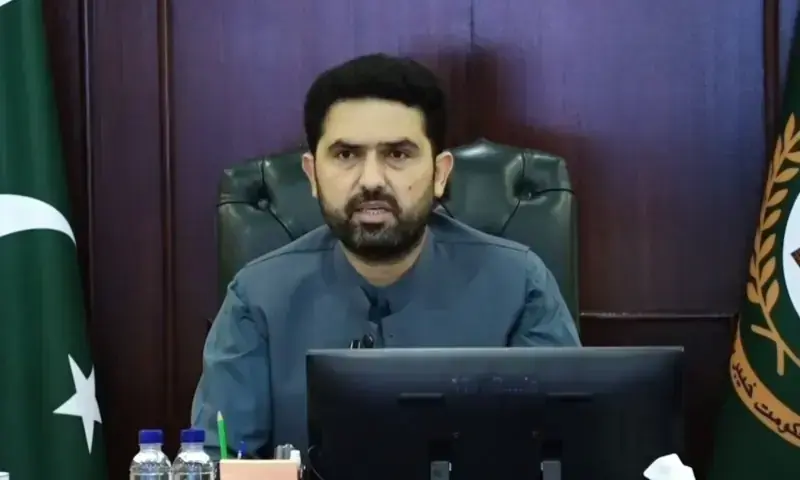

PESHAWAR: Khyber Pakhtunkhwa Chief Minister Sohail Afridi on Wednesday complained that the province faced systemic fiscal constraints due to the non-provision of constitutional funds by the Centre.
“The constitutionally mandated transfers under both the heads of the National Finance Commission Award and net hydel profit remain outstanding, placing additional pressure on our [provincial] finances,” Mr Afridi told a news conference at KP House in Islamabad.
He outlined the province’s position on terrorism, fiscal federalism, federal policy alignment and the prevailing constitutional and political landscape, according to an official statement.
The chief minister said that his engagements in recent meetings with the federal government’s representatives were guided by the singular objective of advocating for the constitutional and financial rights of the people of the province.
Afridi outlines province’s position on terrorism, fiscal federalism, federal policy alignment
He said despite the administrative merger of Fata with KP, the corresponding fiscal integration remained incomplete.
Mr Afridi said that since 2018, resource distribution under the NFC Award had not aligned with constitutional provisions, effectively resulting in an inequitable allocation framework.
He said that the provincial government had proactively advanced a policy framework, aligned with the vision of PTI founder Imran Khan, for addressing the root causes of terrorism.
“While this framework was formally presented at the Apex Committee level, implementation is missing,” he said, adding that the continuation of failed policies over the last two decades had yielded no outcomes.
The chief minister said that KP government had independently borne the financial burden of supporting those affected by terrorism, with expenditure amounting to around Rs15 billion, while no corresponding support has been provided by the federal government.
He said that after the recent devastating floods, the provincial government mobilised its resources for relief and rehabilitation, without any financial contribution from the Centre.
Mr Afridi said that his government would not be party to any policy that adversely affected residents.
He said that around 45 per cent of the population stood below the poverty line, so the federal government, particularly in light of the current Middle East crisis, must provide relief to people instead of placing additional burden on them.
The chief minister said that the narrative constructed against his party PTI had effectively collapsed.
He emphasised that the party had consistently adhered to democratic norms and had refrained from protest for the last 18 months, yet restrictions on meetings with Mr Imran continued.
Mr Afridi questioned the continued denial of access to his family members, including wife Bushra Bibi, and said while engaging constructively in federal forums in the national interest, actions such as the initiation of new cases against him raised concerns regarding political victimisation.
He expressed concern over the “poor institutional performance” and insisted that certain elements were utilising state institutions to sustain those in power.
The chief minister said that PTI members and supporters were being treated as second-class citizens.
He said on April 9, 2022, an elected government was removed through a foreign-backed conspiracy and that the public mandate was undermined.
Mr Afridi said after exhausting all constitutional and legal avenues without meaningful progress, a public gathering would be held at Liaquat Bagh in Rawalpindi on April 9 for which a NOC request would be submitted.
He said that if permission was denied, the protest would be held peacefully at the “point of restriction”.
The chief minister said that policies treating citizens as passive subjects were unacceptable, particularly at a time when the middle and lower-income segments were under severe economic strain.
He said that the judiciary must ensure the delivery of justice and uphold constitutional principles.
“I hold no personal attachment to my office. My objective is the supremacy of the Constitution, the rule of law and the establishment of genuine democracy,” he said.
Mr Afridi said that the PTI was moving on in line with Mr Khan’s vision and that organisational mobilisation was under way across the country in preparation for the upcoming public gathering.
He said that the party would continue its struggle within the framework of the Constitution and law to safeguard democratic values and people’s rights.
Published in Dawn, April 3rd, 2026