0
0

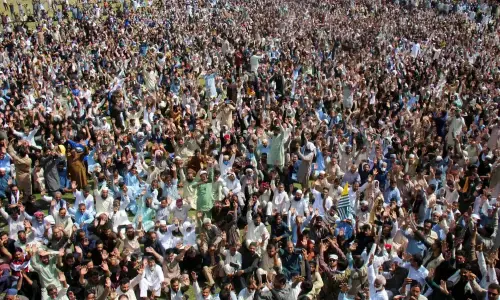
KARACHI, June 26: Necessary steps be undertaken so that the challenges of development should be met adequately. This was stressed at a forum organized here by the Karachi Women's Peace Committee (KWPC) to analyse the national development programme.
A statement on Monday said that a number of women's NGOs took part in the deliberations.
Speaking on the subject of poverty, Nadira Umar, General Secretary of the Karachi Women's Peace Committee, stated that the rich-poor divide had to be bridged so that poor could enjoy better health, learn skill and receive education to make them contributors to development rather than millstones.
President of YWCA and Educationist Nuzhat William, welcoming the progress in NWFP to contain the high dropout rate of students and enhancing the quality of teachers through teachers training, felt that rote learning should be discouraged, more emphasis should be placed on enhancement of facilities for girls to receive education in the rural areas.
Naushaba Burney opined that the curriculum should stimulate analytical and intellectual skills, promote discipline and this had not been addressed in the development programme.
Humaria Quraishi, President of Working Women's Organisation, was of the view that there was a communication gap between government and civil society. More social security and law protection should be provided to women workers as well as day care centres at work-place as had been promised. There was now a growing labour force of women who needed urgent attention.
Echoing her thoughts, Begum Jahan Ara Hai, Vice-President APWA, complimented the media for promoting awareness and imparting useful information to women regarding their rights.
Begum Akhtar Ibrahim, founder member of Bahbood, said that national development was based on everyday life problems like an efficient garbage disposal system which was not evident in any part of the country. Here she stressed that citizens had to also play a proper role in protecting the environment.
Dr Ruby Abbasi, President of Al Umeed Rehabilitation Centre, presented the problems of the disabled and handicapped.
Dr Talat Pasha, family physician, felt that reproductive health care and maternal mortality had to be given more attention.
Begum Shirin Rahimtoola, President, Senior Citizens Association, lauding the recent judgment of Supreme Court in the steel mill case urged the government to mobilize the services of able senior citizens in National Development programmes as had been done in China.
Begum Tazeen Faridi, founder-member and Patron of APWA, in her presidential address, said experts from civil society and not just government officials should be inducted in the monitoring committees.
Begum Nargis Rahman, in her concluding remarks, stated that success of the national development programmes depended on realistic assessment and feasibility of programmes, long-term planning consistency.
To accelerate development in the 50 per cent female population of the country, women had to be given access to education, income skills, protection through legal reforms of their rights and status.
The 33 per cent representation in assemblies and councils was a major advancement but these representatives had to be given due dignity and status as decision making legislators.
The participants passed a resolution to make the women's forum a permanent body and a women's platform of action.
The participating NGO's were APWA, PANAH, PAWLA, YWCA, OAKS, SAARC Women, FALAH Trust, Bahbood, Soroptimist, Kashana-i-Atfal, Aurat Foundation, Senior Citizens Association, Karachi Floral Arts Society, Media Women Organisation, Consumer Protection Society, Al Umeed Rehabilitation Centre, Working Women Welfare Trust, Pakistan Federation of Business and Professional Women's Organisation.—APP