AJK govt announces plan to reform education, industry

MUZAFFARABAD: The Azad Jammu and Kashmir (AJK) government is considering a set of reforms aimed at improving the quality of education and modernising the system.
At a meeting presided over by Prime Minister Raja Faisal Mumtaz Rathore here on Tuesday, key aspects of a proposed education package — focusing on sectoral reforms, improvement in academic standards and restructuring along modern lines — were discussed and reviewed in detail.
Participants deliberated on enhancing the capacity of the Elementary and Secondary Education Department, improving its administrative structure, and ensuring effective, merit-based deployment of teachers and staff. Measures to introduce innovation within available resources also came under discussion.
The meeting considered steps to improve school governance, promote modern teaching methods and develop a strategy to equip students with education aligned with contemporary requirements.
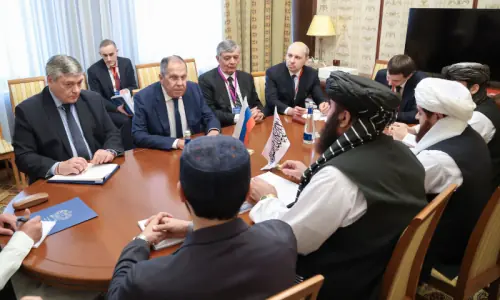
Rathore announces measures to boost industrial growth and ease of doing business
Special emphasis was laid on expanding educational facilities in remote and underdeveloped areas, improving school infrastructure and ensuring equal learning opportunities. It was decided to prioritise the establishment and upgradation of schools in line with needs and available resources.
Speaking on the occasion, the prime minister said education was a fundamental pillar of development and prosperity, and reiterated the government’s commitment to sustainable and result-oriented reforms in the sector.
Mr Rathore directed that teachers’ appointments be made strictly on merit and in a transparent manner, in line with modern requirements and principles of efficiency.
He stressed the need for curriculum innovation, promotion of information technology, expansion of digital learning and introduction of skill-based education to prepare students for future challenges.
He added that the government aimed to transform the education system into a model, transparent and high-quality structure ensuring equal access for all children.
Meanwhile, in a separate development, the prime minister chaired another meeting to review measures aimed at promoting industrial growth and improving ease of doing business in the region.
He said the government would take full ownership of industrial initiatives and ensure effective implementation of policies through institutional coordination, terming industrial development a cornerstone of sustainable economic stability.
Under the new measures, sectors including information technology, poultry (controlled sheds) and meat processing have been allowed to set up units in industrial zones. In addition, industries such as steel, flour mills, rice husking, stone crushing, oil blending units and foam manufacturing have been removed from the negative list, making them eligible for tax concessions.
The meeting also approved the development of Mirpur Special Economic Zone on the pattern of similar zones in Pakistan. The zone will be linked to the national highway through a dedicated road from Lehri, while provision of electricity and other essential infrastructure on a priority basis was also endorsed.
To streamline business processes, the director industries has been authorised to approve plot transfers and changes in trade, a move aimed at resolving business-related matters on a fast-track basis.
Participants said the measures would help create a favourable investment climate, enhance revenue and attract both local and foreign investors. The meeting also reaffirmed commitment to promoting small and medium enterprises (SMEs), generating employment opportunities and making effective use of local resources.
The prime minister said the government’s priority was to eliminate unemployment and provide dignified job opportunities to youth, adding that all available resources would be utilised to promote investment, encourage viable businesses and ensure public welfare.
Published in Dawn, April 1st, 2026