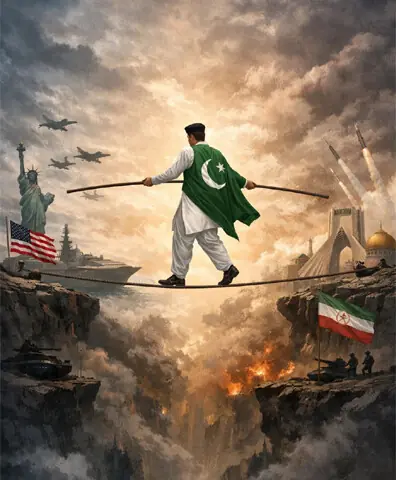
The ongoing conflict has created a fragile but significant diplomatic opening for Pakistan. The Strait of Hormuz, through which nearly a fifth of the world’s oil supply passes, has become a flashpoint, highlighting how regional conflicts can quickly cause global economic instability. Reports indicate that Pakistan, alongside Turkiye and Egypt, is quietly facilitating indirect communication between the two capitals — Washington and Tehran — even as both sides continue to fire missiles against the other’s strategic assets.
Pakistan’s emergence as a mediator is rooted in its geopolitical position. Islamabad maintains working relations with the United States while sharing deep cultural, religious and border interactions with brotherly Iran. This dual connectivity allows Pakistan to act as a bridge between adversaries.
Pakistan’s military leadership has been reportedly engaged directly with high-ranking American officials to support de- escalation efforts, signalling a proactive diplomatic role. At the same time, Pakistan has deliberately avoided direct military involvement, emphasising a cautious stance neutrality to protect its own vital, strategic interests.
The mediation effort carries both opportunities and risks. In the short term, success may stabilise oil markets and ensure secure trade routes, benefiting Pakistan’s energy-dependent economy. The crisis has already demonstrated how quickly disruptions in the Gulf affect global markets. By contributing to regional stability, Pakistan positions itself as a responsible actor in a volatile environment.
In the long term, Pakistan’s diplomatic visibility could enhance its global standing, shifting its image from a security-dependent state to a constructive inter-national facilitator. Yet, these gains are not guaranteed by any means. Iran has reportedly hardened its negotiating stance, while the US continues to combine military pressure with selective diplomacy. This structural mistrust limits the effectiveness of any mediator, including Pakistan.
Regionally, Pakistan’s mediation may strengthen ties with Iran and the Gulf states that seek stability amid escalating conflict. Relations with the US may also improve through cooperative crisis management. However, there is no evidence to suggest that this would significantly alter Pakistan’s relationship with India, where strategic rivalry is shaped by long-standing political and historical factors.
Ultimately, Pakistan’s mediation represents a test of its ability to convert relevance into influence. Short-term diplomatic visibility and economic relief are likely if tensions ease, but long-term strategic gains depend on sustained neutrality, consistent engagement, and the willingness of both the US and Iran to pursue meaningful dialogue.
The conflict is one driven by massive rivalry and deep mistrust, Pakistan’s challenge is not just to mediate, but to do so without overestimating its influence.
Ruqia Khan Nasar
Islamabad
Published in Dawn, March 31st, 2026