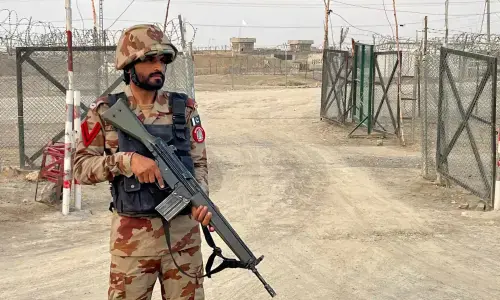
LONDON: The most widely used weapon in conflict zones around the world in the next 20 years will be the Kalashnikov assault rifle because its trade is so poorly regulated, arms control campaigners say.
The claim, made by Oxfam International, Amnesty International and the International Action Network on Small Arms (IANSA), is contained in a report to be read at a UN conference on small arms and light weaponry which opens on Monday.
The groups, whose report is entitled “AK-47: The World’s Favourite Killing Machine,” say the gun’s inventor, Lieutenant General Mikhail Kalashnikov, supports them in seeking a global arms trade treaty that would make suppliers more accountable and prevent weapons falling into the hands of unscrupulous regimes.
Before the two-week UN conference opens in New York, the groups will deliver a petition made up of one million faces from 160 countries to UN Secretary-General Kofi Annan, calling for tougher arms controls.
“Out of control and unregulated, AK-47s have been used to murder and maim, fuelling conflict and poverty in the world’s poorest countries,” said Jeremy Hobbs, the director of Oxfam International.
“One million people have signed this petition calling for tougher arms control. At this UN conference governments must agree global rules for arms sales and help put an end to this suffering.”
The report estimates that there are up to 100 million AK-47s and variations of its design around the world. The rifle, which can fire up to 600 bullets a minute, is made in at least 14 countries and used by at least 82 state armies, it says.
The study argues that the gun’s prevalence, plus the absence of global standards and laws to regulate its transfer, makes it easy for the weapon to be traded by unscrupulous arms dealers.
The AK-47 — “Avtomatni Kalashnikova” — won a competition in 1947 to find the ultimate submachine gun for the Red Army.
It first saw service in 1949, and during the Cold War Russia encouraged its allies to produce the weapon. But there was little control on the production agreements and in some cases, no production agreement at all.
Others were supplied to regimes around the world and are still in circulation.—AFP