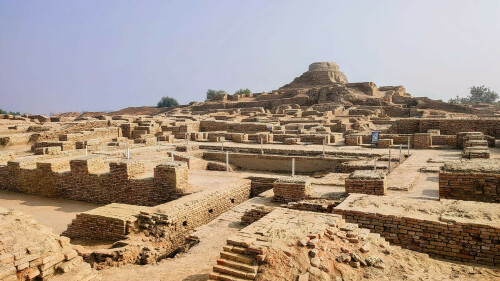
Fresh studies trace Mohenjo Daro’s urban roots to 3300 BC

LARKANA: Recent excavations and new radiocarbon dates confirm an earlier urban occupation at Mohenjo Daro during the Kot Diji Phase, circa 3300-2600 BC, a source in Technical Consultative Committee (TCC) of the National Fund for Mohenjo Daro (NFM) has disclosed to Dawn.
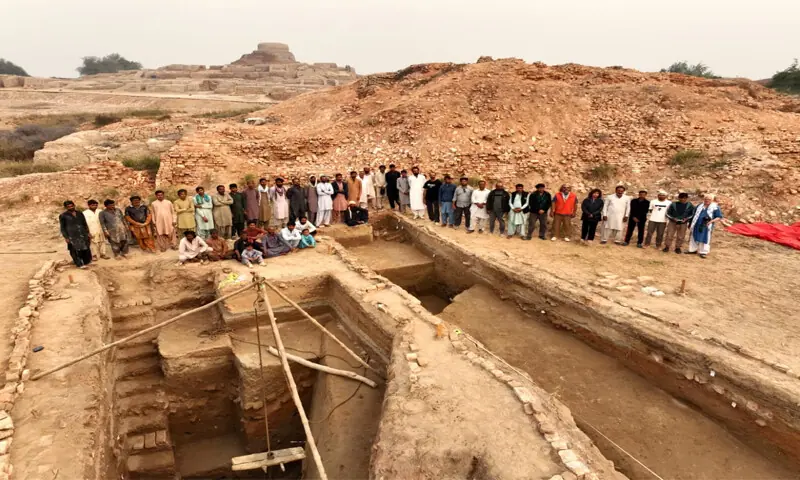
New excavations at the plain level to the west of the famous Stupa Mound have provided five new radiocarbon dates for a massive mud brick perimeter wall of the city.
Sir Mortimer Wheeler had first discovered this structure in 1950, “but misidentified it as a revetment or flood protective bund”, experts working at the site said.
The recent archaeological investigations were carried out at Mohenjo Daro under the direction of the NFM after a lapse of many years. A Joint Mission of the Directorate General of Archaeology and Antiquities, Sindh, and the Sindh Exploration and Adventure Society (SEAS), Pakistan, carried out excavation during the summer of 2025, and winter of 2025-26.
The project was led by leading Pakistani Archaeologists Dr Asma Ibrahim and Ali Lashari along with Dr Jonathan Mark Kenoyer, University of Wisconsin, Madison, US, and a team of scholars and students from various US and Sindh universities.
Radiocarbon dating of objects done in US; excavation reveals more facts, says expert
Dr Asma Ibrahim, when contacted by Dawn, authenticated the recent findings obtained after radiocarbon dating of the material secured during the excavation. She had been at Mohenjo Daro along with other members of mission during the excavation. She said: “Yes: radiocarbon dating facility is not available in Pakistan, so it was carried out in the US. It was the second phase of the excavation at the site,” she added.
TTC member Sikandar Hulio, talking to this journalist, said that the main focus of the excavations was to delineate the overall plan and chronology of the mud brick city wall that surrounds the western Stupa Mound.
Sir Wheeler’s 1950 excavation and drawings show that this wall was built in many phases and the earliest structure was built on top of an even earlier occupation deposit. Although the lowest levels are now below the water table, the recent excavations were able to reopen the earlier trench to re-document and date the construction of the multiple phases of the mud brick city wall.
The pottery and carbon samples from the lowest levels of the first wall indicate that this initial structure was constructed at the end of the
Early Harappan or Kot Diji Phase, around 2700-2600 BCE, approximately 100 years before the beginning of the Harappan Phase.
Kot Dijian pottery recovered from new deep coring below the first city wall indicate the presence of a substantial Early Harappan occupation before the first city wall was constructed. These findings correspond with the results from excavations at the site of Harappa, Punjab, which also has an Early Harappan, Kot Dijian Phase occupation and city wall dating to around 2800-2600 BCE.
Pottery and carbon samples from the middle and upper levels of the new excavations confirm that the later phases of the mud brick city wall at Mohenjo-daro were constructed during the Harappa Phase, beginning around 2600 BCE. The walls were expanded and maintained until around 2200 BCE and possibly even longer. Future investigations will trace the plan of the city wall around the Stupa Mound in order to try and locate gateways and to determine how this wall functioned and when it began to erode.
The TTC chairman has called the fresh studies a step forward in the understanding of the evolution of urban fabric and society. He expressed his resolve to continue these studies with the hope that frontiers of knowledge should be extended further.
Published in Dawn, March 25th, 2026