Women in Kohistan, Torghar still live under yoke of centuries-old customs


 0
0
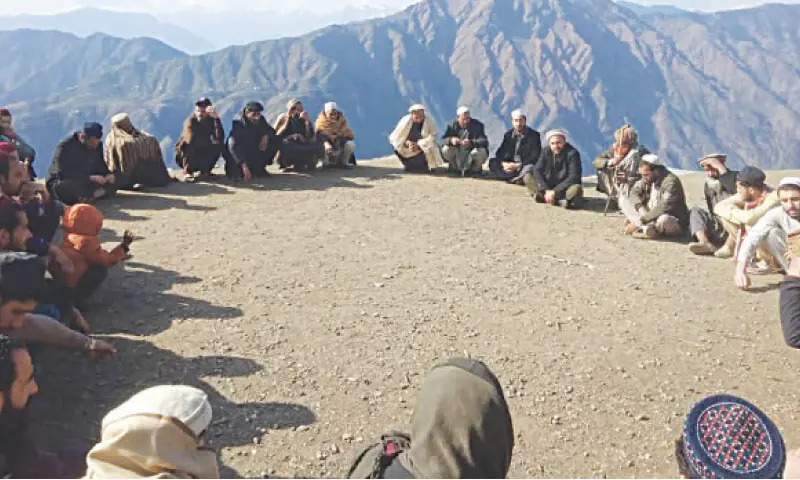

KOHISTAN and Torghar are still considered hotbeds of gender-based violence (GBV), harassment, denial of inheritance and other issues faced by women and girls.
The jirga system, entrenched in the two societies for centuries, has lost much of its traditional authority over time but remains a strong private forum that proclaims decrees even in honour-related cases.
However, homicides in the name of honour and other crimes against women have seen little decline in recent months and years. The ratio of unreported cases is still higher in both districts as compared to the rest of Hazara division.
In the absence of adequate education, health, communication and other development infrastructure, women in both districts continue to live under constant pressure.
Experts say ratio of unreported cases of gender-based violence higher in both districts
Amendments to the British-era Pakistan Penal Code (PPC) of 1860, including Section 354-A, Section 509, Criminal Law (Amendment) Act 2010, and Prevention of Anti-Women Practices Act, along with the empowerment of women through local governments have significantly contributed to reducing cases of murder in the name of honour and other gender-based crimes in many parts of Khyber Pakhtunkhwa by empowering women socially, economically and politically. However, women in these remote districts still continue to suffer under a deeply entrenched patriarchal jirga system.
“Although there has been a slight decline in gender-based violence after the amendments introduced by successive federal governments in colonial-era laws, women in conservative societies like Torghar and Kohistan still face the wrath of jirga decrees and centuries-old customs,” Zahid Khan, the representative of Human Rights Commission of Pakistan, told this scribe.
He said that cases of homicide committed in the name of so-called honour, as well as incidents of gender-based violence and harassment, were still treated as matters of societal pride in communities there.
“I have reported 18 to 20 deaths of men and women in the name of honour in recent years alone in Torghar. Police even made arrests. The ratio of unreported homicides in such cases is higher than that of reported ones,” Mr Khan said. He added that local government system had so far failed to replace the centuries-old jirga system in Torghar for various reasons.
“Most seats reserved for women in Torghar remain vacant because men do not allow females to become part of the system. Even where they have entered grassroots political and governance structures, they cannot openly exercise their powers, and male members of their families act on their behalf,” he said.
Taib Khan, the chairman of Torghar’s Darbani village council, said that though his wife was also a member of the council led by him, her presence was only symbolic.
“In our district’s 44 village councils, female members are represented by their husbands or brothers, and women cannot freely move anywhere to challenge the centuries-old culture and traditions,” he said.
Taib Khan, who, as chairman of his village council, is also a member of Kunder Hassanzai tehsil council, said that local governments, which were the backbone of governance, failed across the province.
“How can we expect that female councillors could play their due role in addressing women’s issues when our tehsil council did not meet even a single time, except the inaugural session during its four-year term,” he questioned. He said that 18 women were elected as members of Kunder Hassanzai council on seats reserved but they were not provided with a single opportunity by the government to even discuss the issues faced by their gender, which they were representing in that council.
Kohistan, which has been divided into Upper Kohistan, Lower Kohistan and Kolai-Palas districts, is infamous for gross women’s rights violations and centuries-old customs and traditions.
“The jirga system is still strong enough here and has proclaimed a decree completely barring women’s participation in electoral process,” said Juma Shah Jallali, the chairman of Lower Kohistan’s Dubair Bala village council.
He said that under the same proclamation by clerics, non-governmental organisations were also bound not to approach indigenous women, even through their female staffers.
“Would you believe that not a single one of the eight tehsil councils and hundreds of village and neighbourhood councils throughout Kohistan region has representation of women,” he questioned.
The village council chairman said that the district was still without adequate educational and health infrastructure, particularly for women.
“Women here cannot even move to other houses. How can they be part of the electoral process when clerics in one of the recently proclaimed decrees allowed local men to forcibly marry an unmarried woman staffer of any NGO, if she accesses their houses,” Mr Jallali said.
The Khyber Pakhtunkhwa government recently notified committees on the status of women in 26 districts across the province after decades of delay, but these bodies working for women’s welfare and rights, with representation of deputy commissioner and district social welfare offices, couldn’t be notified in Kohistan and Torghar.
Shakeela Rabbani, who was recently nominated as chairman of district committee on the status of women in Mansehra, said that launching of those committees couldn’t be possible in both hidebound districts as local women were strictly forbidden by the jirga and men members of their families to be part of such public forums.
“I have personally experienced that women have no access even to their female representatives and vice versa,” she said.
Ms Rabbani, who made history by contesting the 2024 general elections as a woman from Torghar’s only provincial assembly constituency, PK-41, said that women outnumbered men in voters’ turnout during the 2024 elections as of 37,043 polled votes, women cast 20,437 votes, yet they still did not have a practical role to play in that patriarchal society.
Sungi Development Foundation has been working to sensitise local communities about the importance of women’s participation in politics and inclusion through behavioural change.
“We have also been working to strengthen community response mechanisms, particularly for women, to end inequality between men and women in the district,” said Shahid Aziz, the regional head of Sungi.
Free and Fair Election Network (Fafen) chairman Mukhtar Javed said that to empower women economically and politically, all hurdles coming in their way should be removed, which was also one of the objectives of their network.
Hazara DIG Nasir Mehmood Satti said police were striving to enforce laws in letter and spirit to bring an end to cases of GBV and other crimes across the division, including Kohistan and Torghar districts, and encouraging results were recorded.
“I have already directed the district police officers of Torghar and Kohistan to take strict action against perpetrators in honour-related issues and involve clerics. As a result of our efforts, such cases, which are also repugnant to Islamic Shariah, plunged significantly in these districts,” he said.
Published in Dawn, March 24th, 2026