
Pakistan’s persistently high population growth — exceeding 2.5 per cent annually — is quietly but steadily reshaping the country’s farm structure. In the absence of laws that restrict excessive subdivision, inherited agricultural land continues to be divided among family members with each passing generation. Consequently, the number of farms keeps rising, while the average farm size is shrinking at an alarming pace; this trend is clearly reflected in the 7th Agricultural Census of Pakistan 2024.
As a result, family landholdings that were once large enough to be measured in squares (a unit equivalent to 25 acres) have gradually fragmented into acres and, in turn, into fractions of an acre. Thus, the economic viability of millions of such tiny farms is increasingly in question.
To many, high-value horticulture — including fruits, vegetables, flowers, and medicinal plants — offers a promising pathway to generate reasonable income from small landholdings. Yet this labour-intensive opportunity remains constrained by a limited domestic market and small export potential, primarily due to poor compliance with the sanitary and phytosanitary regulations of importing countries. As a result, even a modest expansion of 10–15pc in cultivated areas can quickly create a supply glut, which leads to a market crash.
The experience of the past two years clearly illustrates this vulnerability. Faced with poor wheat prices, many farmers shifted to vegetable and potato cultivation, but they suffered heavy losses due to supply-demand imbalances — further compounded by the closure of the Afghan border. The challenge is further aggravated by Pakistan’s nearly non-existent agro-processing industry, which could otherwise absorb surplus agricultural produce through value addition while some generating much-needed rural employment.
A growing segment of the rural populace is trapped between shrinking farm sizes, declining rural employment opportunities, and limited job prospects beyond agriculture
In the given context, shrinking farm sizes raises a far more pressing concern: what is the future of the youths belonging to these micro-scale farming families? The question becomes even more pertinent and crucial when viewed against Pakistan’s troubling education landscape, where over 260 million children — around 38pc of the school-going population — are out of school. A large proportion of these children come from precisely such rural families or landless households.
Until the last few years, such youths — largely illiterate and unskilled — could still find seasonal employment in villages, particularly during the sowing and harvesting of major crops such as wheat, rice, and maize. In recent years, however, the rapid spread of farm mechanisation has begun to alter the rural employment landscape. The number of combine harvesters, half-feed rice harvesters, rice transplanters, maize harvesters, maize planters, potato field graders, drones for pesticide application, and other specialised agricultural machines has increased markedly.
While mechanisation has improved productivity and saved farmers’ time and money, it has also significantly curtailed jobs for seasonal workers and daily wagers. As a result, rural workers — who once relied heavily on farm operations for their livelihoods — are facing steadily diminishing casual and seasonal work.
Rural-to-urban migration has long been an option for many rural youths, who traditionally found work in the construction and industrial sectors in urban centres, mostly as unskilled labour. However, flawed and inconsistent government policies in recent years have stifled the growth and job-creation potential of these sectors. The situation has worsened to the point where even the existing workforce is increasingly facing layoffs.
The matter becomes even more troubling when viewed in a broader demographic context. Each year, nearly 2m young people enter the labour market, yet the economy lacks the momentum to absorb them productively. Many therefore try to seek opportunities abroad. However, for poorly educated rural youths with little or no vocational skills, overseas employment remains largely out of reach.
Consequently, a growing segment of the rural population finds itself trapped between shrinking farm sizes, declining rural employment opportunities, and limited job prospects beyond agriculture. It is therefore not surprising that Pakistan is facing its highest unemployment rates since FY04.
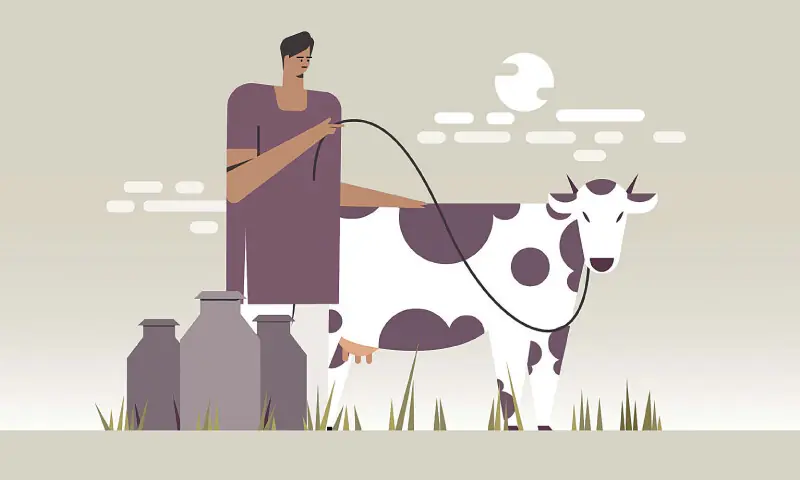
In this broader context, where jobs are scarce and farm sizes are shrinking, rural families are increasingly turning to livestock — milk and meat production — to supplement their household incomes and to provide their youth with some meaningful work.
This growing focus on livestock is evident in the sector’s 4.72pc growth in FY25 and its expanding share within agricultural GDP, where it now accounts for 63.6pc — significantly higher than the crop sector. However, despite the rising importance of livestock, the sector’s challenges, growth dynamics, and policy imperatives receive far less attention in both print and electronic media vis-a-vis the crop sector.
Nevertheless, the livestock sector faces a complex set of challenges. A decades-long government price cap on milk and meat has created a clear market distortion, where input costs rise unchecked while output prices remain suppressed. Persistently low milk yields per animal, suboptimal feed conversion ratio, the import of cheap, low-quality whey powder and skimmed milk powder, and restricted export access due to transboundary animal diseases such as foot-and-mouth further undermine the sector’s growth potential.
Against this backdrop, government policy must anticipate shrinking agricultural farm sizes and the rapid growth of livestock smallholders. Only with a supportive policy framework and an enabling business environment can the sector become a key engine of economic growth that generates large-scale employment for illiterate and unskilled rural youth and thereby mitigates the risk of rising social instability.
Khalid Wattoo is a development professional and a farmer, Dr Waqar Ahmad is a former associate professor at the University of Agriculture, Faisalabad.
Published in Dawn, The Business and Finance Weekly, March 23rd, 2026