Tech entrepreneur develops AI-designed mRNA vaccine to save dog dying of cancer
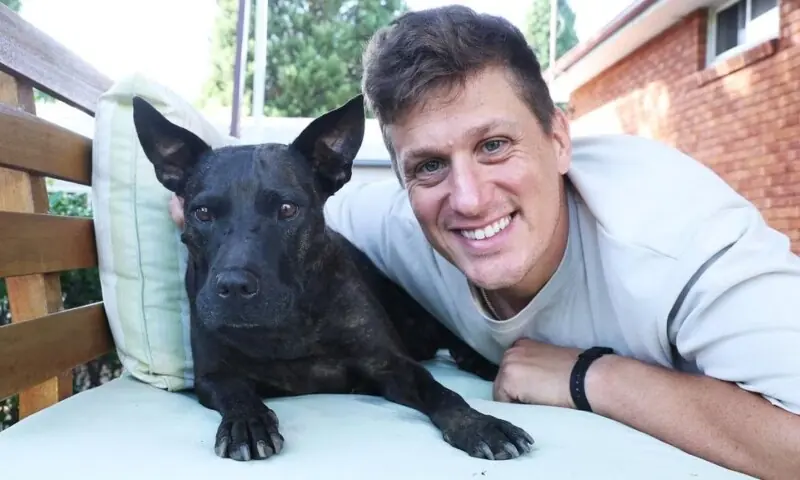


An experimental cancer treatment using an mRNA vaccine, which was developed with the help of Artificial Intelligence (AI), is offering hope to humans after a successful run with a dog with cancer in Sydney, The Australian reported on Friday.
Rosie — an eight-year-old rescue dog — was adopted by Sydney-based tech entrepreneur Paul Conyngham in 2019. She was diagnosed with a deadly mast cell cancer in 2024.
After showing no improvement following the initial treatment, Conyngham turned to a chatbot to brainstorm ideas for her treatment, which led to him partnering with elite medical scientists to find a cure.
The vaccine produced in the result, which Rosie was given over the Christmas break in 2025, caused one of her tumours to shrink by half.
According to The Australian, “the recovery has astounded researchers at the cutting-edge of human cancer treatments”.
Martin Smith, an associate professor of computational biology and director of the Ramaciotti Centre for Genomics at the University of NSW, where a team of scientists worked on the vaccine, recalled the development, saying, “It was like holy crap, it worked!’
“It raises the question, if we can do this for a dog, why aren’t we rolling this out to all humans with cancer? It gives hope to a lot of people, and it’s something we’re passionate about trying to chase up here.’’
According to The Australian, Conyngham “used a chatbot to brainstorm possible cures for Rosie’s cancer — then harnessed artificial intelligence to process gigabytes of genetic data to create the blueprint for an mRNA vaccine”.
Conyngham has 17-years of experience in machine learning and data analysis.
Conyngham then went to Australia’s “most sought-after” scientists. ChatGPT pointed Conyngham to the UNSW’s genomics centre, where he asked them to “DNA sequence his dog”.
“DNA sequencing is a way to profile the tumour and identify mutations that might be causing the disease,” the report quoted Smith as saying.
Within weeks of the treatment, researchers observed that the vaccine was working, with one of Rosie’s tumours “halved”. They maintain that while the tumour has not yet completely disappeared, it has made the dog more comfortable”.
“This is the first time anyone’s ever done this therapy, but it won’t be too far down the line before we can have personalised therapies for individual pets,” The Austrailian quoted one of the researchers as saying.
As per the report, Conyngham was now working on a “second vaccine targeted to attack one large tumour that did not respond to the initial treatment.
“I’m trying to do a second round of (DNA) sequencing to see if we can find why parts of the tumour didn’t respond,’’ he was quoted as saying.
“There’s actually a chance that for some cancers, we can change it from being a terminal sentence to a manageable disease, because you can create treatments ahead of the mutations.’’
‘Overhyped’
Some scientists, however, caution that the development may be receiving more attention than the evidence currently supports. Biomedical engineer Patrick Heiser wrote on X that while the story is impressive, creating a single mRNA vaccine is not particularly difficult.
“Sorry to be the downer because this is an impressive story in some senses. But it is trivially easy to make a single mRNA vaccine. It’s not hard,” he wrote. “It is impressive. But y’all are overhyping it.”
“I literally have an ongoing cancer experiment where 100% of the untreated and control animals have had to be euthanised, while 100% of the treatment animals are seemingly unaffected. But we’re still extremely far away from ‘proving that it works’. Science is hard,” he continued.