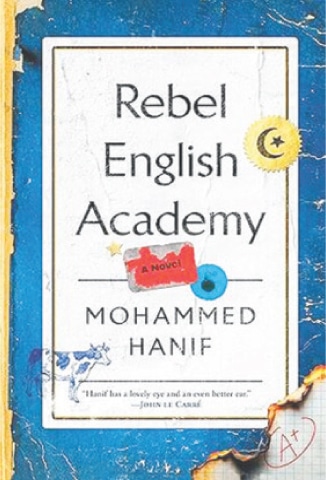
Rebel English Academy
By Mohammed Hanif
Maktaba-e-Danyal
ISBN: 978-969-419-131-7
223pp.
Rumour says he is coming back. The coffin was locked. The burial supervised. The paperwork completed. Yet, somewhere in a dusty bazaar, someone swears former prime minister Zulfikar Ali Bhutto has been seen. A pamphlet circulates. A whisper grows. And suddenly, a military officer, hundreds of miles away, is being screamed at for failing to keep a dead man dead.
In Rebel English Academy, Mohammed Hanif opens up the charged space between fact and rumour, showing how, in Pakistan, political gossip is never just talk. Set in the days following Bhutto’s execution, the novel unfolds in the fictional OK Town, where grief, denial and opportunism mingle in the air, and whispers travel quickly — from tea stalls to offices, from mosque loudspeakers to private bedrooms.
Soldiers, clerics and ordinary citizens alike find themselves unsettled by the slogan “Bhutto Lives”. Hanif understands something we continue to witness today: power may control events, but it rarely controls the story that follows.
It is through people, not slogans, that this tension becomes visible. Hanif explores three lives that reflect different responses to power. The first is Sir Baghi, who embodies the exhaustion of failed rebellion. Once a fiery revolutionary who paid for his rhetoric with torture, he now runs a modest English academy in a mosque’s compound. The academy of the novel’s title is less a school than a scaled-down revolution, a space where rebellion survives in language when it can no longer survive in politics; here, Baghi’s revolution narrows into grammar lessons and small, stubborn principles, a form of survival that may still afford him some dignity.
Mohammed Hanif’s deeply satirical new novel, set in the days following former prime minister Zulfikar Ali Bhutto’s execution, uses three protagonists to explore ways of thinking about power
In contrast, Captain Gul represents a different kind of survival. Young, ambitious and slightly ridiculous, he works for the Field Intelligence Unit and dreams of becoming a legend whispered about in foreign capitals. Instead, he is posted to OK Town, where he must deal with slogans claiming “Bhutto Lives.” He is ordered to “make him go away” again, as if rumour requires a second burial. His bravado masks insecurity. He is loyal to the state but unsettled by how easily a whisper can undermine it.
Between these two men stands Sabiha Bano, who refuses both nostalgia and obedience. Once Baghi’s student and the daughter of a labour union leader, she re-enters his life carrying a pistol and difficult questions. Her essay Our Cow begins as a school exercise and turns into a charged memory of comrades, fire and impending violence. When she confronts Baghi and asks whether he is still the rebel people claim he was, she exposes the gap between his past and present. Sabiha is not content with nostalgia. She is impatient with compromise.
The academy of the novel’s title is less a school than a scaled-down revolution, a space where rebellion survives in language when it can no longer survive in politics.
It is in the friction between these three lives that the novel’s argument takes shape. Hanif does not linger on them merely for colour or subplot; each becomes a way of thinking about power. Through Baghi, we see what happens to rebellion when it survives but does not win. Through Gul, we see how authority performs strength while remaining anxious about legitimacy. Through Sabiha, we see the cost of inheriting both failure and force. Their stories are not digressions from the political moment, but its most intimate expression.
However, as the narrative expands in different directions, its momentum is occasionally unsettled by frequent shifts in perspectives and the sheer sprawl of voices and episodes. The narrative moves from Captain Gul’s cantonment theatrics to Baghi’s bruised introspection, from Sabiha’s essays to the spectacle of the alleged rumour-spreader’s burning.
In a town gripped by rumours and fear after the hanging of an ex-prime minister, stories do not unfold neatly. They collide, overlap and burn out mid-sentence. The fragmentation reflects a society where no life is allowed a single, uninterrupted narrative.
Hanif writes in a brisk, controlled style that carries the sharpness of his journalism. His sentences move quickly, often driven by dialogue that feels lived-in and unfiltered. He has a keen ear for how people in power speak, how rumours sound in a bazaar and how piety and paranoia share the same vocabulary. At times, this journalistic edge turns the novel into something close to public commentary. The satire bites harder than the sentiment lingers, giving the book its urgency and political clarity.
To write about a leader who was executed decades ago is not, in Hanif’s hands, an act of nostalgia. It is a way of asking why that moment still feels unfinished. The novel does not appear stuck in the past so much as alert to how often Pakistan returns to it and how the same tensions between elected power and uniformed authority resurface under new names and new slogans. Bhutto becomes less a historical figure and more a recurring argument.
The strong presence of Captain Gul underscores how deeply institutional power continues to shape civilian life. If there is an allegory here, it is not about one man’s authoritarian streak but about a cycle in which charisma, populism and control blur into one another.
Hanif suggests that, unless the balance between civilian rule and state authority is resolved, history will not simply echo but repeat itself. In that sense, Rebel English Academy reads less like a backwards glance and more like a warning about cycles we have yet to break.
The reviewer is a Teaching Fellow at the Department of Humanities and Social Sciences at LUMS
Published in Dawn, Books & Authors, March 15th, 2026