Israeli strikes massacre 52 in Lebanon


• Bombings on Beirut suburbs, southern towns trigger mass exodus
• Lebanese government outlaws Hezbollah military activities after attacks
• Israel issues evacuation warnings
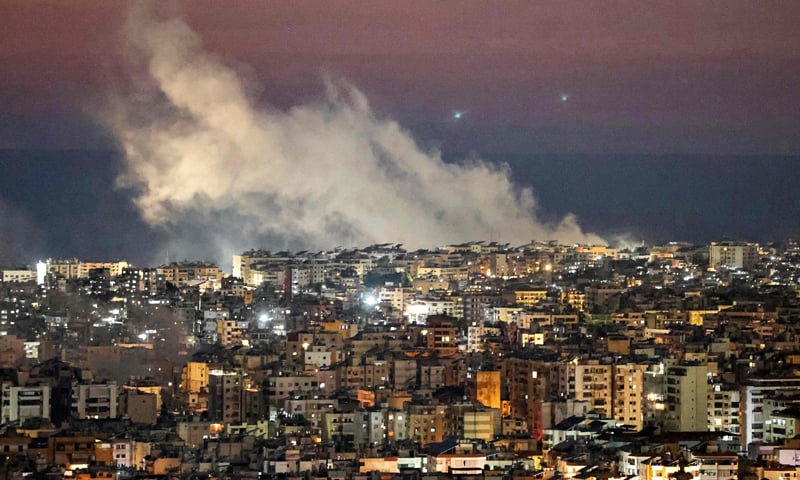
BEIRUT: Hours after Israeli air strikes massacred at least 52 people across Lebanon on Monday, the Israeli military issued an evacuation warning for several towns, signaling another imminent strike.
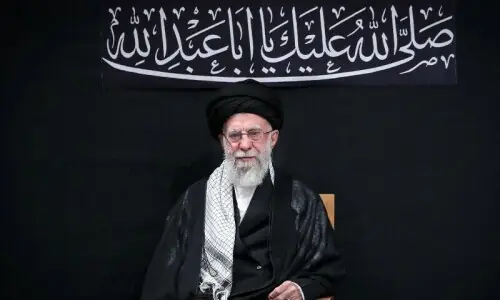
Monday’s attacks marked a brutal escalation of hostilities following a retaliatory strike by the Lebanese resistance movement Hezbollah for the US-Israeli assassination of Iran’s supreme leader Ayatollah Ali Khamenei.
Israel’s military vowed to intensify its unrelenting assault on the country and make Hezbollah pay a “heavy price”. It launched several strikes on Beirut’s southern suburbs and south Lebanon, both strongholds of the resistance.
The Israeli strikes wounded 154 on Monday, the Lebanese government said in an updated toll. A previous toll shared by the health ministry said 31 people were killed and 149 wounded.
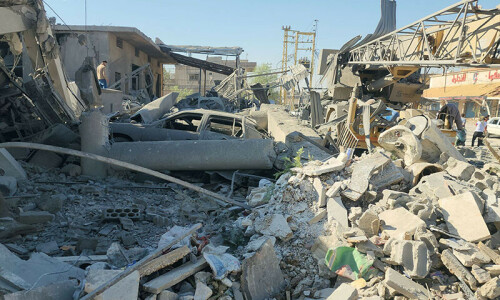
In the capital’s southern suburbs, Israeli strikes tore through the top two floors of at least two buildings, an AFP photographer reported.
A fire blazed in one targeted apartment as the bombings triggered a mass exodus from the area. Families hastily fled their homes on motorcycles or in cars.
Further south, an AFP journalist in Sidon saw huge lines of cars packed with families escaping the attacks.
Hezbollah’s response came hours earlier, fulfilling a promise to avenge the death of Iran’s supreme leader, Ayatollah Ali Khamenei. The movement announced on Monday that it had targeted an Israeli army site south of Haifa with “a barrage of high-quality missiles and a swarm of drones”.
The operation, it said, was “retaliation for the pure blood” of Khamenei, whose assassination on Saturday was the result of a joint US-Israeli operation against Iran. It was the first time Hezbollah had claimed an operation against the Zionist entity since a November 2024 ceasefire.
Israeli military officials responded with predictable threats. “Hezbollah chose the Iranian regime over the State of Lebanon and initiated an attack on our civilians… they will pay a heavy price,” Rafi Milo, head of the Israeli military’s Northern Command, said in a statement. “The strikes continue, their intensity will increase.”
Meanwhile Lebanon’s government sided against Hezbollah, announcing an “immediate ban” on its military and security activities as Israel’s bombardment continued.
Prime Minister Nawaf Salam called Hezbollah’s retaliatory rocket fire “irresponsible”.
After an emergency cabinet meeting, Salam declared the state’s “absolute and unequivocal rejection of any military or security actions launched from Lebanese territory outside the framework of its legitimate institutions”.
“This necessitates the immediate prohibition of all of Hezbollah’s security and military activities, considering them to be outside the law, and obliging it to hand over its weapons,” he said.
Salam ordered the military and security agencies to implement the decision and prevent “any military operation or the launching of missiles or drones from Lebanese territory”.
Published in Dawn, March 3rd, 2026