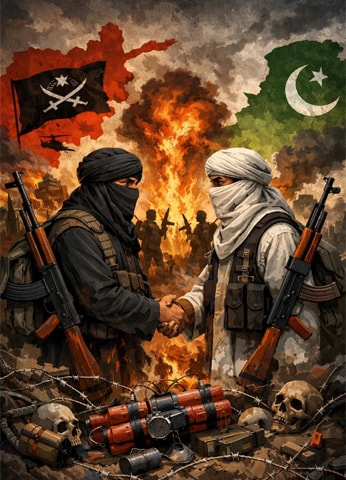
THIS is with reference to the report “Forces repel ‘miscalculated’ attacks by Afghan Taliban” (Feb 27). Hostilities have continued despite negotiations having been held at various places between Pakistan and Afghanistan, with some diplomatic platforms also trying to facilitate talks. However, the main cause of conflict has remained unresolved.
Decisive action against the Tehreek-i-Taliban Pakistan (TTP) is the core of the current conflict. The question many ask is why the Taliban regime in Kabul is not interested in taking action against the TTP. After all, Afghanistan will benefit more from such a path of action.
The first major reason for this hesitation is the past policy in which Pakistan maintained relations and support with both the Afghan Taliban and the TTP at different times. Today, those same historical relations have become a moral and strategic dilemma.
A tough crackdown on the TTP may also increase political and military differences within the regime in Kabul. The Afghan Taliban and the TTP have historical and ideological ties. Those in Afghanistan see the TTP as their ideological brother, not a terrorist group. To cover up the actual reason, Afghan Taliban simply claim that the TTP has no existence in Afghanistan. The United Nations Security Council has already called all such claims unreliable.
Further, the issue for the Afghan Taliban is not just diplomatic pressure, but also internal regime survival. The Islamic State Khorasan (IS‑K) in Afghanistan is an extremist faction that opposes both the Afghan Taliban and the TTP. Some quarters give the impression that IS-K is supportive of the Afghan government, but the reality is the opposite.
In such a situation, if the Afghan Taliban regime openly sides with Pakistan against the TTP, it fears that the relevant TTP elements might collaborate with IS-K and create a potent threat to Kabul. This pratical calculation is what is keeping the Afghan Taliban cautious.
Internal polarisation within Afghan Taliban factions and fresh foreign policy objectives are also keeping the regime in Kabul on its toes regarding any possible action against the TTP. Pakistan has had a deep influence in Afghanistan over the past four decades, and a key objective of its policy has been to limit Indian influence in Afghanistan. However, since 2021, Kabul has reactivated diplomatic and trade ties with New Delhi. The Taliban government is interested in expanding economic and humanitarian cooperation with India, which some observers see as a strategic diversification from Pakistan.
It is clear that the Taliban leadership is avoiding full alignment with Pakistan in order to maintain its identity and to balance regional equations. This diplomatic calculation is considered by many experts to be the key element behind the delay in initiating tough action against the TTP.
Nasrullah Baloch
Multan
Published in Dawn, March 2nd, 2026