0
0

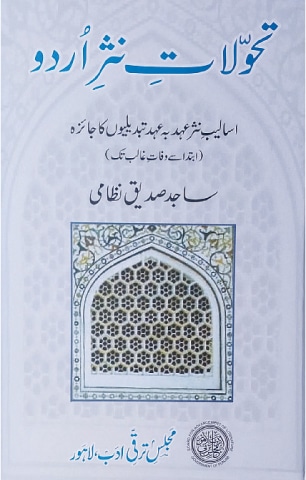
MISCONCEPTIONS about Urdu prose abound. Many believe Urdu prose hardly existed before the revolution of 1857. Some feel there has never been any scientific or philosophic prose in Urdu and most of whatever little we had before 1857 in the name of Urdu prose was either religious and didactic texts or nothing but some fables, love tales and dastans portraying kings, djinns, fairies, sorcerers and supernatural phenomena, like a clad-in-green saint appearing in the dream of a prince and giving him a magic ring to solve all his problems, including winning a competition to marry a princess.
But Dr Sajid Siddiq Nizami’s just-published research-based book on history of Urdu prose from the earliest times to Ghalib not only dispels all these misconceptions but also makes the reader realise that Urdu had had — much before 1857 and Ghalib’s letters — a body of prose that can be classified as scientific, philosophic and academic. The book proves, with ample evidence, that non-fiction, academic texts in Urdu existed side by side with the creative and highly-imaginative Urdu prose as early as in the latter half of the 18th century. Titled Tahavvulaat-i-Nasr-i-Urdu, or the transformations of Urdu prose, it is subtitled Asaaleeb-i-Nasr: Ahd Ba Ahd Tibdeeliyon Ka Jaaeza, Ibteda Se Vafaat-i-Ghalib Tak, or survey of changes in prose styles through eras, from the beginning to Ghalib’s death.
Dr Khwaja Muhammad Zakariya, a veteran scholar and professor Emiratus at Punjab University Oriental College, has rightly mentioned in his intro to the book that in such studies in Urdu usually the word irtiqa is used to say evolution, though it means progress or development. But evolution does not always necessarily result in progress or development, so the title of the book includes the word ‘tahavvulaat’ instead and it is more apt as it means changes or transformations. Modern research and critical studies in Persian use the word tahavvulaat rather than irtiqa and one hopes the term will become familiar and get currency in Urdu too, adds Dr Zakariya.
In his preface, Dr Nizami has mentioned a number of books that have already been written on the history of Urdu prose, but are lacking in one way or the other. Several of them are either limited to history of Urdu prose in certain regions or a certain era and a history comprehensively covering all the regions and the entire period was needed. Secondly, says he, literary historians generally have to discuss literary and cultural tendencies as well and it is often not possible for them to study the tradition and evolution of Urdu prose exclusively. Furthermore, some literary histories have outlived their usefulness as new discoveries and new research entail removing certain misunderstandings found in those books, Dr Nizami adds.
First having discussed the definition of ‘style’ and the kinds of ‘prose’, Dr Nizami traces the earliest specimen of Urdu prose and removes many misconceptions. He has made clear, for instance, the fact that the earliest Sufi treatises in Urdu prose are wrongly attributed to some Sufis as they are not their work, especially Me’raajul Aashiqeen, believed to be penned by Khwaja Syed Muhammad Husaini, entitled to the appellation Banda Nawaz Gesoo Daraaz, was not written by him. Dr Nizami has also established, with references to authentic sources, that Urdu’s earliest prose work, Kalimatul Haqaaiq written by Burhanuddin Janam in Deccan, was penned between 1582 and 1598. In 1635, Sab Ras, an allegory in Urdu prose, was written by Mulla Vajih.
The 18th century Urdu prose flourished in North and it had three distinct colours, says Nizami: religious, imaginative and historic. The works written in this era showcase prose that is much plain and less ornate. In the early 19th century, Urdu prose burst into full bloom with Fort William College, established in May 1800 at Calcutta, promoting Urdu prose. Christian missionaries began translating Bible into Urdu, with Muslim scholars replying with their prose works. Shamsul Umera patronised scientific works in Urdu. According to the author, Delhi Translation Society got over 130 English scientific works translated into Urdu and had 1857 revolution not disturbed its working, Urdu would have become a medium of instruction for teaching sciences. Rurki’s Thomson Engineering College was another institution where technical syllabi were in Urdu. Sir Syed Ahmed Khan’s Scientific Society, too, promoted scientific prose. Ghalib’s Urdu letters were another milestone.
Published by Lahore’s Majlis-i-Taraqqi-i-Adab, the 546-page book has an index, too, a rarity in Urdu works. The book deserves kudos as it unfolds the history of early Urdu prose comprehensively and objectively, backed by authentic research. Sajid Siddiq Nizami is a young scholar from Lahore and teaches Urdu at Punjab University Oriental College.
Published in Dawn, March 2nd, 2026