“THERE is a silver lining in a country that is completely destroyed,” said Mariam Jalabi — one of the founders of the Syrian Women’s Political Movement (SWPM) — during a conversation marking the first anniversary of the fall of Damascus in December 2024. Jalabi was referring to the opportunities inherent in building a new system from scratch — the possibility that in the hollowed-out shell of a country lies the chance to construct a system that is equitable from the very beginning.
The fact that Jalabi and the other women of the SWPM can find hope in an otherwise bleak landscape of infighting and revenge is remarkable. It is also a testament to the power of hope and the idealism that sustains revolutionary change. The SWPM came into being in 2017 after Jalabi and other feminist activists involved in resistance to the Assad regime grew tired of demanding inclusion in other groups.
Again and again, they lobbied resistance factions to allow women a presence in discussions — most of them taking place outside Syria — about the country’s future. In forming their organisation, they turned the tables and began to hold meetings of their own, highlighting the challenges faced by Syrian women.
There were and remain many such challenges. Even though Bashar al-Assad’s regime fell in December 2024, Syria today does not have a clear political future. Factions persist and acts of vengeance from more than a decade of conflict continue.
On the ground, women remain in crisis — struggling for basic food and shelter amid weak government institutions. While incomes have risen in some areas since Assad’s fall, they remain extremely low relative to the cost of essential goods. This has forced non-government actors like the SWPM back into crisis mode, helping provide survival basics to women competing for scarce resources. Without such organisations, many women would have little chance to prevail in the fray.
Despite challenges, freedom remains worthwhile in Syria.
Amid all this, political transformations are underway. Syria now has an interim constitution governing a transitional period, but no permanent charter yet. This makes the current moment urgent for women and feminists. If they do not fight now to ensure representation and voice in the drafting process and the ultimate document, generations of Syrian women risk institutionalised inequality and erasure. That requires assertiveness within a patriarchal and militarised political culture that has long marginalised them.
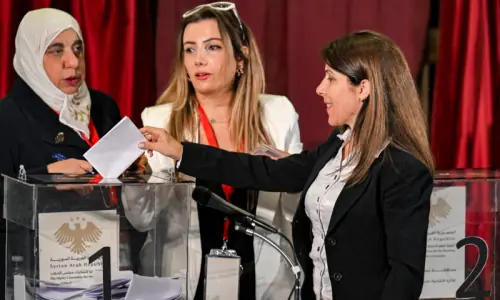
Just how steep the climb remains was visible in elections for the interim parliament held late last year. After decades of dictatorship and years of war, Syrians have limited democratic tools available to them. The transitional electoral process was indirect, relying on regional electoral bodies and presidential appointments rather than a fully competitive party system. In such circumstances, candidates often did not articulate clear platforms, and voters gravitated towards sectarian or factional affiliations. Women’s organisations held discussion sessions in major cities prior to the elections, yet the results were discouraging. In Damascus, despite hundreds of nominations, only a handful of women succeeded in securing seats — a dismal showing for a city of millions.
Revolutions — Syria demonstrates yet again — are ugly affairs. Normal life has been shredded by conflict and its wounds run deep. Those who assume power in this nascent state must confront the question of transitional justice. The scale of human rights violations demands either sweeping amnesty or some form of accountability through which survivors can claim dignity. Here too women often suffer most. One example cited by SWPM concerns a woman whose father was killed by the Assad regime, her brother by IS and another brother by a Turkish-backed armed group. Will all actors be held to account, she asks? The question captures the complexity of Syria’s path forward and the fragility of a country emerging from iron-fisted rule.
The SWPM is a brave organisation deserving support from women around the world. They are undeterred by the vast array of problems that freedom has brought to Syria and understand that freedom remains worthwhile nonetheless. In his recent book on the Syrian revolution, journalist Anand Gopal compared Syria to France after the French Revolution. Revolutionary change, he notes, does not unfold in an instant, but across long, drawn-out decades. As Syria endures these revolutionary pangs, the undaunted women of the SWPM are working to ensure that Syrian women will claim a place in their unwritten future.
The writer is an attorney teaching constitutional law and political philosophy.
Published in Dawn, February 28th, 2026