0
0

Kleber Mendonça Filho’s The Secret Agent (O Agente Secreto, 2025) marks a moment of consolidation in one of contemporary Brazilian cinema’s most consistent careers.
Since his early short films, such as Cold Tropics (Recife Frio, 2009), the filmmaker has developed a unique style packed with movie references that tantalisingly falls somewhere between arthouse and genre film. These traits reach new heights of self-awareness and formal freedom in The Secret Agent, which has been nominated for four Academy Awards, including best picture, and best actor for Wagner Moura.
The film belongs to a recent wave of Brazilian productions revisiting the military dictatorship (1964-1985), including Walter Salles’s Oscar-winning I’m Still Here (Ainda Estou Aqui, 2024), and actor/director Wagner Moura’s Marighella (2019). Yet these films do more than reconstruct historical episodes: they process, through cinema, an unresolved trauma whose reverberations continue to shape Brazil’s political present.
One of the features that makes The Secret Agent, set predominantly in 1977, particularly compelling in this regard is its treatment of universities, as battlegrounds where memory, power and democracy collide.
The 2025 Brazilian film The Secret Agent is a gripping thriller that reminds us why academic freedom needs protecting
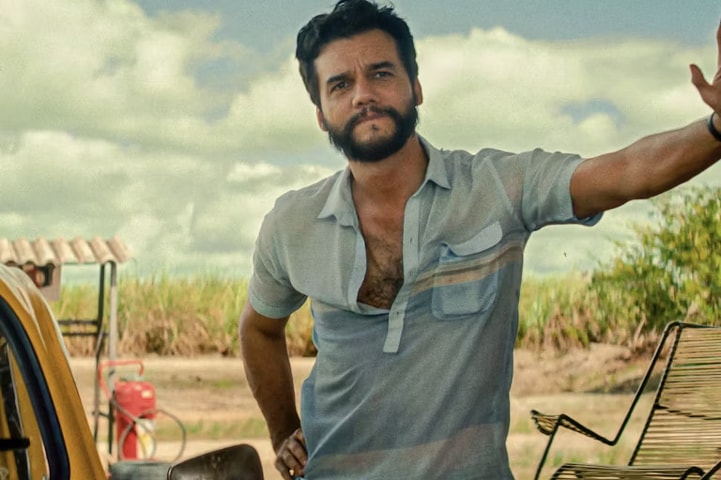
The film’s main character Armando, played by Oscar-nominated Moura, is not, in fact, a secret agent and has no obvious links to opposition movements. He is an academic forced into hiding after clashing with big business interests aligned with the authoritarian regime, who want to get their hands on his research.
Brazilian philosopher Marilena Chauí has spoken of her personal experience of these dark days in Brazil portrayed in Mendonça Filho’s film. Chauí returned from France in 1969 with her PhD in hand, just after the Brazilian military suspended most civil rights in the country, leading to a state hunt for “communists” and the intensification of torture and censorship.
Chauí describes the presence on campus of mysterious military figures with the power to hire and fire and “disappear” staff and students who were hostile to the regime. The presence of secret agents disguised as students to monitor professors and students in classrooms in public universities was commonplace.
In The Secret Agent, Armando has recently returned from the University of Leeds in Britain. He and the international research team he has set up at the Federal University of Pernambuco in Brazil’s north-east fall under the scrutiny of Henrique Ghirotti, an industrialist from Sao Paulo.
Armando openly questions Ghirotti’s ethics and points to a conflict of interest: how can a wealthy industrialist justify taking government funding, destined for universities, for his own private interests? Armando’s bitter reaction to such an open show of corruption is enough for him to become a marked man. Much of the film portrays Armando’s attempt to hide from Ghirotti and the corrupt law enforcement and paid assassins he has at his disposal.
This dramatic situation illuminates not only the surveillance and repression universities endured under the dictatorship, but also broader patterns of corruption. The spider’s web connecting military interests with big business that drained Brazil’s economic momentum throughout the 1970s, is a history that is only now fully coming to light.
The film’s focus on academic freedom carries contemporary resonance. Mendonça Filho wrote The Secret Agent during the presidency of far-right Jair Bolsonaro (2019-2022), whose long list of hostile measures included attacks on public education. Between 2019 and 2022, federal universities lost 14.4 percent of their budget, and by 2022 funding had fallen below 2013 levels.
Universities reported severe difficulties maintaining basic operations and scholarship programmes, with accumulated cuts exceeding R$100 billion ($18.9 billion) over four years. Bolsonaro and his followers encouraged the reporting (and “outing” on social media) of teaching staff deemed to be “ideological”.
Following Lula’s victory in the 2022 elections, modest relief arrived and, with the renewal of funding lines, the reconstruction of this ravaged terrain is slowly getting underway.
Archives of repression
The Secret Agent also speaks to renewed global debates around the privatisation of research, intellectual property, and the political vulnerability of universities, increasingly viewed as hotbeds of leftist sedition. Mendonça Filho’s film suggests that authoritarianism attacks society not only through violence but through the destruction, privatisation, or silencing of knowledge production itself.
The industrialist Ghirotti takes delight in informing Armando that he’ll be recommending that his research team is shut down and the work transferred to the University of São Paulo, with whom Ghirotti has dubious links. Ghirotti questions the usefulness of any research being carried out in the north-east that speaks to national interests, particularly when Canadians are working on the same tech and Brazil can pay for foreign science and technology.
Mendonça Filho, who is from Recife, the capital of Pernambuco, has been very vocal about the ingrained prejudice of many from the wealthier and whiter southern states in relation to the north, which is dismissed as backward. It is telling that, in The Secret Agent, Armando’s international research team first took shape in Leeds, given similar prejudices are often held about the north of England.
In a subplot set in the present day, a group of students work on an oral history project involving tape recordings made by dissidents during the dictatorship, including Armando. One of them, Flávia, travels to Pernambuco to visit Armando’s now middle-aged son.
A young black mother with family in the north-east, living in the periphery of São Paulo, Flávia, typifies the new, more diverse university student body, made possible by hard-won affirmative action initiatives and the expansion of the public university network.
In The Secret Agent, it is Flávia and students like her who have inherited not only the archives of repression, but also the possibility of transforming knowledge into a form of democratic repair.
Anchored by Wagner Moura’s compelling performance, Mendonça Filho’s film connects the struggles of the past to the curiosity and courage of a new generation. In so doing, The Secret Agent powerfully underscores cinema’s ability not only to entertain, but also to illuminate, question and inspire.
Stephanie Dennison is Professor in Brazilian Studies at the University of Leeds in the UK
Alfredo Luiz Paes de Oliveira Suppia is Associate Professor at the Dept of Multimeios, Media and Communication at the Institute of Arts, Unicamp in Campinas, Brazil
Republished from The Conversation
Published in Dawn, ICON, March 1st, 2026