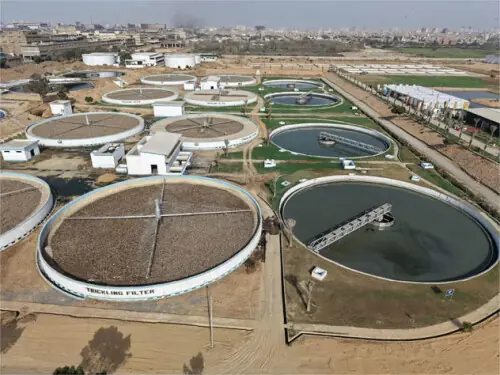
WATER scarcity hit Karachi in the last week of February 1976, when the work began to connect the newly laid 48-inch diameter pipeline in Gulshan-i-Iqbal with the federal trunk main. On Feb 24, the Karachi Development Authority (KDA) claimed it had resumed water supply 20 hours ahead of schedule in most parts of the city after the work was completed on Feb 22. The supply was stopped for 36 hours. Fortunately, the KDA engineers were able to complete the job much earlier than expected.
Apart from water shortage, uninterrupted supply of electricity was also becoming a problem for citizens as a result of which the Provincial Coordination Committee had to have a discussion on the subject in a special meeting. On Feb 27, it was announced that the Sindh government would have an effective control, and participation in the management, of the Karachi Electric Supply Corporation (KESC, now KE). The announcement came from the Sindh Information Minister, Mir Hazar Khan Bijarani, while speaking at the annual day function of the social committee of the KESC officers. He said the decision would be implemented as soon as the matter was finally decided by Chief Minister Ghulam Mustafa Jatoi and the Federal Minister for Power, Yousuf Khattak. Mr Bijarani iterated that the government was making all-out efforts to improve and streamline the electricity supply system throughout the province.
As better facilities for Karachiites were being considered, on Feb 28, a news story revealed that Pakistan’s only port at Karachi, considered to be the busiest in the region, had no facilities for salvaging vessels that ran aground or sank. It had become evident from the fact that at the time wreckage of at least six ships was either buried in the sand of the coast or lying under the sea. Experts suggested what’s needed for salvaging ships was the training of personnel in deep-sea diving, carrying out underwater repairs, and acquiring the equipment needed for the purpose.
Staying on the subject of maritime activity, on Feb 29 (yes, it was leap year), the Chairman of the National Shipping Corporation, Vice-Admiral (retd) S M Ahsan, said the increasing use of computers in Pakistan was bound to have a salutary effect on the growth and development of the country. Inaugurating the first short post-graduate course in computer science, organised by the Institute of Marine Engineering at PNS Karsaz, the NSC chairman said it was the duty of those engaged in scientific activities to understand the working of computers. The vice-admiral said in many countries, computers were being used for a multiplicity of operations such as civil engineering, advanced communication systems, administrative record-keeping, research information processing and statistical purposes. Their spread into all facets of society had been so great that a ‘computer revolution’ was regarded as being more significant than the industrial revolution. He pointed out, tremendous progress had been made as a result of computer utilisation in human capabilities to encode, record, reproduce and disseminate information. He added, “All these advances have made information a new basic resource that supplements familiar natural resources of water and energy.”
Published in Dawn, February 23rd, 2026