EXHIBITION: STATES OF MIND

The riddling title of Zahra Mansoor’s solo show ‘Fanaa is the Eclipse’ complements the enigmatic quality of her artwork.
Figures painted on fabric emerge from a watery backdrop as if they are participants in a ghostly theatrical performance. The use of diffused light and violet monotones serves to enhance the atmospheric content of Mansoor’s paintings. The presence of a moon in the paintings suggests the time is night — a time pregnant with mystery, shadow and silvery light.
This surreal environment befits the artist’s inquiries regarding gender archetypes and behavioural tropes. Mansoor states: “I have been consumed by desire, fantasy, mirages for most of my life.” Her imagined paradisiacal garden, or gulshan as she calls it, is a liminal zone where certainty is eschewed for the creative possibilities yielded by uncertainty and indeterminism. Noor Ahmed, the curator of this exhibition, says that the work “offers a space where the viewer must sit with the ambiguity of intimacy, of memory, of becoming.”
Mansoor, in the spirit of a flaneuse, has explored city environments from which she extracts inspiration for photographs and paintings. Karachi, Lahore and Paris figure in her alert wanderings. She notices repetitions in patterns of daily life, which she draws into her whimsical gulshan. She marries the textures of society to intellectual engagement with objects such as Persian manuscripts and calligraphic works. From an array of stimuli, Mansoor distills her poetic renditions with oil paint on a variety of fabrics such as cotton toile, gauze and chiffon.
Zahra Mansoor’s latest exhibition grapples with the nature of intimacy and unresolved inter-human relationships in a quirky manner
The softness of fabric is a challenge to the artist, whose hand must maintain the integrity of line and brushstroke on a pliable surface. However, the challenge is an integral part of the psychological and even psychic motivators for Mansoor’s art production, which explores shifting patterns.
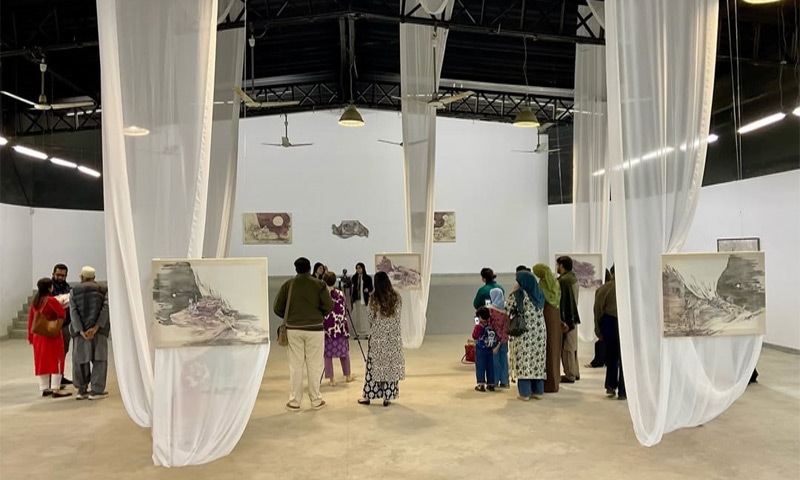
Within the cavernous space of the Sanat Initiative, Mansoor has hung stretched paintings on walls. She has also painted on sections of entire bolts of cloth, which are suspended from the ceiling to the floor. On these bolts, an area of cloth at eye level has been prepared by stiffening to become a canvas for a painting. These cascading displays function dually — as surfaces for paint and as arresting vertical installations.
The paintings represent visionary, almost hallucinatory, states of mind in which the mundane and the wondrous mingle with equal status. The painting I spend this summer missing last summer shows a semi-reclined woman on a divan. A large moon looms beside her.
In the work Over our sandwich and coffee I felt something inside me for you, three female figures, with disproportionate scaling, and a sofa coexist with the omnipresent moon reduced to a tiny circle.
I have never been a bulbul of Sufi song shows a youthful figure lying on a bed while another figure, off to a side, is occupied with a utensil. The two people are seemingly oblivious to each other’s presence. Although represented on a single surface, they may well occupy different dimensions of reality.
These images may be construed as psychological statements that grapple with the nature of intimacy, of inter-human relationships that are unresolved and unformalised. By contrast, the artist has recurring props, such as the sofa/divan/couch (and occasionally a bed) that seem to offer a comforting familiarity. These domestic objects should be devoid of relationship dilemmas, but not so in the Zahra Mansoor universe.
Mansoor’s self-conscious exploration of uncertainty, which is so nuanced in her paintings, is handled more explicitly in a short film called Doomed Love Trope, which is part of the exhibition. The simple plot of the film is based on Mansoor planning her wedding to the object of her love that is a purple couch. Without revealing the denouement of the story, it is sufficient to say that this seemingly absurd premise is meant to challenge what terms such as normality and ordinariness construe for us.
An engaging catalogue accompanies the show with quirky contributions by the artist, the curator and 11 of the artist’s friends, who have taken that bold leap into philosophical uncertainty required to probe the subliminal depths of Mansoor’s lilac-tinted gulshan.
‘Fanaa is the Eclipse’ was on display at the Sanat Initiative from January 13-22, 2026
The writer is an independent researcher, writer, art critic and curator based in Karachi
Published in Dawn, EOS, February 22nd, 2026