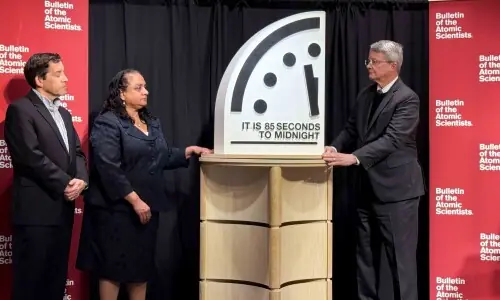
ISLAMABAD: Experts warn that the expiration of the New START Treaty marks a decisive shift in the global nuclear order, pushing it into a more uncertain and unstable strategic era, what a scholar called, the “fourth nuclear age”.
According to a media statement issued on Friday by the host institute, the warning came during a discussion titled “Entering Uncharted Waters: Arms Control after the Expiration of the New START Treaty”, organised by the Centre for International Strategic Studies (CISS), Islamabad, where experts examined the trajectory of the global nuclear order, reflected on key milestones such as 1995 and 2005, and debated the prospects for future arms control in a shifting geopolitical and technological landscape.
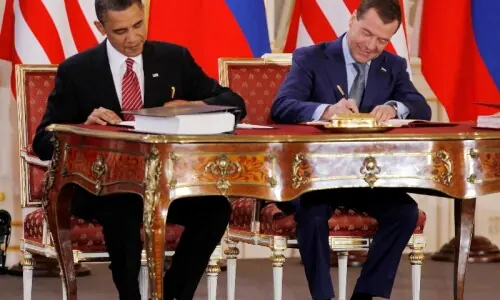
The New START Treaty between Washington and Moscow, which has been effective since 2011, capped the number of deployed strategic nuclear warheads, backed by inspections, data exchanges and notification mechanisms.
It was initially set to expire in 2021, but was extended once until Feb 5, 2026. With no follow-on agreement reached, the treaty expired, ending verifiable bilateral limits on US-Russian strategic nuclear forces for the first time in decades.
There was a consensus among the experts that the outlook for global arms control appears bleak.
CISS Executive Director Ambassador Ali Sarwar Naqvi said in a transformed strategic environment, the debate has moved beyond whether arms control can endure in its traditional form.
“In this transformed strategic environment, the central question before the international community is not merely whether arms control can survive, but what form it can realistically take in a rapidly changing technological and geopolitical landscape.”
Prof (Dr) Zafar Nawaz Jaspal, dean of social sciences at Quaid-i-Azam University, said the lapse of the treaty had ushered in a new strategic era.
“With the expiry or termination of the New START Treaty, we have now entered the fourth nuclear age.”
He added that broader multilateral arrangements would be difficult to achieve. “The convergence of all nuclear states on one treaty, or a multilateral treaty, will be difficult,” Dr Jaspal maintained.
Dr Rubina Waseem of the Centre for International Peace and Stability, Nust, stressed that the treaty’s value lay not only in numerical limits but in its stabilising mechanisms.
“New START’s importance extended beyond numerical limits to transparency, verification, and predictability mechanisms such as inspections, data exchanges, and notification regimes,” she argued.
She outlined the structural fallout of its expiration saying “its expiration produces three structural consequences - removal of legal ceilings on strategic arsenals, allowing potential rapid quantitative expansion; collapse of verification systems, increasing uncertainty and worst-case planning; normative erosion, weakening the credibility of the global non-proliferation regime.”
Sharing Moscow’s perspective, Dmitry Stefanovich of the Primakov Institute said the end of the treaty does not automatically mean an arms race but creates long-term risks.
“The expiration of New START does not automatically trigger an arms race, but creates the conditions for one over time,” he said, adding that “in the absence of negotiations, states will increasingly plan on worst case assumptions, shaping military force postures and industrial planning for decades ahead.”
Dr Bilal Zubair, director of CISS, said the implications extend beyond the loss of a single agreement as it represents “a broader erosion of the arms-control mindset that sustained strategic stability for decades”.
Published in Dawn, February 21st, 2026