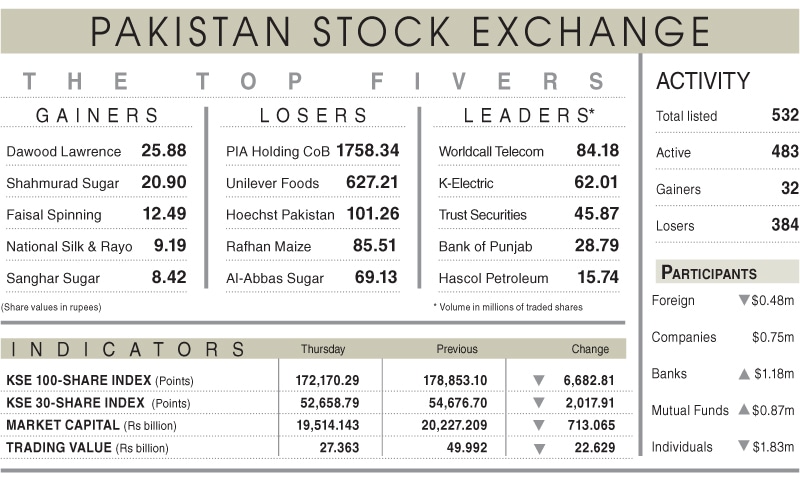

KARACHI: Mounting geopolitical tensions and a surge in global oil prices triggered across-the-board panic selling at the Pakistan Stock Exchange (PSX) on Thursday, dragging the benchmark KSE-100 index below the 173,000 barrier and wiping out Rs713 billion in market capitalisation in the first session of Ramazan.
The index suffered its steepest single-day decline in history, closing at 172,170.29, down down 6,683 points or 3.74 per cent after touching an intraday low reflecting a drop of 7,205 points amid relentless selling and extreme volatility.
The sell-off followed a spike in international crude prices, up over 6pc in two days amid fears of supply disruption linked to escalating tensions between the United States and Iran. As a net oil importer, Pakistan is particularly vulnerable to higher energy prices, which intensified macroeconomic concerns and dented investor confidence.
Farid Alam of AKD Securities said investors reacted swiftly to perceived regional instability, citing reports of a possible US attack over the weekend. Pakistan’s geographic proximity and economic vulnerabilities amplified market anxiety, he added.
He noted that heightened domestic political tensions, including sit-ins and roadblocks, further weighed on sentiment.
Mr Alam also referred to data from the Securities and Exchange Commission of Pakistan showing that 125 foreign companies had exited the country, but said a detailed breakdown suggested this did not represent sudden capital flight. Many of the firms were dormant, project-based, or undergoing restructuring. In volatile conditions, he observed, headlines can disproportionately affect sentiment relative to underlying fundamentals.
Addressing speculation about market manipulation, he said broad-based declines of such magnitude are typically driven by sentiment, leverage unwinding and macroeconomic risks rather than coordinated action by large players. He advised small and new investors to avoid panic selling during periods of extreme volatility.
Mohammed Sohail, Chief Executive of Topline Securities, attributed the downturn to reports of delays in the Reko Diq project, aggressive foreign selling and corporate results falling short of expectations.
Market pressure was compounded by persistent foreign corporate outflows, while data showed local insurance companies emerging as major sellers, adding to downward momentum.
Shortened trading hours due to Ramazan curtailed participation and amplified price swings. Trading volume fell 22.17pc to 543 million shares, while traded value plunged 45.26pc to Rs27.39bn.
Index-heavy stocks, including Fauji Fertiliser Company, Engro Holdings, United Bank Ltd, Oil and Gas Development Company, Pakistan Petroleum Ltd and Meezan Bank, collectively erased 2,113 points from the benchmark.
Ali Najib, Deputy Head of Trading at Arif Habib Ltd, said intense selling pressure erased the previous session’s rebound and reinforced the market’s fragile undertone.
On the corporate front, Faysal Bank reported CY25 earnings of Rs22.5bn (earnings per share of Rs14.80), down 6pc year-on-year. Quarterly profit stood at Rs6.5bn, up 83pc year-on-year and 17pc quarter-on-quarter. The bank announced a cash dividend of Rs2 per share, taking its total CY25 payout to Rs6.5 per share.
Financial and technical analyst Khalid Saifuddin said the market had already priced in most positive triggers and scaled historic highs, leaving it vulnerable to correction. With the results season largely over, conditions were ripe for exhaustion, he remarked, describing the earlier rally as a “bull trap” and Thursday’s fall as a release of built-up pressure.
He said political uncertainty, cross-border tensions and heightened regional risk perceptions, particularly linked to US-Iran developments, had amplified volatility. Investors were also closely watching the outcome of the prime minister’s engagement with US leadership, as ambiguity over Pakistan’s geopolitical positioning tends to unsettle markets.
Regarding upcoming external payment obligations, including a maturing Eurobond in April, he said such factors typically act as volatility catalysts and are often discounted in advance through price action.
Analysts expect the 172,000-170,000 range to serve as critical support, while 180,000 has emerged as immediate resistance for any meaningful recovery attempt.
Published in Dawn, February 20th, 2026