The looming US stock market correction
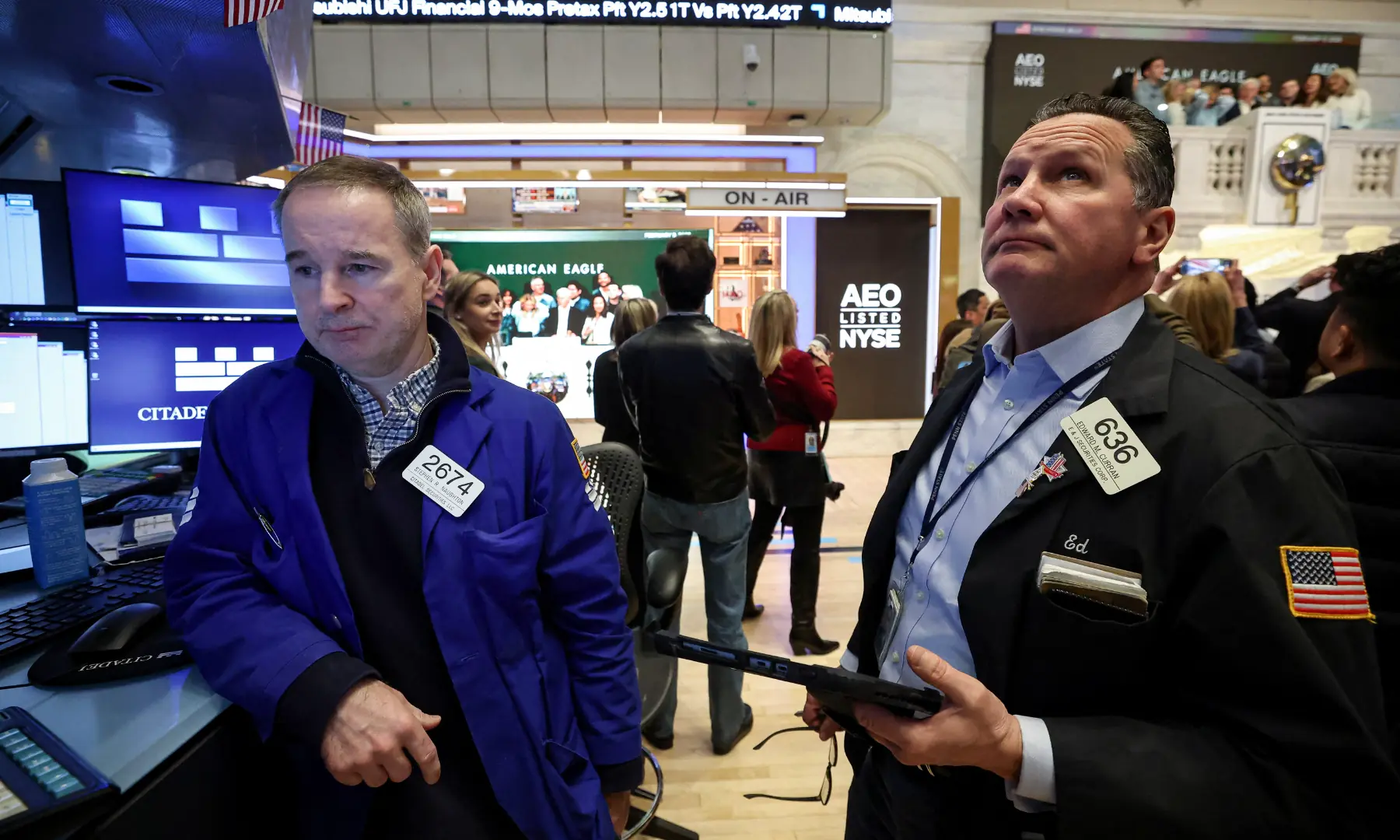


THE US equity market enters 2026 priced for near-perfection; after backto-back gains exceeding 20 per cent in 2023 and 2024 and further advances in 2025, the S&P 500 trades near record highs. Yet beneath index strength lies extreme concentration, elevated valuations, record peacetime fiscal deficits, and heavy positioning in a narrow artificial intelligence-driven leadership cohort. History suggests such combinations rarely resolve without turbulence.
Since 1950, the S&P 500 has experienced an average intra-year draw down of about 14pc; even in the years that ultimately finished positive.Double-digit corrections occur with regular frequency roughly once every 18 months on average. Midterm election years have historically been among the most volatile in the fouryear political cycle, with draw downs often materialising before year-end stabilisation. Policy uncertainty fiscal negotiations, tariff risks, regulatory shifts and central bank independence debates tends to peak during these periods.
Valuations leave little margin for error. The S&P 500`s forward price-to-earnings ratio has hovered in the 21-23x range, materially above its 30-year average near 16-17x. The Shiller or the cyclically adjusted price-to-earnings (CAPE) ratio has fluctuated around 38-40, a level seen meaningfully only during the 1999-2000 dot-combubble and briefly during the 2021 liquidity surge.
Historically, starting from such CAPE levels has implied subdued forward 10-year real returns.
The concentration risk is acute. The top 10 stocks account for roughly one-third of the S&P 500 market capitalisation near record territory. The so-called `Magnificent Seven` have driven a disproportionate share of cumulative returns over the past three years. Equal-weighted indices have materially under performed their cap-weighted counterparts, revealing weak breadth beneath headline gains.
Howard Marks, co-founder of Oaktree Capital and one of the world`s most respected credit investors, addressed this dynamic in his 2025 memo on return dispersion. He noted that headline index returns obscure the extreme divergence beneath the surface: a small subset of mega-cap Al beneficiaries delivered extraordinary gains while the median stock lagged significantly. Dispersion between the top and bottom quartile performers reached levels more typical of late-cycle environments or speculative episodes. When leadership narrows excessively, systemic fragility rises because capital crowds into fewer names.
The fuse is lit by overextended Al bets. The largest US technology companies are guiding toward roughly $200-250 billion annually in capital expenditures, much of it tied to Al infrastructure and data centres. Over a multi-year cycle, cumulative spending approaches $700bn.
Markets are pricing in high and sustained returns on this capital. If revenue realisation lags expectations, multiple compressions could be abrupt.
The macro transmission channel is powerful.
US households hold more than $40 trillion in equi-ties. A 10pc market decline would erase approximately $4tr in wealth. Federal Reserve research suggests that each dollar of lost equity wealth reduces consumer spending by roughly two-four cents over time. That implies an $80-160bn drag on consumption on the order of $100bn in GDP impact via wealth effects alone. In an economy where consumption represents about 70pc of GDP, the feedback loop is nontrivial.
Recent volatility in Al-sensitive software and growth stocks has already demonstrated how quickly repricing can occur. During rotation phases over the past two years, trillions of dollars in market capitalisation have been erased, peak-to-trough, across high-multiple technology sectors. While some investors frame these episodes as buy-thedip opportunities, they underscore how dependent index stability has become on continued enthusiasm for capital-intensive Al leaders.
Positioning adds fuel; Bloomberg, citing Goldman Sachs prime brokerage data, reported that during recent risk-off weeks hedge funds` net selling of US equities outpaced long purchases by roughly two-to-one, with notional short exposure rising toward historical highs. The industry remains structurally net long, but the tactical shift signals growing scepticism about valuation sustainability. If key technical levels in the S&P 500 were breached, systematic and commodity trading advisor strategies could mechanically accelerate de-risking, amplifying volatility.
Moreover, fiscal arithmetic compounds the risk.
US federal deficits remain near 6-7pc of GDP outside recession historically rare. Public debt exceeds 120pc of GDP. Treasury issuance is heavy, and refinancing occurs at interest rates farabove the near-zero regime that prevailed for more than a decade. Even modest upward pressure on yields tightens financial conditions and raises discount rates applied to future earnings a headwind for high-duration equities.
The global context is equally fragile. Ray Dalio, founder of Bridge water Associates, the world`s largest hedge fund, has argued that the US and the global economy are in the late stages of a long-term debt cycle. High debt burdens, rising interest costs and geopolitical`capital wars` are eroding trust in the monetary order. His framework suggests that elevated asset valuations combined with structural debt imbalances historically precede sharp repricings.
Gita Gopinath, former first deputy managing director of the International Monetary Fund (IMF) and the IMF`s Chief Economist, has similarly warned that global buffers are thinner than before prior downturns.
The diversification argument is further reinforced by asset performance in 2025. A weakening US dollar provided additional tailwind to international equities. Historically, periods of dollar softness coincide with stronger relative performance for non-US stocks and commodities.
As such, precious metals were standout beneficiaries with gold reaching repeated record highs during 2025 and silver outperformed gold during parts of the year.
The writer is the former head of Citigroup`s emerging markets investments and author of`The Gathering Storm`.
Published in Dawn, The Business and Finance Weekly, February 16th, 2026