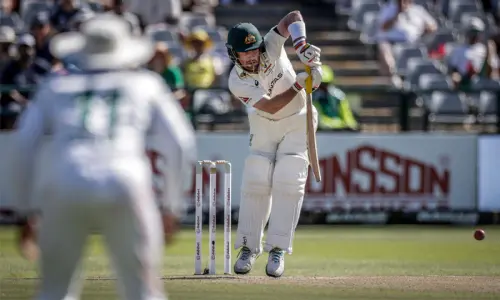
COLOMBO: India captain Suryakumar Yadav and his Pakistan opposite number Salman Ali Agha did not shake hands at the coin toss for their T20 World Cup showdown in Colombo on Sunday.
Salman won the toss and elected to bowl in the Group A match, which was only confirmed as going ahead six days ago when the Pakistan government made a U-turn on a threat to boycott the match.
Yadav also did not shake hands with Salman in any of their three matches at the Asia Cup in Dubai last year, including the final.
The biggest and most lucrative clash in world cricket was in doubt after Bangladesh refused to play their T20 World Cup matches in India and were kicked out, replaced by Scotland.
The Pakistan government protested and responded by ordering its team to boycott the India game in Sri Lanka, the tournament’s co-hosts.
The cricket teams of the nuclear-armed neighbours only meet in multi-nation tournaments at neutral venues as part of a compromise deal.
It has been more than 18 years since India and Pakistan last met in a Test match, and 13 years since either side crossed the border to play a bilateral series.
Former Indian cricketer Sanjay Manjrekar directly addressed the no-handshake policy, criticising it sharply on X: “This ‘no shaking hands’ is such a silly thing that India has started.
“It’s unbecoming of a nation like ours. Either play properly within the spirit of the game or don’t play at all. The 35,000-capacity R. Premadasa Stadium was sold out for the clash, with tickets going for more than four times face value on the black market.
Excitement was building outside the ground before the start of the hotly awaited clash.
Sri Lanka nationals Saleem Ali and Naseem Ali took a seven-hour bus ride from Trincomalee to be at the game.
“We are here to support Pakistan,” said Saleem, 32. “I predict Pakistan will score 180 and then get India out for 140. I want a Sri Lanka v Pakistan final in Colombo.”
Indians Inderjeet Singh Satwal and Kuldeep Singh Nirh travelled from Aurangabad in Maharashtra.
“India is the clear favourite, but the build-up to this match was disappointing,” Nirh said. “Politicians have spoiled a good game of cricket.”
Former England captain and commentator Mike Atherton weighed in on the broader context of the fixture’s politicisation, writing in his column.
“When Pakistan pulled out of the fixture a fortnight ago on government advice, sending a financial shiver down the spine of the cricketing fraternity, it highlighted two things: first, how politicised the game has become in the region and, second, how fragile the cricket economy is — disproportionately reliant on a single match that can be played only at global events on neutral soil between two countries whose relationship is toxic.”
Published in Dawn, February 16th, 2026