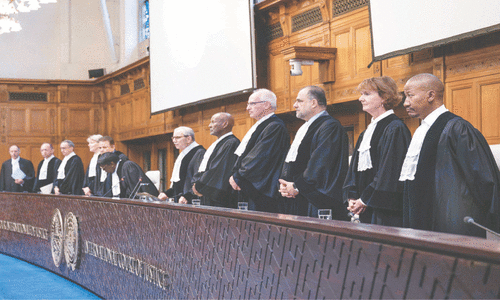
NABLUS: Five months after Israel’s Supreme Court ruled that its prisons were failing to provide enough food for Palestinian detainees and ordered conditions be improved, emaciated prisoners are still emerging with tales of extreme hunger and abuse.
Samer Khawaireh, 45, said that all he was given to eat in Israel’s Megiddo and Nafha prisons was ten thin pieces of bread over the course of a day, with a bit of hummus and tahini. Twice a week some tuna.
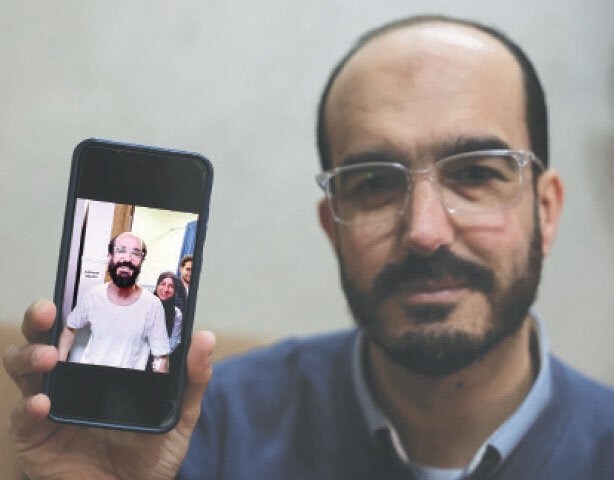
Videos saved on Khawaireh’s phone show him at normal weight before he was detained in the West Bank city of Nablus last April, and clearly emaciated upon his release. He says he lost 22 kg (49 pounds) during nine months in captivity, emerging a month ago covered in scabies sores and so gaunt and dishevelled his 9-year-old son Azadeen didn’t recognise him.
This news agency reviewed 13 such reports from December and January, in which 27 prisoners complained of a lack of food, with most saying provisions had not changed since the court order.
The Association for Civil Rights in Israel (ACRI), which was involved in last year’s landmark court case that led to the order for better treatment for prisoners, has accused the government of harboring a “policy of starvation” in prisons. Khawaireh, a journalist at a Nablus radio station who was held without charge, said he was never told why he was detained in a night raid on his house in April.
Contempt of court
Independent verification of the treatment of detainees has become more difficult since the start of the Gaza War, when Israel barred prison visits by the International Committee of the Red Cross, a role the Geneva-based body has played in conflicts around the world for a century.
ACRI has petitioned Israel’s Supreme Court to allow Red Cross access to Palestinian detainees. It has also applied to court to have the prison service held in contempt for failing to comply with last September’s order that it improve conditions. “All the indications that we’re getting are that not much has changed” since the court ruling, the group’s executive director Noa Sattath said.
“The prisoners are not getting more food if they ask for it. There hasn’t been any medical examination of the situation of the prisoners, and the prisoners are still hungry.”
Ben-Gvir’s control over prisons
Prime Minister Benjamin Netanyahu put prisons in the hands of Ben-Gvir, a far-right settler activist known for keeping a portrait in his living room of a Jewish gunman who killed 29 Palestinian worshippers in a West Bank mosque.
Among Ben-Gvir’s first acts in office was to shut prison bakeries where Palestinian detainees had been allowed to make their own food, saying he aimed to cancel “benefits and indulgences”.
He has since publicly denounced courts for trying to force prisons to coddle Israel’s enemies. During last year’s court hearings, he called the case “crazy and delusional” in a post on X, mocked the judges for debating “whether the killers’ menu is balanced”, and said he was “here to make sure the terrorists get the bare minimum”.
ACRI says the far-right’s criticism of judges amounts to a smear campaign intended to intimidate the judiciary. In 2024 the Supreme Court took the unusual step of complaining publicly over posters put up by right-wing activists, denouncing judges.
Hunger, more widely, has been an issue in Gaza, where the United Nations says Israeli supply restrictions caused malnutrition among the more than two million Palestinian residents, reaching famine scale in mid-2025.
Published in Dawn, February 12th, 2026