KARACHI: After three vibrant days of literature sessions, including discussions, debates, book launches, culture sessions, poetry recitals, film screenings and so much more, the 17th Karachi Literature Festival (KLF) at the Beach Luxury Hotel came to a close on Sunday evening.
In the words of the Managing Director of the main organiser Oxford University Press (OUP) Pakistan, Arshad Saeed Husain, the event “enthralled, captivated, satiated and prompted deep thought”.
This year’s theme of the KLF, ‘Literature in a fragile world’, was felt deeply in the concluding day’s keynote address by the acclaimed writer Mohammed Hanif, who earlier in the day also had the launching of his latest book Rebel English Academy.
While offering his translation to ‘fragile world’ as “dangerous times”, he said literature festivals such as the KLF bring together people who love books and some who pretend they like books to impress others.
“But I also have friends who don’t read or write and they are perfectly fine people, too,” he reminded.
Three-day event concludes
Getting more serious then, he said that he wanted to tell a story since books are about stories. “It is a story about a boy who was slightly more literary than others. His name is Junaid Hafeez and he was born in the small district of Rajanpur into a regular struggling family,” he began his story, while adding about how brilliant the boy was. “He topped in FSc and easily got admission to the King Edward Medical University in Lahore where after two years of acing all exams he falls in love with books. Reading all kinds of literature, he could lay his hands on, he suddenly realised that he is no longer interested in becoming a doctor because he thought that with that he would be living a singular life but with reading and writing he could live many lives within one life. Therefore, he quit medicine,” he said.
“A scholarship got him into a Master’s programme in a US university. From there he returned for an MPhil from the Bahauddin Zakariya University following which he started teaching. And one day, while teaching he said something which got him arrested, charged with blasphemy and sentenced to death. His first lawyer was also shot dead. No judge is interested in hearing his case. But sitting in his solitary cell for the last 13 years he wrote a poem with each of its verses ending with ‘you’. He is looking to you to do for him whatever is in your power. And if you think that he did say something that was so wrong, then say a quiet prayer for him,” he concluded.
Earlier, the day opened with an inter-school debate on ‘Literature Today: Elitist or Essential?’, setting the tone for discussions on access, relevance, and the future of ideas.
The screening of the short film Screen Locked resonated with those addicted to their mobile phones and social media.
“Umar Mujhay Likhti Hai by Kishwar Naheed’ was another beautiful session moderated by senior journalist and poet Fazil Jamili with the panel comprising Kishwar Naheed, Syed Jaffar Ahmed, Noorul Huda Shah and Najeeba Arif. On being read out by the moderator, Kishwar Naheed’s famous poem Hum Gunahgar Aurtein earned a standing ovation yet again.
Ghazi Salahuddin said that the government can close down a newspaper in half an hour and a channel within 10 minutes. “But the challenge is to run these successfully while taking on the pressure,” he said. He also said that with the closing of The Herald and Newsline magazines, investigative journalism itself died here as no one was interested in it anymore.
A public interest session about ‘Media in the emerging world order’ had journalists Amber Rahim Shamsi, Ghazi Salahuddin, Azhar Abbas, Owais Tohid and Nadia Naqi highlight the challenges faced by the media today.
Another session about ‘Pakistani TV Drama: adakari, hidayatkari ya kahani’ with Ahmad Ali Akbar, Saife Hasan, Zhalay Sarhadi and Alyy Khan, which was moderated by Raju Jamil, ran into extra time as the panellists debated whether the story, clothes, looks, makeup, sets or script matter more in making a play a big hit with the audience.
‘The great KLF debate: will AI take over?’ attracted enthusiastic audience participation. Salma Alam, CEO Durbeen said, “We are planning on scaling up teachers’ skills. A good teacher is a good educator. We are working on a public-private partnership to set up a graduate programme to produce teachers’ educators.”
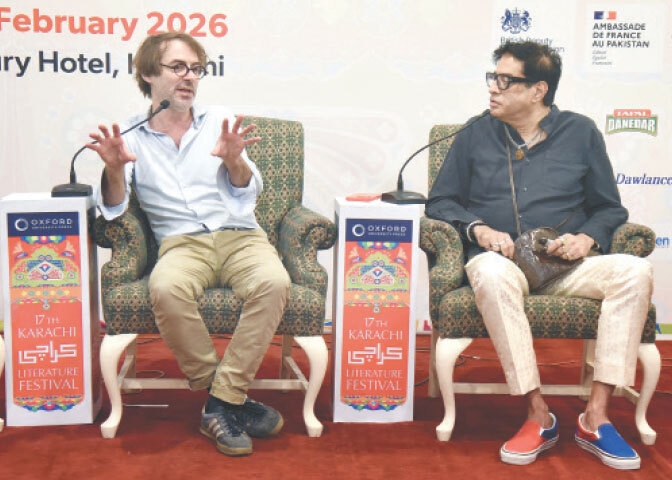
In two arty sessions, Amin Gulgee spoke about his book Gulgee Museum: The Handbook with Niilofur Farrukh and with Nicolas Engel about ‘Museums without borders: A curator’s journey’.
Published in Dawn, February 9th, 2026