Two worlds: Deepa Mehta’s films and Kamila Shamsie’s novels
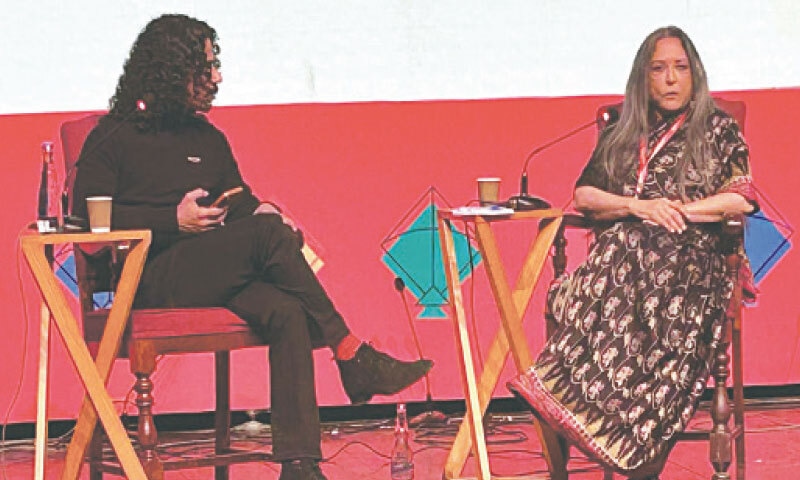


LAHORE: One of the stars of this edition of Lahore Literary Festival was Indian-Canadian film director and writer Deepa Mehta. In a session on Saturday, she discussed her process of film-making and the challenges she faced in her work among other things.
The moderator of the session, most of the time, looked lost and disoriented as if he was not familiar with Ms Mehta’s cinema or had lost the set of questions he had written on his cell phone. Deepa Mehta, the director of Midnight’s Children, Earth, Fire and Water and many others, as well as her audiences deserved better.
During the conversation, she herself gave something worth listening to the audience who had come to hear her speak about their favourite films. Speaking about Earth, set in Lahore at the time of the Partition, she said she wanted to do a film on the subject of Partition.
“I thought I would do that on my parents. My father who went to Govt College here. He missed Lahore, missed his friends.” He was forced to migrate to Amritsar after the Partition.
She went to the South Asian section of a bookstore and saw a novel (Ice Candy Man) by ‘someone named Bapsi Sidhwa’. On its back, it there was a line, “All wars are fought on women’s bodies”. It was a eureka moment, she said. She called her Pakistani friend, Nasreen Rehman, asked about Bapsi and found that they were the best of friends.
Regarding working with Salman Rushdie for her film, Midnight’s Children, she said she took him on board beforehand so that there won’t be any differences later on and on most points, both of them were on the same page.
Speaking about challenges during film making, Ms Mehta said she would have loved to shoot Earth in Lahore. She said she had visited with her production designer and spent a lot of time with Nasreen’s mother. Once they were sure that they won’t be allowed to shoot here, they went back to Delhi and found it similar to Lahore.
“There is not one shot in Earth which was in studio,” she said.
She regretted shooting Fire in English. She had written the script in English and two weeks before shooting gave it to an Indian writer to translate it into Hindi but he did not like the subject. She and Shabana Azmi decided to do it in English.
KAMILA SHAMSIE: Pakistani-British novelist Kamila Shamsie said her first four books were based in Karachi where she grew up and the fifth one was also going to be a novel set in Karachi in summer 1998 when there were nuclear bomb happened and the character who was from Karachi had a Japanese grandmother who was in Nagasaki when it was bombed. This shifted her focus to look for the grandmother and questions about her life in the Japan of 1945.
While teaching creative writing in America, Kamila said she always told her students that if you are comfortable with what you are going to write about, it’s waste of time and “if you wanna write something and it scares you, you have to at least try”. That what she herself did when she started writing her novel, Burnt Shadows, about Nagasaki of 1945 as for writing the novel, she had to do research on people’s outfits and eating habits during the war and it took the longest time. For such books, she said, writing becomes a form of discovery.
Replying to a question, Ms Shamsie said she was very optimistic about the people at the personal level. I once almost drowned in Australia. “I was swimming in Byron Bay and got caught in rip tide and I had no idea what it was……I almost drowned.”
She said about eight strangers saved her life that day and she had conviction that those strangers would not let her down. At individual level, people are extraordinary to each other but when in power, it would become a different story, she said and added that when humans would involved in politics, they would get selfish.
Kamila said she became a British citizen in 2007 and was surprised to see how passport changed things for her. “For the first time when I went to Italy, the customs personnel just looked at my passport and waved her through. But they looked at every page of a Pakistani passport.”
She said it had become harder now to acquire more passports. About 1.5 years back, Kamila moved to Doha where she lives now.
Published in Dawn, February 8th, 2026