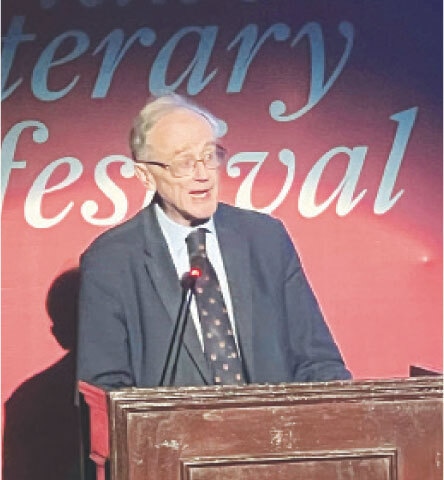
LAHORE: British historian Robin Lane Fox opened the 14th edition of the Lahore Literary Festival (LLF) with his keynote address that gave another view of Alexander’s invasion of that part of ancient India, which is now Pakistan.
Speaking at the Alhamra Art Centre here on Friday, he said there was no archaeological evidence of Alexander’s invasion of India (Pakistan) but there were literary accounts. He said according to Alexander’s teacher Aristotle, the world ended by Afghanistan and the River Nile at some point met River Indus. Alexander also thought that if he rowed by the Ganges, he would reach the edge of the world.
About India at the time of Alexander, Fox said the Indian tribes were attacking each other and Alexander thought he would lift them. He said if any local ruler submitted to the Greek invader, he was honoured and reinstated and if anybody challenged and rebelled against him, he was attacked.
Fox said there were people in Pakistan who claimed to be descendents of Alexander like Kailash tribe in the north and Afridi tribe in Khyber Pakhtunkhwa but there was no genetic evidence of it. He found similarities in the followers of Dionysus and Sufi dancers of Sehwan Sharif in Sindh.
Describing the life as Alexander soldiers saw in Taxila, he said that in Taxila, the officers described the women as beautiful, graceful and modest. The Greeks also gave details of marriage practices, saying that “how sometimes the poor fathers would bring their daughters to the market place and first of all would strip them on the front so that men could see and then the back, so that they could see the back and then would give them away as brides”.
He said the Greeks noticed the practice of Satti where younger wives of men were burnt on the funeral pyre with him on them. “Why were they doing this, the Greeks asked, they came up with a wonderful answer. Indian men married younger girls and younger girls became bored with their growing old husbands. So they took young lovers and wanted to get rid of their older husbands. So they thought of poisoning them. And husband introduced the rule that if they did poison them, they would be on fire with them”.
Regarding how to seduce these extremely modest women, not willing to slip and that if you gave them an elephant you could seduce them easily.
Speaking about war elephants, he said it was another different thing that the Greeks encountered in India. Showing old archaeological testimonies, he said the howdah on an elephant was a Greek idea.

Robin Lane Fox talked about the famous battle of Alexander with King Porus with the help of images. He said Alexander had studied the movement of elephants and how their legs moved. He said the Greek leader noticed that if attacked from behind an elephant or from the sideways, it would not charge or confront you and you could scare it.
He said Alexander founded two cities in present day Pakistan, one after his dog and another after his horse.
According to Fox, the Greeks encountered a tide in the sea for the first time on their way back and they were quite averse to the Indian monsoon rains too. He also met the spiritual men (wise men) and was quite impressed by their philosophy. He said Alexander brought to India military understanding, coinage and monumental writing.
Earlier, FS Aijazuddin introduced Fox and read a paper on him.
RAFAQAT HAYAT: Urdu fiction writer Rafaqat’s book of short stories, Ooper Wali Mazil, was launched in a session moderated by academic and writer Zaheer Abbas. Hayat’s first book of short stories, Khah Makhah Ki Zindagi, was published in 2003. He has published two novels since then.
When asked about this gap, the author said he had started his writing career with short stories in 1991/92 and this collection was published by Asif Farrukhi.
“I considered myself a short story writer. But I had a repertoire with Saleemur Rehman and I used to send him my writings. Saleem Sahib used to say that your short stories showed that you were a novelist.” Hayat said he himself felt that his short story would start expanding and after a certain time, the stories would start getting out of control.
He declared that writing short stories was more difficult than writing a novel because a writer had to do extensive work on the start, climax and end for every story. He said he wanted to publish his next novel in 2027 and a short stories collection in 2030 but Dr Anwar of Readings called me and insisted on publishing my short stories. But he had to write some stories once again altogether.
“Out of 11 stories in the book, eight were written 20 years back and in the last 20 years, I wrote just three short stories. That’s how this book was ready to be published.”
Hayat called Dostoevsky as his writing guru and that he learnt a lot from him, describing his writing process and what inspired him to write a certain story. One story in the book was inspired by the Russian master’s “A Most Unfortunate Incident” but he kept its setting in Hyderabad, Sindh, while another story was inspired by ‘White Nights”.
Rafat Hayat said he learned from Chekhov as he had read him closely.
Published in Dawn, February 7th, 2026