Egyptian and Indus Valley civilisations ‘were in contact’


 0
0

• Archaeologist says love of jewellery was common to both cultures
• Says unlike ancient Egyptian texts, Mohenjo Daro’s scripts are yet to be deciphered
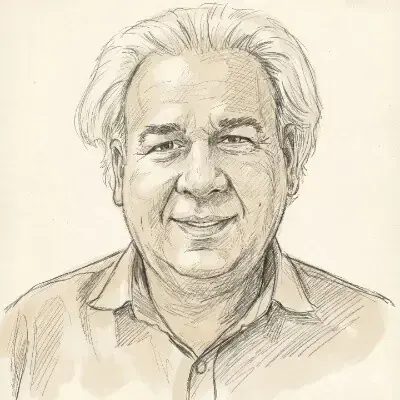
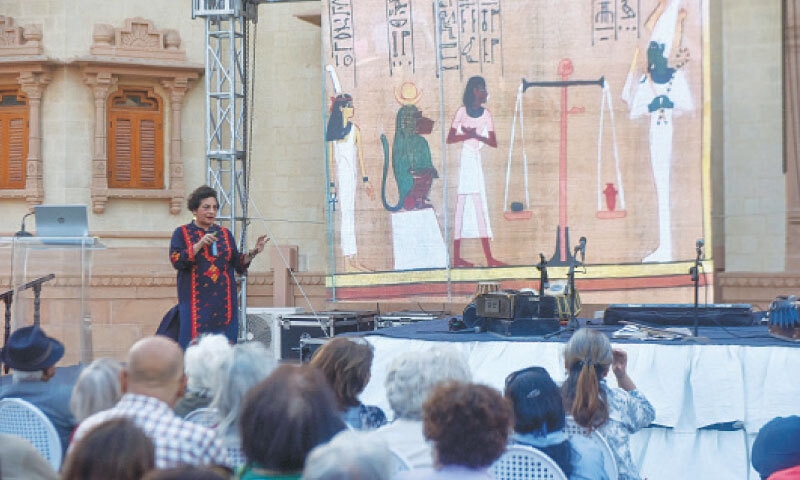
KARACHI: While ancient Egyptians made a statement about power through their art, the Indus Valley Civilisation did not use much of its art as propaganda, said eminent Egyptologist, archaeologist and author Dr Salima Ikram.
During her talk on the subject ‘From the Indus to the Nile: Exploring Religion and History’at the Mohatta Palace Museum on Wednesday evening, she said, “We are about 4,000kms away from central Egypt. Despite that, there have been several communications over the years where people have been coming and going between these two separately vast places.
“Ancient Egypt has managed to command popular imagination. It’s managed to enthral us in so many ways which is why you’re [audience] all here today because you do live with the Indus, with Mohenjo-Daro, with Harappa. Ancient Egypt has also exerted a spell over people over millennia and you can see it in all sorts of things, such as, its architecture.”
She said ancient Egyptians influenced art through the ages. “Even the cubists were influenced by them as Picasso and other artists changed their way of looking because of Egyptian art. It was how the image was formulated… Of course, it also influenced fashion. Obviously, Hollywood and film culture all over the world has been influenced by them.”
She mentioned some films such as The Mummy in that regard and pointed out that even in Karachi we see inspirations from ancient Egypt with examples such as ‘Pyramid productions’.
Since the archaeologist is the only Pakistani Egyptologist in the world, she then briefly went down memory lane to tell the audience about the time when her parents gave her a book on ancient Egypt when she was eight years old. She was mesmerised. When she was nine years of age, she went to Egypt which cemented her love of Egypt.
Coming back to the topic, the scholar said people ask her why Egypt, what’s wrong the Indus Valley Civilisation?
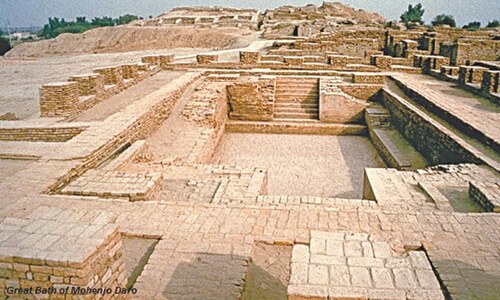
“It is difficult sometimes. I mean, [here] we have urban planning, we have fantastic mud brick architecture, we have incredible water systems, sewerage systems that nowadays we would die for, we had complex rituals. From Mohenjo-Daro, we have social stratification. It is indeed a complex culture. It is really a phenomenal set-up. In Egypt, we also have some of the same. We have urban planning, not as good, we have water supplies, not quite as good, but we have the Nile, we have complicated temples. One thing to remember about the Indus Valley Civilisation is that everything, apart from the pots, are small, everything is miniaturised. I don’t know why it is. Our culture seems to shrink down. The Egyptians, on the contrary, go big. That, too, is something that’s part of their appeal.”
She reasoned why in Egypt they try to be big. “Some of it is associated with kingship, making a statement about power and control. What was going on with the Indus Valley [because] they were not using much of their art as propaganda?”
Shifting her attention to [possible] contact between the two civilisations, the archaeologist talked about the gods that existed in Egyptian Civilisation, and it’s not clear in the Indus Valley as to who’s god and who is not.
“One thing I’m sure both cultures had in common was their love of jewellery. You would think that it [gold-work] would be traded. There would be some sort of interchange going on. One of the challenges of our history is that the texts are undeciphered. That is where the problem lies because in Egypt texts were deciphered in 1822.”
Dr Ikram again asked was there any contact between the two? “Capitalism is something that rules the roost. What we have is trade. When you have trade, you have traders. And you just don’t trade things; you trade ideas. So the most common thing that we have that’s been traded is lapis lazuli. We have trade with lapis lazuli from at least 4000BC from Afghanistan. But it comes not directly. It goes from here [Indus Valley] to there and hops about with a variety of traders… and yet we don’t have much else.”
Describing the process of mummification, she also touched upon the ‘Persian Princess’ found in Pakistan, and was invited to examine it. She thought: ‘fake’.
Coming back to other links between the two civilisations, the scholar spoke about Alexander the Great, who came to this region but it was not his first port of call.
“Although Alexander had defeated Porus, his soldiers said let’s go back home. Very sadly, his horse died who is buried probably in Jalalpur Sharif. Some people think that the Kalash are leftover people from Alexander’s army. It is possible, although I think when you look at their culture and habits, they might have been part of the army mercenaries but from other parts, because when you look at their religious rituals, they don’t fit with Greek traditions…
“Alexander died. There was an undignified scuffle over his body. His half-brother managed to take Alexander, buried him in Egypt and started the Ptolemy dynasty. And this is where we see a lot of interaction between our part of the world and Egypt.”
The talk was followed by a musical performance by ustads Zulfiqar, Nazar and Mazhar from Hyderabad, who recited ‘Shah jo Raag’. They were introduced to the guests by DawnMedia CEO Hameed Haroon.
The lecture was organised by the Mohatta Palace Museum and the Endowment Fund Trust for Preservation of Heritage of Sindh in collaboration with the Lahore Literature Festival.
Published in Dawn, February 5th, 2026