CULTURE: LAHORE’S FORGOTTEN KITE ARENA
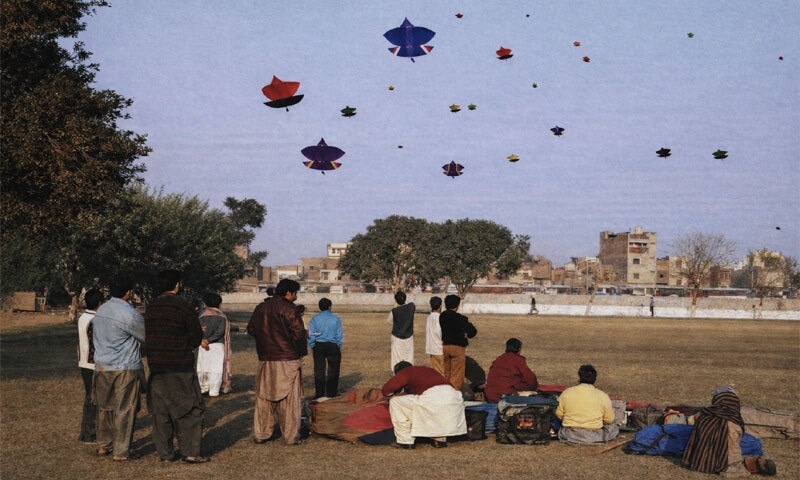
With the return of Basant to Lahore this year, many tales associated with a festival once lived across every street, park and rooftop of the city return with it.
Among these stories, I was particularly interested in the popular spots of the city where not only this festival but the larger practice of kite-flying in Lahore thrived. After speaking to a number of people associated with the sport of kite-flying in its heyday, a subject that everyone kept returning to was the now non-existent Guddi Ground.
Across the Lorry Adda [bus stand] in Lahore, the area that now constitutes the northwestern part of Greater Iqbal Park, was once popularly known as Guddi Ground among locals. Guddi Ground lay within the area once known as Minto Park, later renamed Iqbal Park. Once a stage of epic kite-flying contests in Lahore, the ground is nowhere to be found anymore — a casualty of the ban on kite-flying in 2007.
The name itself hints at an intimate relationship with the sport of kite-flying as guddi commonly translates to a ‘kite’ in local vernacular. The Guddi Ground, however, was no ordinary place for kite-flying. It had a prestige much like Lord’s for cricket aficionados or Wembley for football fans.
In a corner of Greater Iqbal Park lies the ghost of Guddi Ground, where kite-flying wasn’t a hobby — it was a battlefield. As Lahore prepares to celebrate Basant again, veteran fliers remember the ustaads, the duffs and the phatta challenges that made this ground sacred…
As a kite-flier, one had to pass a strict criterion to become eligible for playing in a kite-flying competition at the Guddi Ground. Amateurs were not welcome, and only the professionals were allowed to display their mastery in a sport that had its own unique rules of the game.
Kite-flying holds centuries’ old tradition in Punjab, promoted more widely during the four decade-rule (1799-1839) of Maharaja Ranjit Singh, who tied it with Basant Panchami celebrations. The union became so popular that now the name Basant is synonymous with kite-flying. The old origins allowed kite-flying ample time to mature as a tradition and, more importantly, as a sport. It developed its own lineage system, particular linguistic terms, governing laws and an economy that supported the livelihoods of hundreds of thousands of people.
Shakil Sheikh, once a prominent kite-flier and the current president of the All Pakistan Kite Flying Association (APKFA), remembers the Guddi Ground as a place where young men came to hone their skills. “Guddi Ground was like a university,” he says, “where kite-flying enthusiasts would come to learn from the masters, choose allegiance to a particular master, and start the long journey of play and practice to one day become eligible to participate in a kite-flying contest here.”
Contrary to how it is generally perceived now, kite-flying in Punjab — and particularly in Lahore — was not just another recreation or a hobby to relieve boredom. It was a serious sport, having its own hierarchy, allegiance system and levels of play. If you’re an amateur, you fly from the roof; if you’re a pro, you fly from the ground; and if you’re a master, you fly from the Guddi Ground.
The Origins of Guddi Ground
Legend has it that Guddi Ground rose to fame in the 1920s, when two kite-fliers started a friendly competition among them. They would each come on their bicycles, to the erstwhile Minto Park and the land adjacent to it, and bring four kites each for the duel. Such was the showmanship of their skill that spectators gradually arose and this friendly contest became a sought-after event. It developed extensively over the years, as more and more kite-fliers declared allegiance to certain masters.
Although it is difficult to find names of those who started this tradition in Guddi Ground, but some of the pioneers from the pre-Partition era who popularised Guddi Ground were Ustaad Imam Deen, Ustaad Khalifa Faiz Muhammad, Ustaad Daddu, Ustaad Khalifa Sultan and Ustaad Jalal, all of whom were highly revered in the kite-flying community and had hundreds of students of their own.
Unlike other local sports, kite-flying had a much a deeper lineage and allegiance system in Lahore, indicated by a system of ustaads [masters] and shaagirds [apprentices]. This allegiance system was known as ‘duff’ in the local vernacular. Each duff traced lineage from a master and a network of students who bore allegiance to him. Many of those students gradually became masters in their own capacity, with another branch of students who bore allegiance to them, and the lineage continued.
The customary rules of the duff were sacred, sometimes holier than blood relations. Kite-fliers belonging to the same duff were not allowed to compete against each other. On the other hand, real brothers belonging to different duffs could compete against each other, with the same ruthlessness of the game.
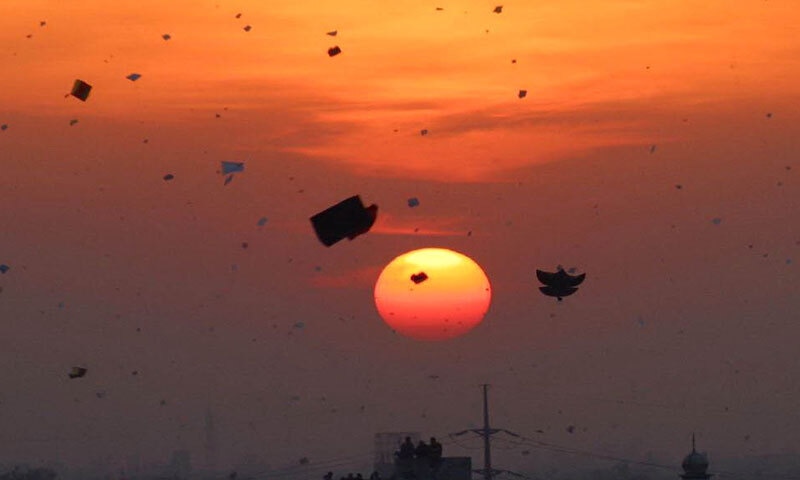
A ruthless competition
The Guddi Ground competitions were both formal and informal, albeit neither was non-serious. An informal competition would begin by any kite-flier or a group of kite-fliers from one duff challenging member(s) of another duff. The peculiar term for declaring this challenge was known as ‘waada’, which translates to ‘promise’.
At the time of waada, the rules of the game are established. For example, the number of total kites and their sizes, the standard of the string [dor] etc would be agreed. On the day of the competition, each challenger would come backed by those who were part of their duff. The ustaads of both challengers would also be there to support and advise. The matches — or paich, as they are known in local vernacular — would be played, scores would be counted and the winner would get a heroic reception.
A more formal competition was virtually a large-scale multi-team tournament, which could continue for months. Many such tournaments have been played at the Guddi Ground. Different teams would take part, each team comprising five to six kite-fliers on average. A single match would comprise of an agreed number of paich wins, as per the rules of the tournament, and whoever achieved that number first would win the match.
There would be a play-off stage, followed by quarter-finals, semi-finals and finals. The final would be viewed by hundreds of spectators and the winners and runners up would get worthy prizes, such as a motorcycle or small kites made of gold and silver.
A game between kite-fliers in the Guddi Ground would be played on the toughest format, known as the phatta [stool] challenge locally. The challengers would climb an elevated stool, with a platform measuring roughly three to four feet. They would conduct the paich from atop the stool and referees with whistles would ensure that no competitor exceeded the elevated space they were allowed.
Anyone who has an idea of kite-flying would know that the more space a kite-flier has, the more margin they get to pull the string and play their moves to engage the other kite. On the phatta, you have limited margin. The going gets tough and so the tough must get going.
From atop that phatta, with the barest of margins, the master kite-flier must play his moves and show everyone why he is the master. If he stumbles and falls down the stool, the game is over for him.
![An archival image of a gigantic red kite lying on the ground while young men fly kites: the Punjab government has stipulated that wingspan of kites will not exceed four-and-a-half githi [span of hand] or dimensions of 35 inches in width and 30 inches in length. For guddas, the larger and heavier kite variants, wingspan is capped at one-and-a-half taawas or 40 inches in width and 34 inches in length | White Star](https://i.dawn.com/primary/2026/01/697e13e952261.jpg)
Death of a Sport
A close look at the history of kite-flying and its institutionalisation in the event of Basant sheds more details on how it all came to an unfortunate halt. There were longstanding arguments against Basant, such as the relatively popular one calling it an un-Islamic ritual.
The festival’s marriage with music, dance and occasional betting in post-Gen Zia Pakistan received vocal opposition from Islamist groups. One argument even claimed that Basant started after some members of the local Hindu community flew kites as an expression of their resentment against the death penalty to Haqeeqat Rai in the early 18th century. Haqeeqat Rai, according to the account, was a Hindu teenager who was found guilty of committing blasphemy against Prophet Muhammad (PBUH) during the rule of Zakariya Khan, the Mughal subahdar [governor] of Lahore from 1726-1745.
While such accounts — prominent yet unverifiable — and religious opposition could not stop Basant from growing every year, it was the tragic reality of innocent deaths it caused that eventually brought the festival down. The resistance to Basant, and kite-flying in general, because it led to the deaths of people and children is well and truly justified. After all, no festival should kill people. However, to understand the nuances of what led to this reality, one needs to look at the cultural and ethical changes that infiltrated the sport of kite-flying more prominently in the late 1990s.
The game, as it was played by the elders, had a code of ethics and sportsmanship, which was also a reason for its popularity. Winning and losing were part of the game and any result was heartily accepted by both competitors. On occasions such as tournaments, the losing sides would also participate in celebrations with the winners and both would dance on the same rhythms of the dhol [drum]. It was a sport in the true sense of the word.
What spoiled the game was a change in its ethical code and a spirit of unhealthy competitiveness, in which losing became a matter of shame.
Timmy Shah is a veteran kite-flier, who was a kite-seller in his heyday but now sells toys at the erstwhile kite market inside Mochi Gate of the Walled City of Lahore. He does not blame the government alone for the ban on kite-flying. “The ethical competitors, after realising that their kite had been defeated in the sky, would give up on the remaining string in the air by cutting it from their teeth, rather than pulling it back to use for another game,” he tells Eos. “This was considered a respectable gesture of sportsmanship.”
But, Shah continues, the newer lot make it a matter of their ego. They use every possible means to avoid defeat and to retrieve the dor, which endangers people. “This is from where the evil entered,” contends Shah.
The ugly competitiveness and clashes of ego in kite-flying should not be seen as disconnected from the political and cultural changes in the social fabric of Pakistan in the 1990s that dimmed tolerance levels among people.
In the domain of kite-flying, it brought two main changes. The first change was the size of the kite. What were initially a few standard sizes for kites across all formats of the game, measured in a unit called taawa in local language, now started to increase by the year. The bigger the kite, the bigger the pride.
The second and killer change, which was also to some extent connected with the first — as bigger kites needed stronger support — was the change in the thickness of the string. Initially, there were two variants of a locally produced string used for kite-flying, commonly known as a 10-number and 12-number strings. Both were differentiated by the direction of twists of the threads that made up the string that affected its firmness.
These were sturdy yet safe strings to use, as their side effects were limited to small cuts on the flier’s fingers in the case of strong winds and sudden pulls. This level of injury to a player is acceptable in many sports around the world. However, the desire to get better results in the game saw the demand for and use of thicker strings imported from India, England and Germany, accommodated by a lack of government oversight and regulation.
Investors saw an incredible opportunity for business by importing these strings and many grew rich overnight. These strings came in multiple variants and, while more sophisticated, blurred the line between safe and dangerous strings. The results were tragic and unfortunate, with many people and children losing their lives because of undetected sharp strings. Eventually, kite-flying was officially banned by the Punjab Government in 2007.
Revival of Basant?
The Regulation of Kite Flying Ordinance 2025, passed in December 2025, has marked the return of the Basant Festival in Lahore after a ban of 18 years. While the government of Punjab is promoting its decision as a revival of this cherished festival of Lahore, old school kite-fliers and kite-makers are divided in their opinions.
While many have welcomed the government’s decision, there are also those who feel that an overly regulated festival would strip away its charm. In any case, considering the controversial nature of Basant, caution and celebration have to go in tandem. The legacy of this decision can only be measured once the event has passed.
The writer is a culture and history enthusiast, currently working as the director of National History Museum Lahore. He can be reached at alifahmedmeem@gmail.com
Published in Dawn, EOS, February 1st, 2026