SOCIETY: CENTRE OF INTELLECTUAL GRAVITY

On a cold, foggy December evening in Islamabad, there was an air of almost palpable anticipation inside the 60-seat auditorium at The Black Hole (TBH), a community space in Islamabad’s G-11/3 area.
The audience was a diverse mix of ages and backgrounds, typical of the venue. On that evening, a young troupe was discussing a preview performance of Irish playwright Samuel Beckett’s Waiting for Godot. From my seat, I noticed a camera pivoting in the corner, prepared to document the evening for its eventual broadcast on TBH’s YouTube channel — a reminder that the space’s audience extends well beyond the room.
The ambience reflects the place’s wide-ranging intellectual reach, which spans art and science, book launches and even the exploration of topics widely considered taboo. This vibrant space — located in an eccentric-looking three-storey building — has now established itself as a landmark of dialogue in Islamabad.
What happens when a nuclear physicist answers the questions of starry-eyed children, when film, music and theatre are deconstructed and difficult conversations finally find a platform? The Black Hole in Islamabad is reasserting what community space can mean in Pakistan…
FILLING THE VOID
Islamabad, the country’s capital, has experienced the loss of several valuable cultural and educational spaces. This includes the British Library, multiple community libraries and the American Centre. As a resident of Islamabad, I’ve long felt a lack of a community space, or a meeting ground, where people and ideas can connect and grow. This is a common feeling for many of us in the capital city. But my recent experiences at TBH have shown that it has been effective in filling this void.
At the heart of this initiative, which was launched in 2022 by a group of academics and intellectuals, lies a vision of nurturing a dynamic and evolving ecosystem of exploration and learning, one that thrives beyond formal modes of scientific, social and cultural education.
This is precisely how I feel every time I step into the place.
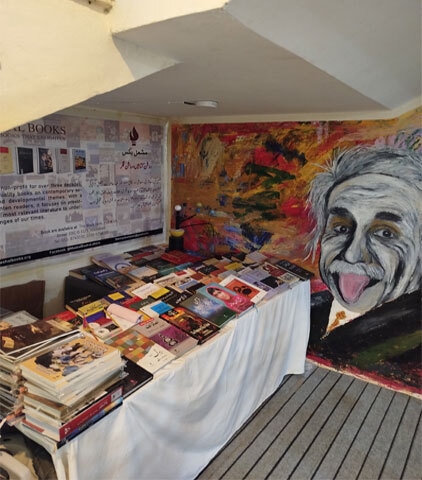
Each week, the space hosts a variety of events, including video screenings, discussions, book launches, music classes and more. All this takes place in the available spaces: an auditorium in the basement, a library on the ground floor and a science lab on the first floor.
NURTURING YOUNG SCIENTISTS
In June last year, TBH launched an internship programme for science students, designed to give them exposure to practical skills in science and technology. Over six weeks, a batch of 24 students from matric, intermediate, and O- and A-levels worked on various science projects.
For Fatima, one of the participants, it was a unique experience. She was overjoyed by the opportunity to work in a science laboratory, with the required tools and, more importantly, a sense of freedom. Fatima shared that she had volunteered to train a younger batch of students; she looked totally at home with her surroundings.
Observing the groups collaborating, I could sense an ease and pleasantness that permeated the work environment. “Designing and preparing a project at this stage is so crucial — you get practical experience of the concepts you learn in books,” Rayan, an A-levels student, pointed out with great enthusiasm. Another young participant revealed that her public school has only one laboratory, which drastically limited learning opportunities.
The Science Lab at TBH addresses the need for readily accessible science societies in Pakistan, particularly for matric and O-levels students, who often do not have access to tools for practical application of theoretical STEM [science, technology, engineering and mathematics] knowledge.
TEACHING BEYOND THE TEXTBOOK
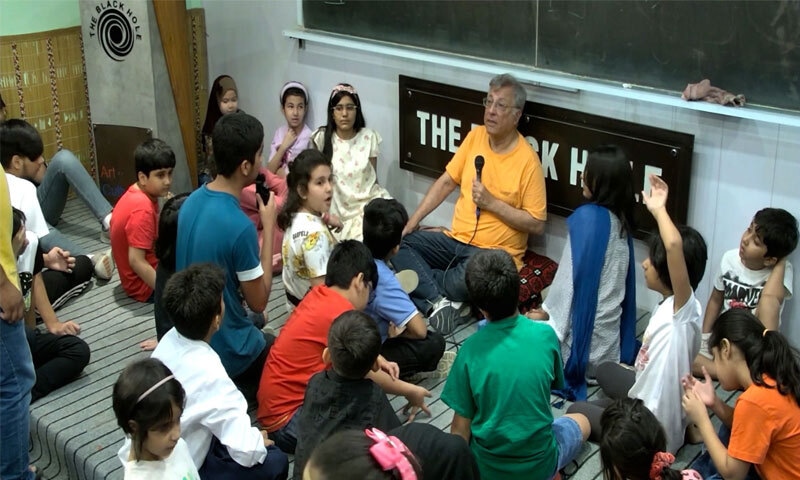
On another visit, I found the auditorium filled with children attending an eight-week winter camp. The winter, and summer, camp sessions offer young minds an opportunity to undertake science lab projects, and to participate in music, art, theatre, mental well-being workshops, science talks, math sessions and much more. During the programmes, the children are introduced to a new language. Previous summer camps included French, German, Chinese, Japanese and Turkish, while this time the children were being introduced to Balochi.
One interesting, recurring session is called “Gup Shup with PH”, which translates to chit chat with Prof Pervez Hoodbhoy, one of Pakistan’s most well-known nuclear physicists, who is also an author. During the activity, children engaged in an open discussion about the nature of stars and cosmic activities with the professor. It was amusing to see the eminent professor letting the children lead the discussion, rather than the other way around.
Such informal discussions and the plethora of activities at TBH continue to inspire and light up young minds. Minahil, a young teacher, used to frequent the library to prepare for her Central Superior Services exams, and later volunteered as a teacher at the winter camp. “This is a place that makes people think, gives them space to explore ideas,” she says. “There should be a community space like this in every sector of the city.”
I also learned about a teachers’ training programme that took place a couple of years ago. Out of 500 applicants, 126 were shortlisted. Only six people were selected, who completed the course. Prof Hoodbhoy prepared the modules, which are available on the TBH website. The training aimed to provide a thorough grounding in undergraduate-level physics and mathematics. The goal was to address conceptual gaps in their understanding, which are a consequence of the poor quality of our education system.
From the science lab and the astronomy club to teacher training and summer/winter camps for children, the focus at TBH is on making learning an exploratory and fun experience. And perhaps, most significantly, it seeks to foster critical scientific thinking and address gaps left by a subpar education.
MORE THAN A VENUE
Though TBH serves as a space where Islamabad residents connect with a global community through online viewership, it is the in-person attendance that provides a really invigorating experience. Evening book launches lead to impromptu discussions, while art talks transition into philosophical debates. Film screenings often evolve into dynamic discussions as audiences engage directly with filmmakers, transforming passive viewing into lively intellectual exchanges.
What makes the experience even more unique is the team managing the place: the musician who teaches classical music, the calligrapher who, with deft strokes, turns the blackboard into a canvas announcing each programme in hand-lettered artistry, and the tech whiz who makes starlight visible on the screen. Undoubtedly, the charm of this space is its dynamism and vibrancy.
The centre also hosts theatrical performances, like the one on the cold December evening, and holds discussions on ideas and themes within the plays to explore their societal impact. From time to time, the centre also invites medical professionals and psychologists to discuss physical and mental health issues, and stress management tools.
TBH is also perhaps one of the only spaces where the silence surrounding the blasphemy laws was finally broken. There were at least two discussions held here, in which families of those detained on blasphemy charges shared harrowing accounts of their entrapment and opened about the predatory mafias, whom they accused of weaponising faith for monetary gains and to settle scores. These narratives have been systematically denied a platform elsewhere, but finally surfaced into the light through open discussion sessions. The discussions are available on TBH’s YouTube channel.
It’s no wonder that TBH’s audience has considerably expanded over the past year. However, the space now struggles to accommodate the growing numbers. Organising discussions at TBH, and participation in them, remains free of charge, to the joy of its visitors. But this facility also imperils the centre’s vital work due to a lack of financial funding, since it depends entirely on grants and private donations for its continuity.
Given its invaluable nature, one wishes TBH continues and thrives as a vital addition to Islamabad’s cultural landscape.
The writer is a lecturer at COMSATS
University in Islamabad. She can be
contacted at ayesharamzan83@gmail.com
Published in Dawn, EOS, January 25th, 2026