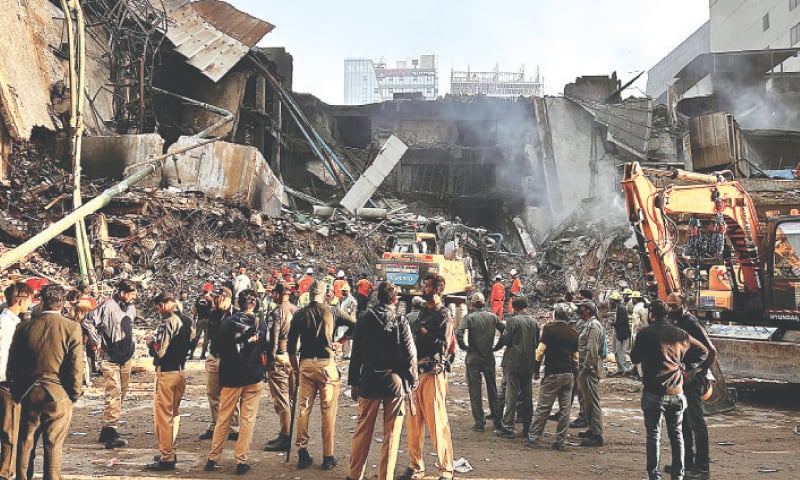
Rescuers risk life and limb as Gul Plaza smoulders


 0
0

• Toll rises to 28; rescuers say efforts to continue until all missing people found
• Lawmakers play blame game in National Assembly, demand judicial probe into incident
• Karachi mayor says action started against ‘non-compliant’ buildings; governor reassures traders
KARACHI/ISLAMABAD: Thick smoke continued to billow from the charred ruins of Gul Plaza as firefighters made frantic efforts to search for and rescue any survivors present in the wreckage of the shopping plaza, while the death toll rose to 28, with scores still missing.
The inferno, which reduced the building to ashes, also prompted a blame game in the National Assembly, as lawmakers demanded a judicial probe into the fire to fix accountability while also calling for empowered local bodies to improve governance.
A visit to the spot on Tuesday evening showed thick smoke emanating from the top floor of the plaza, while two snorkels were busy controlling the flames, which were not visible from outside the building.
Rescue 1122 spokesperson Hassanul Haseeb Khan told Dawn that their team finally gained access to the building’s basement, first and second floors, where rescue and search operations continued for the third day. He said the operation would continue until the recovery of the last missing person.
Police surgeon Dr Summaiya Syed told Dawn that the death toll had increased to 28, including “probably” five women. She said post-mortem examinations had been conducted on fragmentary human remains. Eight bodies had been identified, while 48 samples from relatives for DNA profiling and cross-matching had been collected.
South DIG Syed Asad Raza told Dawn that out of a total of 75 missing persons, the locations of 38 had been confirmed at Gul Plaza through geofencing. He said DNA samples had been sent to the University of Karachi lab, and cross-matching was expected to continue over the next two to three days.
Meanwhile, a committee formed by the Sindh government initiated its probe to ascertain the circumstances that led to the devastating fire, sources said. The committee, chaired by the Karachi commissioner, summoned relevant officials as well as the mall owner and sought details from them.
Mudslinging in NA
Meanwhile, lawmakers in the lower house of parliament used the incident for political mudslinging. The 18th Amendment also came under fire, as treasury benches claimed that the amendment had provided resources to the provinces that were not devolved further.
MQM-P leader Dr Farooq Sattar blamed the PPP government in Sindh for poor civic conditions, saying the local administration failed to handle the inferno effectively. “The PPP has been ruling Sindh for 18 years and has done nothing to improve civic conditions,” he said, while calling for the creation of more administrative units for better governance and strengthening local government systems.
On the other hand, PPP leader Shehla Raza clarified, “There is an impression being created that there is no local government system in Sindh. [But] Sindh is the only province where local government systems are working.”
She also objected to the claims made by MQM-P’s Sattar, stating that “it is not necessary for ministers to show up when such an incident happens”. She admitted that there had been a delay due to traffic congestion in the area.
‘Coordinated action’
Across party lines, lawmakers stressed that coordinated action by federal and provincial governments was essential to ensure such tragedies were not repeated, and that public safety must be strengthened through enforceable laws and effective urban governance.
“If we want to empower the people in a true sense, we will have to bring in the local government system,” PML-N leader Khwaja Asif said. He stressed that, due to the 18th Amendment, all administrative powers had been assigned to the provincial governments.
“If local government systems are not strengthened, then the defence ministry, the navy and aviation will be doing your work for you,” the defence minister said, as the House was informed that water bowsers of the Pakistan Navy had also taken part in the operation.
Meanwhile, Karachi Mayor Murtaza Wahab said the Sindh Building Control Authority had started action against “non-compliant buildings” under the Fire Safety Regulations. In a tweet, he said a letter containing a list of such buildings had been sent to the Association of Builders and Developers (ABAD), requesting it to direct its members to comply with fire safety measures within three days.
Separately, Sindh Governor Kamran Tessori met traders to discuss the tragedy’s impact on businesses housed in Gul Plaza. “We must learn lessons from this incident. If such a murderous plaza stands or is about to be built, we must prevent it,” he asserted. The governor noted that legislation stopping such buildings from being constructed existed but lacked implementation.
SBCA rejects ‘baseless reports’
Rejecting what it called “baseless reports” in the media, the Sindh Building Control Authority (SBCA) said the impression being given that records of Gul Plaza were not available with the authority was incorrect.
It said Gul Plaza was originally constructed in the 1970s, and a revised no-objection certificate (NOC) for sale and advertisement was issued in 2005, under which approval was granted for at least 1,102 shops.
According to the approved building plan, the building had two staircases from the basement to the ground floor, six staircases from the ground floor to the first floor, five staircases from the second floor to the third floor, and 16 exit routes on the ground floor for evacuation purposes.
Published in Dawn, January 21st, 2026