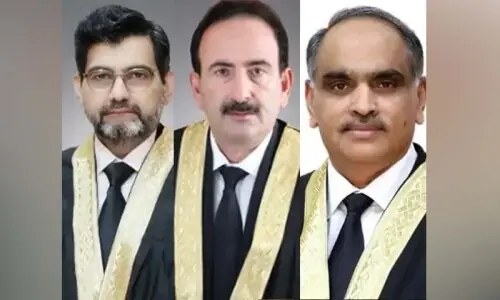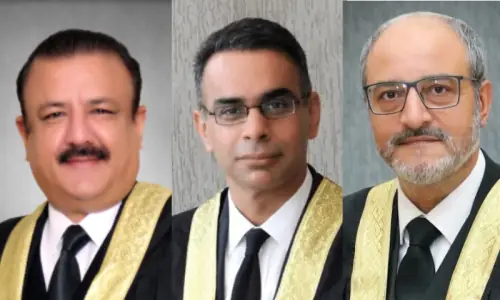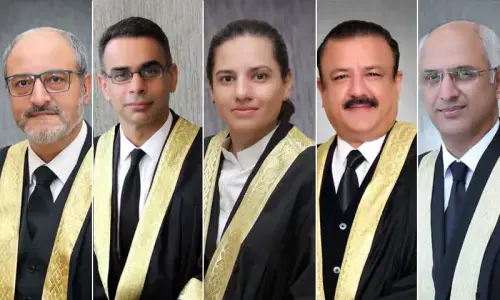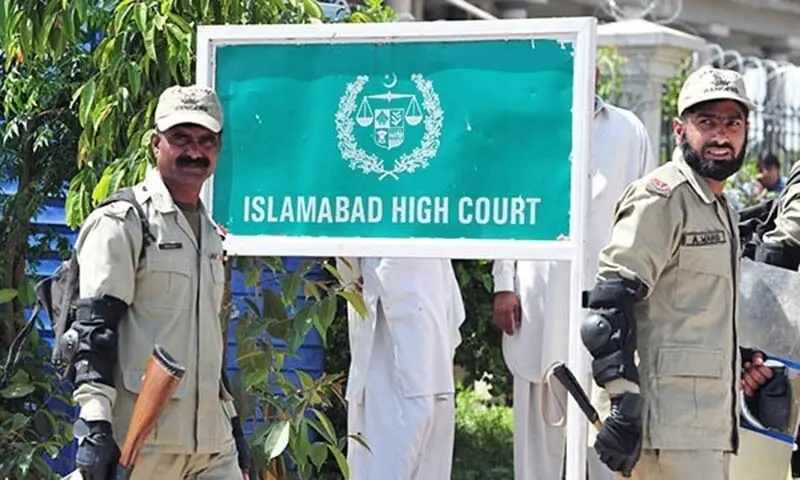

ISLAMABAD: Three judges of the Islamabad High Court (IHC), including Justice Muhammad Azam Khan, Justice Muhammad Asif and Justice Raja Inam Ameen Minhas, on Monday took oath as permanent judges of the court following the president’s approval.
The oath-taking ceremony was held in the common room of the IHC and was administered by IHC Chief Justice Sardar Muhammad Sarfaraz Dogar. The ceremony began with the recitation of the Holy Quran, followed by the national anthem, after which the registrar of the IHC read out the official notification of the appointments.
Interestingly, Justice Mohsin Akhtar Kayani, the senior puisne judge of the IHC who had opposed the confirmation of these judges during the JCP meeting, attended the ceremony. However, Justice Babar Sattar, Justice Saman Rafat Imtiaz and Justice Sardar Ejaz Ishaq Khan were not present.
Law Minister Azam Nazeer Tarar, judges of the high court and district judiciary, Islamabad High Court Bar Association President Syed Wajid Ali Shah Gilani, Secretary Manzoor Ahmed Jajja, senior lawyers and court reporters were also in attendance.
The Ministry of Law and Justice issued the notification of appointment on January 17 with the approval of the president, appointing the three judges under Article 193 of the Constitution with effect from the date they took oath. All three judges had served as additional judges for nearly a year prior to their permanent elevation.
The confirmations followed a meeting of the Judicial Commission of Pakistan held on January 12, which recommended the appointment of the three additional judges as permanent judges. Although their oath-taking was initially scheduled for the following day, the ceremony was postponed as President Asif Ali Zardari was abroad and the notification could not be signed at the time.
The appointments came against the backdrop of an unusual internal judicial controversy. Senior puisne judge Justice Mohsin Akhtar Kayani, who is also a member of the JCP, wrote a letter to IHC Chief Justice Sardar Muhammad Sarfaraz Dogar and JCP Chairman Justice Yahya Afridi opposing the confirmation of the judges on grounds of performance and competence.
According to informed sources, Justice Kayani had sought progress and performance reports of the additional judges from the IHC administration in his capacity as a JCP member. When the record was not initially shared by the IHC, it was later provided through the JCP secretariat, following which the letter was written.
During the JCP meeting, Justice Kayani reiterated his objections, alleging that the performance data of the judges had been manipulated and claiming that they focused on deciding comparatively easier cases instead of clearing old and contested matters.
However, official statistics placed before the commission contradicted these claims.
According to disposal data of old cases (up to December 31, 2017) shared with the JCP and the IHC chief justice, Justice Inam Amin Minhas disposed of 93 old cases, Justice Muhammad Azam Khan decided 39 old cases, while Justice Saman Rafat Imtiaz 39, Justice Asif 6, Justice Sardar Ejaz 4, Justice Babar Sattar and Justice Tariq Mehmood Jahangiri 3 each during the relevant period. In comparison, Justice Mohsin Akhtar Kayani disposed of 10 old cases falling in the same category.
The same official data further showed that, in terms of overall case disposal during 2025, Justice Inam Amin Minhas topped the list by deciding 2,039 cases as a single bench, followed by Justice Muhammad Azam Khan with 1,841 cases and Justice Muhammad Asif with 1,338 cases, figures that were discussed in detail during the confirmation process.
Published in Dawn, January 20th, 2026